President Trump called off a 50% tariff on a long list of Canadian goods late Tuesday, roughly two hours before the duties were set to take effect at 12:01 a.m. Wednesday. The pause runs three days, and Trump said on Truth Social that it was granted because the two countries, subject to the finalization of documents, have a deal. He did not release terms.
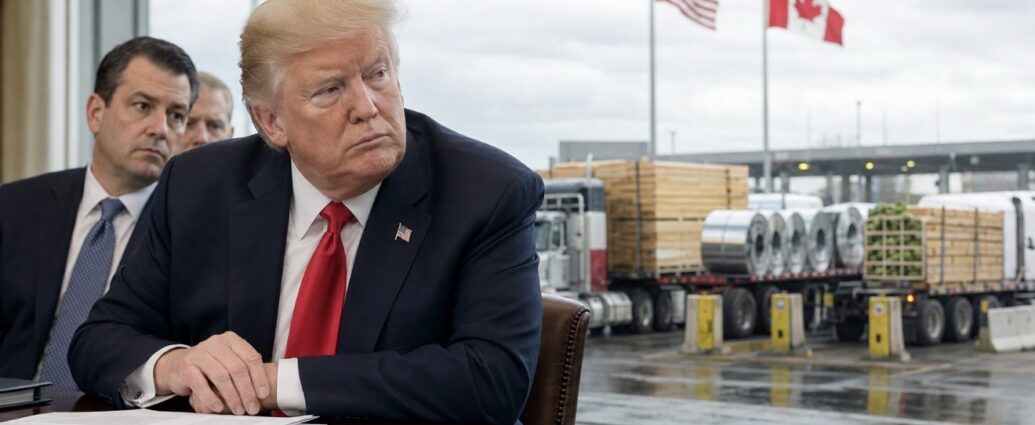
What was about to hit is the part American buyers would have felt. The tariffs covered alcohol, hockey equipment, cement and dairy products, and also reached building materials and certain clothing. The targeted goods add up to about $20 billion a year, roughly 5% of everything Canada ships to the United States — about one dollar in twenty. A 50% duty is paid by the U.S. importer at the border, and at that rate the math usually stops working. Dan Kelly, president of the Canadian Federation of Independent Business, told CNBC that a tariff that size makes a product uneconomic to sell into a market, and that some members were already seeing American buyers hold off on orders in anticipation.
The legal route was unusual. The duties would have been the first use ever of Section 338 of the Tariff Act of 1930, which lets the White House impose tariffs of up to 50% on a trading partner it determines discriminates against U.S. commerce. The administration said the goal was to counter Canadian policies it argues shut out American auto and dairy exports, along with earlier Canadian retaliation including provincial bans on American alcohol. Energy, potash and critical minerals were carved out — the inputs American refiners and farmers cannot easily replace.
The U.S. Chamber of Commerce warned Tuesday that higher tariffs would damage both economies, raise costs for American families, disrupt supply chains and put at risk the 13 million American jobs tied to the North American trade pact.
Prime Minister Mark Carney spoke with Trump on Monday and again Tuesday. Carney told reporters the negotiations were intense and delicate, and not something to conduct in public. Canadian and U.S. negotiators had met repeatedly over the previous three weeks.
The three-day clock is the story now. Sources have said the two sides remain apart on finer points, including what tariff, if any, applies to Canadian autos headed south. Canadian officials have been pushing not only to kill the Section 338 tariffs outright but to lower the separate Section 232 duties on steel and aluminum. Dairy remains the hardest room. American dairy groups want Canada to hand tariff-rate quotas directly to Canadian grocery retailers instead of restricting them to domestic processors, which would make it easier to move U.S. milk and cheese onto Canadian shelves — and David Wiens, president of Dairy Farmers of Canada, said his members have told Ottawa they do not want any further concessions on dairy.Trump added that the Keystone XL pipeline may be revived as part of the arrangement.
For American importers, distributors and retailers carrying Canadian wine, cement, sporting goods and cheese, nothing changes at the border through Friday. If the paperwork is not signed by then, the same 50% is sitting there waiting.
JBizNews Desk | Washington, D.C.
© JBizNews.com All Rights Reserved. Reproduction or distribution without written permission is prohibited.