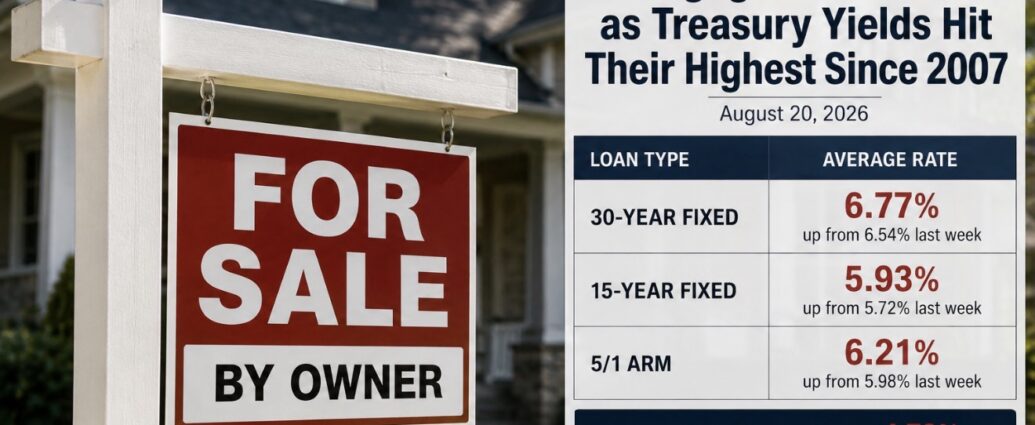
When the U.S. government has to pay more to borrow money, everyone else does too. That is what happened this week. The yield on the 30-year Treasury bond reached 5.323% on Tuesday, a 19-year high, before slipping back to just under 5.3%, and lenders promptly repriced the loans ordinary Americans take out. The average 30-year fixed mortgage rate stood at 6.75% on Tuesday, up from 6.69% at the end of last week, according to Mortgage News Daily.
The mechanism is simple. Investors who lend to Washington for 30 years are demanding more compensation because they expect inflation to stay high and the government to keep borrowing heavily. The national debt is approaching $40 trillion, more than $11 trillion higher than in fiscal 2019. Banks price home loans off those same government yields, so when the government’s cost of money goes up, so does the rate on a mortgage.
The 10-year Treasury yield, the benchmark that fixed mortgages actually follow most closely, is now above 4.7%, compared with below 4% before the Iran war began at the end of February. It eased back toward 4.7% Wednesday as investors waited on the minutes of the Federal Reserve’s July meeting.
For a buyer, the arithmetic is unforgiving. On a $400,000 loan, the move from 6.69% to 6.75% adds roughly $16 to the monthly payment — small on its own. The bigger number is what the full term costs at today’s rate: about $2,594 a month, and roughly $534,000 in interest over 30 years. The buyer pays back more than twice what was borrowed.
It is not only housing. Buyers financing a new vehicle are facing rates near 7%, while used-car borrowers are contending with roughly 10.6%. Variable-rate credit cards, which move with the prime rate, are under the same pressure.
Inflation is the engine behind all of it. Consumer prices rose 3.4% in the year through July, well above the Federal Reserve’s 2% target, and up from 2.4% in January before the war. Minutes released Wednesday from the Fed’s late-July meeting showed many officials believed policy would likely have to tighten further if inflation does not come down, with some saying financial conditions may not yet be restrictive enough. The Fed has held its rate at 3.5% to 3.75%, with three members dissenting in July in favor of an increase.
So what can a buyer actually do? Lawrence Yun, chief economist at the National Association of Realtors, said borrowers should not count on a meaningful drop. “The impact on mortgage rates is directly related to higher bond yields,” he said, adding that inflation and long-term borrowing costs will keep rates elevated regardless of what the Fed does. His practical suggestion for buyers who expect to move before the fixed period runs out: a seven-year adjustable-rate mortgage, which carries a lower starting rate.
The other options are the familiar ones — a larger down payment to shrink the loan, paying points up front to buy the rate down, or a 15-year term, which carries a lower rate and far less total interest for buyers who can carry the higher monthly payment.
What would actually bring rates down is inflation cooling and the government borrowing less. Neither is in evidence this week.
JBizNews Desk | Wall Street
© JBizNews.com All Rights Reserved. Reproduction or distribution without written permission is prohibited.