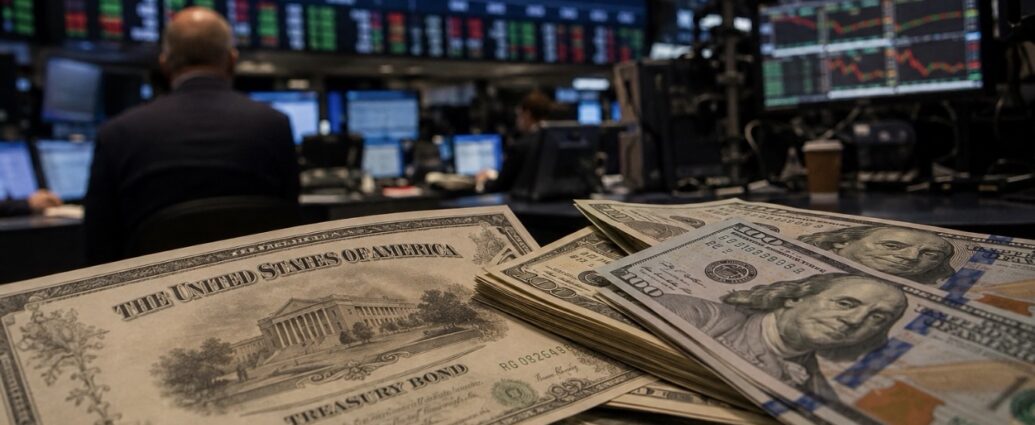
The U.S. dollar has acquired an unusual new source of pressure: the government department responsible for financing America’s $40 trillion debt load.
Citigroup strategists led by Daniel Tobon have turned bearish on the dollar over the next three months, cutting their forecast for a broad dollar index from 102.12 to 98.34. The shift follows the Treasury Department’s decision to at least double certain purchases of older, long-dated government bonds.
Beginning Sept. 9, Treasury will raise the ceiling for buyback operations covering bonds with 10 to 30 years remaining from $2 billion to at least $4 billion apiece. The objective is to improve trading conditions and relieve pressure in a market where the 30-year yield recently reached 5.34%, its highest level since 2007.
But the government is not eliminating debt. It generally must sell new securities to finance the repurchase of old ones. In practical terms, Treasury could remove more long-term bonds from the market while issuing more short-term bills—a change in the maturity of the debt rather than a reduction in what Washington owes.
That distinction is behind the dollar warning.
Reducing the supply of long bonds can push their prices higher and their yields lower. Lower yields make dollar-denominated assets less attractive to overseas investors, weakening one of the principal forces drawing foreign capital into the United States.
The dollar index fell roughly 0.8% after the Treasury announcement, reaching its weakest closing level since May. The euro climbed above $1.16, while the British pound approached $1.36.
The immediate intervention is modest compared with the market it is intended to influence. A $4 billion operation represents little more than one-half of 1% of the $739 billion Treasury expects to borrow during the current quarter. Yet investors are reacting to the signal as much as the size: Washington has shown that sharply rising long-term rates can provoke an official response.
That creates a credibility problem. If traders conclude that the government intends to hold down long-term yields for political or budgetary reasons, they may demand a larger premium to own American debt. Treasury could then obtain temporary relief while increasing longer-term anxiety about inflation, deficits and government influence over markets.
For businesses, a weaker dollar produces clear winners and losers. American exporters receive more dollars when foreign revenue is converted home, while manufacturers competing against imported goods gain pricing room. Multinational companies with large overseas operations can also report stronger dollar earnings even if their underlying sales do not change.
Importers face the opposite arithmetic. A European component costing €1 million equals approximately $857,000 when the euro trades at $1.166, versus $833,000 at $1.20 per euro-dollar inverse? The useful comparison is direct: at $1.166 per euro, that component costs $1.166 million, roughly $66,000 more than when the euro was worth $1.10. Retailers, automobile suppliers and businesses purchasing foreign machinery may eventually pass part of that increase to consumers.
Investors should not confuse Citi’s short-term call with a prediction that the dollar is entering a permanent decline. The bank’s longer-range view remains more constructive because American growth and corporate earnings continue to compare favorably with many other developed economies.
The next test is whether Treasury’s expanded purchases can keep long-term yields down once operations begin—or whether investors decide that buybacks treat the symptoms of America’s borrowing problem without addressing the deficits creating it.
JBizNews Desk | New York
© JBizNews.com All Rights Reserved. Reproduction or distribution without written permission is prohibited.