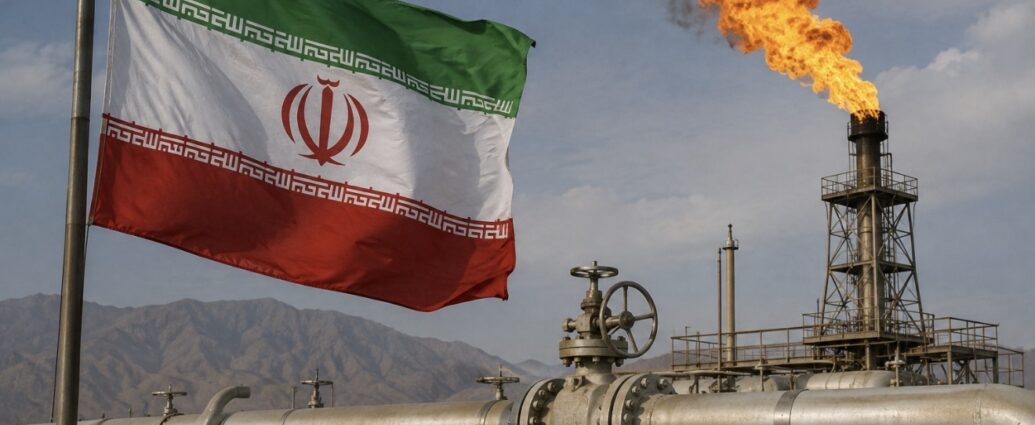
Iran says it has discovered more than 7.5 trillion cubic feet of natural gas in southern Fars Province, adding another significant resource to a country that already holds the world’s second-largest proven gas reserves.
Oil Minister Mohsen Paknejad said approximately 5.7 trillion cubic feet—or more than 72% of the gas discovered in the Takht-e field—may ultimately be recoverable.
The field contains “sweet” natural gas, meaning it has relatively low levels of sulfur compounds and should be easier and less expensive to process than sour gas.
Iran also says the discovery includes substantial gas condensate, a valuable liquid hydrocarbon produced alongside natural gas. Paknejad estimated that the condensate could be worth tens of billions of dollars, although realizing that value will depend on whether Iran can finance and develop the field.
On the surface, 7.5 trillion cubic feet sounds enormous.
But the practical impact is smaller than the headline figure suggests.
Before the latest war-related disruptions, Iran was producing approximately 650 million cubic meters of natural gas per day—the equivalent of about 8.4 trillion cubic feet annually.
At that rate, the field’s estimated 5.7 trillion cubic feet of recoverable gas would equal roughly eight months of Iran’s previous nationwide production.
Paknejad offered a different comparison, saying the recoverable reserves could supply one phase of the massive South Pars gas field for approximately 15 years.
Both comparisons demonstrate that the discovery is meaningful. But it is not large enough by itself to transform Iran into a substantially greater global gas supplier or dramatically alter international prices.
The bigger obstacle is not the amount of gas beneath the ground.
It is Iran’s ability to bring that gas to market.
Developing the Takht-e field will require drilling equipment, processing facilities, pipelines, financing and potentially export infrastructure. If Iran wants to sell the gas beyond neighboring countries, it would also need additional pipeline capacity or liquefied-natural-gas facilities capable of loading the fuel onto ships.
Iran currently lacks a major LNG-export industry comparable to Qatar’s, despite possessing far larger reserves than most gas-producing countries.
U.S. sanctions have historically restricted Iran’s access to the foreign investment, equipment and advanced technology needed to develop some of its largest energy projects. Sanctions also complicate payments, shipping, insurance and long-term supply agreements with international buyers.
The war has made those challenges even greater.
Iranian officials said attacks damaged energy facilities and eliminated approximately 230 million cubic meters per day of natural-gas production capacity—more than one-third of the country’s previously reported daily output.
The government expects approximately 100 million cubic meters of that capacity to return in the coming months. That would still leave Iran with a substantial shortfall unless additional repairs restore more production.
The disruption makes the latest discovery strategically important for Tehran, but commercially complicated.
Major natural-gas fields can take years and billions of dollars to develop. Companies must complete geological studies, drill production wells, build processing plants and connect the field to Iran’s national pipeline network before meaningful volumes can reach homes, power plants or industrial customers.
Iran therefore presents one of the world’s clearest energy contradictions.
It possesses enormous oil and natural-gas reserves, yet sanctions, aging infrastructure, underinvestment and now wartime damage severely restrict its ability to convert those resources into reliable supply and export revenue.
The Takht-e discovery could still strengthen Iran’s long-term energy security.
Iran depends heavily on natural gas for electricity generation, household heating, manufacturing and petrochemical production. New supplies could help replace declining output from older fields, reduce domestic shortages and support industrial activity—if the field is successfully developed.
But global consumers should not expect the discovery to produce cheaper natural gas anytime soon.
The continuing energy crisis has demonstrated that possessing resources underground is very different from having fuel available to consumers.
Iran may have discovered another 7.5 trillion cubic feet of natural gas. The more important questions are how quickly it can develop the field, who will finance the work, how much infrastructure will remain available to transport the gas and whether international buyers will be permitted—or willing—to purchase it.
Until those questions are answered, the Takht-e field remains primarily a strategic asset for Iran, not immediate new supply for the world.
JBizNews Desk | Tehran
© JBizNews.com All Rights Reserved. Reproduction or distribution without written permission is prohibited.