The Federal Reserve may need to raise interest rates again—and potentially as soon as its coming meetings—unless new economic data provide convincing evidence that inflation is finally moving lower.
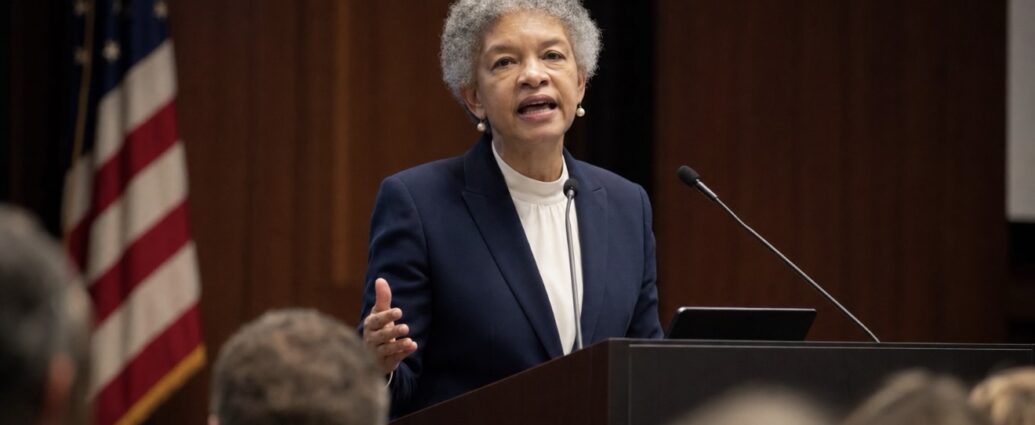
Boston Federal Reserve President Susan Collins delivered that warning Tuesday, saying she supported the central bank’s decision to hold rates steady in July but would not support leaving them unchanged indefinitely if inflation remains elevated.
“Maintaining the current federal funds rate target range will require continued evidence that inflation is indeed coming down,” Collins said. “Should evidence of sustained inflation progress not materialize, I believe it will be appropriate to tighten policy soon.”
That is a far stronger message than simply saying the Fed intends to wait for more information.
Collins is effectively placing the burden of proof on the inflation data: Rates can remain where they are only if prices show sustained improvement. If that improvement does not appear, another increase becomes the appropriate next step.
The federal-funds rate has remained between 3.5% and 3.75% since December. That rate influences borrowing costs throughout the economy, including credit cards, auto loans, business financing and certain home-equity products.
Although Collins does not vote on monetary policy this year, her comments provide another indication that support for higher rates is growing inside the Fed.
Three officials voted to raise rates by a quarter percentage point at the central bank’s July meeting, while several other policymakers have since indicated that they also believed an increase was warranted or may become necessary.
The division reflects the Fed’s increasingly difficult position.
Economic activity continues to expand at what Collins described as a near-normal pace, while the labor market remains broadly consistent with full employment. Under ordinary circumstances, that would be viewed as a favorable economic balance.
But inflation has remained above the Fed’s 2% target for more than five years, and several new pressures threaten to prevent it from returning there.
Economists expect the Fed’s preferred underlying inflation measure—the core Personal Consumption Expenditures Price Index—to show prices rising approximately 3.3% from a year earlier in July. That would leave inflation substantially above the central bank’s goal and essentially unchanged from the previous month.
The July inflation figures are scheduled to be released Wednesday and could immediately influence expectations for the Fed’s September 15-16 policy meeting.
Collins said inflation reports for June and July had been “mildly encouraging,” but warned that one or two favorable monthly readings are not enough to establish a dependable trend.
Tariffs, elevated energy prices and the continued disruption surrounding the Strait of Hormuz remain significant risks. The massive construction of artificial-intelligence data centers and related infrastructure may also be placing upward pressure on demand and the prices of core goods.
Higher oil and gasoline prices are already reducing the discretionary income available to American households.
Collins said business owners and residents across New England describe high prices as a pervasive concern. Some lower-income workers are taking multiple jobs simply to keep up with household expenses.
That real-world pressure is one reason the Fed cannot treat inflation as an abstract statistical problem.
The longer prices remain elevated, the greater the danger that businesses and consumers begin assuming high inflation will continue. Companies may raise prices more aggressively, while employees demand larger wage increases to protect their purchasing power.
Once those expectations become embedded, inflation becomes considerably more difficult—and more economically painful—to control.
Collins still believes inflation can gradually decline without another rate increase. Previous tariff costs may have largely passed through the economy, energy pressures could ease if shipping through the Strait of Hormuz improves, and continued productivity growth may allow companies to produce more without raising prices as quickly.
Long-term Treasury yields have also increased, raising mortgage and corporate borrowing costs even without additional action from the Fed. Those higher market rates may slow spending and investment enough to reduce inflationary pressure.
But Collins made clear that this relatively favorable outcome is not guaranteed.
If inflation stalls or begins accelerating again, the Fed may have to tighten policy even as consumers face rising financial stress and the labor market shows signs of weakening.
That would mean higher borrowing costs for households and businesses at precisely the moment many expected the next major move to be a rate cut.
The focus now shifts to Wednesday’s inflation report and Federal Reserve Chairman Kevin Warsh’s closely watched address at the central bank’s Jackson Hole symposium. Together, they could determine whether the Fed continues waiting—or begins preparing markets for another increase.
JBizNews Desk | Boston
© JBizNews.com All Rights Reserved. Reproduction or distribution without written permission is prohibited.