
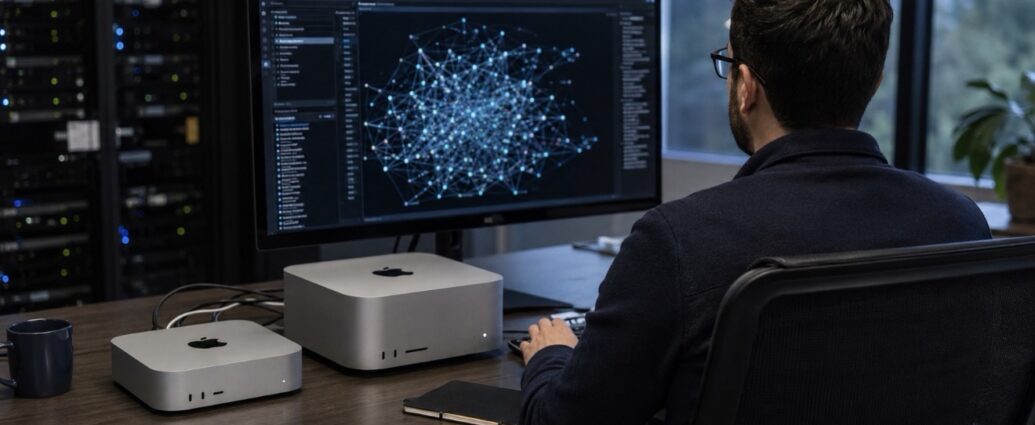
Apple is bringing the artificial-intelligence race directly onto personal computers with a new generation of Mac mini and Mac Studio desktops designed to run increasingly powerful AI models without constantly sending information to remote data centers.
The company unveiled its first 2-nanometer processor, the M6, alongside the M5 Ultra—Apple’s most powerful chip to date.
The new Mac mini will be available with either the M6 or M5 Pro processor, while the Mac Studio will offer the M5 Max or substantially more powerful M5 Ultra.
Prices are also rising.
The M6 Mac mini begins at $899, $100 more than its most recent starting price and $300 above the $599 price at which the M4 version originally launched. The M5 Pro model starts at $1,699.
The Mac Studio begins at $2,499 with the M5 Max and $5,499 with the M5 Ultra.
Preorders opened Tuesday, with the computers scheduled to reach customers and Apple stores on September 22.
The most important development is not simply that Apple has produced faster computers. It is that the company is redesigning the Mac around a future in which substantial AI work takes place directly on a user’s desk.
Today, many advanced AI applications depend on enormous cloud-based data centers filled with costly Nvidia processors. Every request is transmitted over the internet, processed remotely and returned to the user.
Apple’s approach is to move more of that work onto the device itself.
That can reduce dependence on cloud-computing services, improve response times and allow companies to keep proprietary documents, customer information, computer code and sensitive business data inside their own systems.
The M6 Mac mini is aimed at bringing that capability to a wider group of users.
Apple says the new model can deliver as much as four times the AI performance, twice the graphics performance, twice the storage speed and 40% faster central-processing performance compared with the M4 configuration used for its tests.
The M6 contains a 12-core central processor, a 12-core graphics processor and two 16-core Neural Engines dedicated to machine-learning workloads. It also supports as much as 32 gigabytes of unified memory.
For professionals requiring substantially more computing power, the M5 Pro Mac mini can be configured with as many as 18 CPU cores, 20 graphics cores and 64 gigabytes of unified memory.
The Mac Studio moves into an entirely different category.
Its M5 Ultra processor combines four pieces of silicon into what Apple describes as a single operating chip. It can be configured with a 36-core CPU, an 80-core graphics processor and as much as 512 gigabytes of unified memory.
That amount of memory is extraordinary for a compact desktop computer.
It allows developers and researchers to load extremely large AI models directly into the Mac rather than dividing the workload across remote servers or specialized data-center equipment. Apple says the system can run models containing hundreds of billions of parameters entirely on the device.
The M5 Ultra provides memory bandwidth of as much as 1.2 terabytes per second, allowing enormous volumes of data to move rapidly between the processor and memory.
Apple says the new Mac Studio delivers up to 4.3 times faster AI performance, twice the storage speed and as much as 1.8 times faster graphics performance than the previous generation, depending on the configuration and workload.
The machine can also play as many as 33 streams of 8K professional video simultaneously, illustrating how Apple is positioning it not only for AI developers but also for film studios, visual-effects companies, engineers and scientific researchers.
New Thunderbolt 5 connections will allow multiple Mac Studio systems to be linked together, producing as much as three times the AI-inference performance of a single machine. Wi-Fi 7 and Bluetooth 6 are also included for the first time.
That creates an intriguing alternative for smaller AI companies.
Instead of paying continuously to rent cloud-based processing power, a business could purchase several Mac Studio computers, connect them and build a private local AI system. The upfront cost would be significant, but the company could retain physical control over its data and equipment.
Apple’s higher prices also demonstrate how the AI boom is reshaping the broader technology market.
Data-center operators are purchasing enormous quantities of advanced memory and storage chips, creating tighter supplies and raising component costs for consumer-electronics manufacturers. Apple already increased prices on several Mac configurations earlier this year, and the newest models continue that upward movement.
The new computers therefore represent both sides of the AI economy.
Consumers and businesses are receiving dramatically more local computing power, but they are also beginning to pay the cost of a global race for processors, memory, storage and energy.
Apple is betting that users will accept those higher prices if a Mac can increasingly function as a private AI workstation rather than simply a traditional personal computer.
JBizNews Desk | Cupertino, California
© JBizNews.com All Rights Reserved. Reproduction or distribution without written permission is prohibited.




