
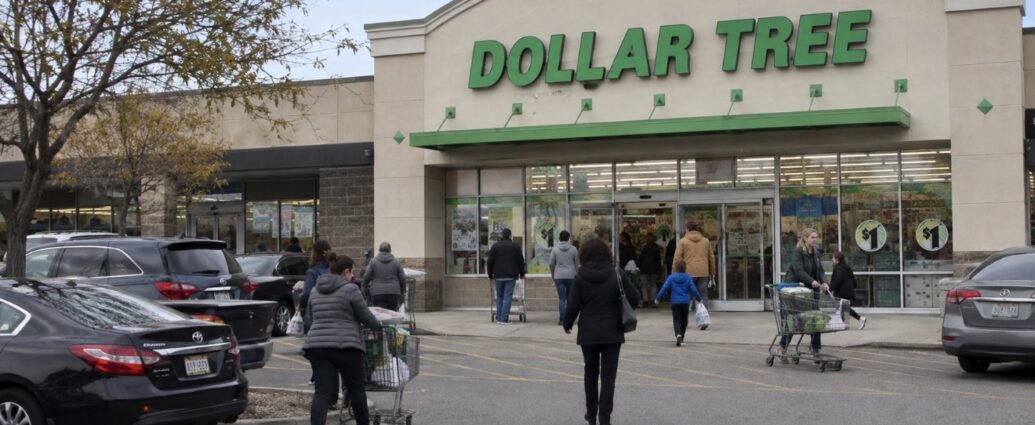
Dollar Tree got a $383 million check back from the government, and it plans to hand most of it to shoppers rather than keep it. That is why the stock fell about 9% Thursday even though the quarter was a blowout.
Here is the mechanism in plain terms. (cite index=“69-1”>The company had paid tariffs under emergency trade powers, and it got that money refunded — $369 million landed in cost of sales, $14 million as interest.</cite> (cite index=“74-1”>That refund alone added $1.31 to quarterly earnings of $2.70 a share, against $0.91 a year earlier and analyst expectations of about $1.15.</cite> Roughly half the profit came from the refund, not from selling more stuff.
The selling was fine too. (cite index=“74-1”>Net sales rose 7% to $4.9 billion for the quarter ended Aug. 1, with comparable sales up 3.7%.</cite> (cite index=“73-1”>Customer traffic rose 0.4%, the first increase after four straight quarters of decline</cite> — small, but it is people walking through the door rather than the same people spending more.
The problem is the guidance. (cite index=“68-1”>For the current quarter, Dollar Tree expects adjusted earnings of $0.80 to $0.95 a share, including a hit of about $0.50 tied to spending the refund money back into the business.</cite> Put simply: management is taking government money and putting it into lower prices and better-stocked shelves instead of into the profit line. (cite index=“68-1”>Full-year guidance went up to $7.70 to $8.05 a share from $6.70 to $7.10.</cite>
For shoppers, that spending is the point. (cite index=“67-1”>Items priced above the old single-dollar mark now account for 17% of sales, up about four percentage points from a year ago,</cite> and the refund is funding more of that range. (cite index=“68-1”>Chief executive Mike Creedon said the strategies are unlocking a better assortment in better-run stores.</cite>
The back half looks harder. (cite index=“67-1”>The company expects higher freight costs and broad inflation to squeeze margins through year-end, and a helium shortage already cost about $15 million in sales last quarter</cite> — balloons matter more to a party-supply aisle than they sound.
What happens next comes down to whether traffic keeps rising once the refund money runs out. (cite index=“73-1”>Strip out the tariff benefit and the full-year range implies about $7.10 to $7.45 a share, still an increase</cite>. The refunds are one-time. The customers, if the price investments work, are not.
JBizNews Desk | New York
© JBizNews.com All Rights Reserved. Reproduction or distribution without written permission is prohibited.




