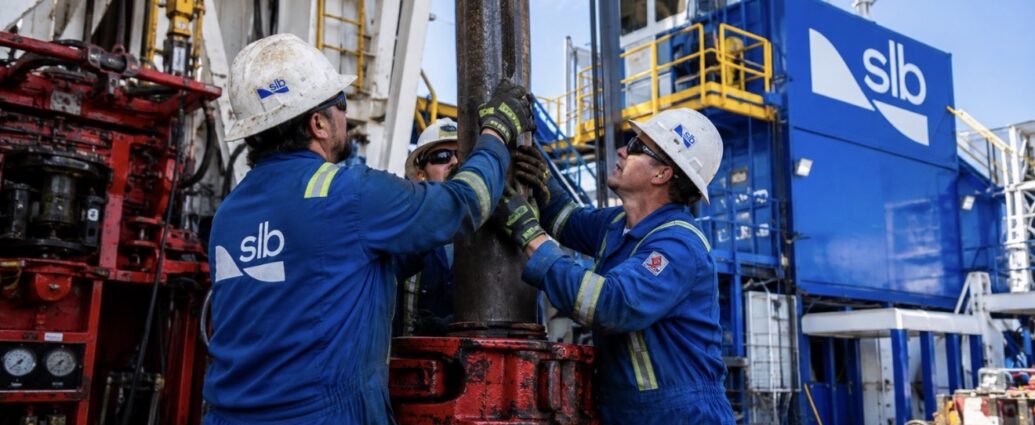
HOUSTON — SLB, one of the world’s largest oilfield-services companies, is making a major move outside traditional drilling with a $4.1 billion acquisition of German cooling specialist Kelvion, betting that the enormous expansion of artificial intelligence will create a new industrial market around keeping data centers from overheating.
The deal is a striking example of how the AI boom is beginning to reshape industries far beyond semiconductors and software.
SLB built its global business helping oil and gas companies drill wells, manage reservoirs and operate energy infrastructure.
Now it wants to help operate the physical infrastructure behind artificial intelligence.
Under the agreement announced Monday, SLB will pay about $3.4 billion in cash and assume approximately $700 million of Kelvion debt.
Kelvion makes heat exchangers and thermal-management systems used across data centers, energy facilities and industrial operations.
But data centers have become its largest and fastest-growing business.
Kelvion expects to generate roughly $2.3 billion to $2.4 billion in total revenue in 2026, with approximately $1.2 billion to $1.3 billion coming from data centers alone.
That is where SLB sees the opportunity.
Modern AI systems require enormous clusters of high-powered chips running continuously inside data centers.
Those chips generate tremendous amounts of heat.
If that heat cannot be removed efficiently, the computers cannot operate properly.
As AI processors become more powerful and are packed more densely into server racks, traditional air conditioning is increasingly insufficient. Data-center operators are turning toward sophisticated liquid-cooling and heat-transfer systems capable of removing much larger amounts of heat.
In simple terms, the more powerful the AI becomes, the harder it becomes to keep the machines cool.
And that is creating an entirely new infrastructure business.
SLB CEO Olivier Le Peuch described AI as driving one of the largest infrastructure investment cycles in history.
The company believes Kelvion will allow it to provide more of the systems required to build and operate those facilities rather than simply participating in the energy side of the business.
That distinction is important.
AI data centers need enormous amounts of electricity, cooling equipment, pumps, piping, heat exchangers, water systems and other industrial infrastructure.
Many of those requirements look much more like the large engineering projects SLB has spent decades working on in the energy industry than they do traditional Silicon Valley technology projects.
SLB therefore sees an opportunity to transfer its engineering expertise into a rapidly expanding market.
Together, SLB and Kelvion are expected to generate more than $2 billion in data-center revenue this year.
By 2028, SLB is targeting between $4.5 billion and $5 billion in annual revenue from its combined data-center solutions business.
That would turn AI infrastructure into a significant new business line for a company historically associated almost entirely with oil and gas.
The acquisition also shows how the economics surrounding artificial intelligence are spreading.
Nvidia and other semiconductor companies may supply the processors, but those processors cannot operate without buildings, electricity and cooling.
That means some of the biggest beneficiaries of the AI boom may ultimately be industrial companies that never designed a computer chip.
Utilities are building new generation capacity.
Construction companies are erecting enormous data centers.
Electrical-equipment companies are supplying transformers and switchgear.
And cooling companies are becoming increasingly valuable because every high-powered AI processor ultimately produces heat that must be removed.
Kelvion sits directly inside that problem.
SLB expects the acquisition to increase both earnings per share and free cash flow per share during the first 12 months after closing and estimates roughly $120 million in annual synergies within three years.
The transaction is expected to close during the first half of 2027, subject to regulatory approvals.
For SLB, the acquisition represents something bigger than diversification.
It is a bet on where industrial spending is moving.
For more than a century, companies like SLB built their businesses around the enormous infrastructure required to extract and move energy.
The next infrastructure boom may increasingly involve the enormous amounts of energy—and cooling—required to run artificial intelligence.
JBizNews Desk | Houston
© JBizNews.com All Rights Reserved. Reproduction or distribution without written permission is prohibited.