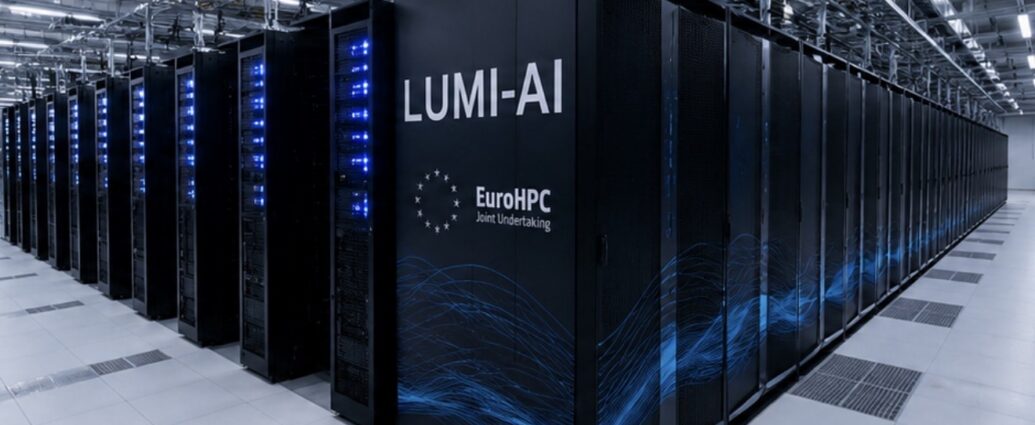
Europe is putting nearly half a billion dollars into a new artificial intelligence supercomputer as governments race to secure the computing power that increasingly determines who can compete in AI.
The European High Performance Computing Joint Undertaking announced that it signed a €387.8 million contract with Bull for a new system called LUMI-AI, which will be installed at CSC’s data center in Kajaani, Finland.
At current exchange rates, the investment is roughly $450 million.
The important part is not simply that Europe is buying another supercomputer.
It is what Europe is trying to build around it.
LUMI-AI is being designed specifically for artificial intelligence workloads that require enormous amounts of computing power, including the training and deployment of advanced AI models, large-scale simulations and work involving massive or confidential datasets.
The system is expected to provide about 10 times the AI computing capacity of the existing LUMI supercomputer.
That is a major jump.
The machine will use next-generation AMD Instinct MI430X graphics processors together with AMD’s sixth-generation EPYC processors. It will be installed in Finland and is expected to become available to users in 2027.
Half of the €387.8 million cost will be funded by the European Union through the Digital Europe Programme. The other half will be paid by the LUMI AI Factory consortium, led by Finland and including the Czech Republic, Denmark, Estonia, Norway and Poland.
The broader goal is to give European companies, startups, researchers and government institutions access to powerful AI infrastructure without depending entirely on private American technology giants or foreign computing systems.
That matters because AI is becoming increasingly dependent on access to enormous quantities of specialized computing power.
Companies may have strong engineers, valuable data and promising AI ideas, but without access to powerful chips and supercomputers, they may not be able to train or operate the most advanced systems.
In simple terms, computing power is becoming the factory floor of the AI economy.
Countries that control more of that capacity can potentially develop better AI systems, attract more technology companies and keep more of the economic value created by artificial intelligence inside their own borders.
The United States currently has a major advantage because companies such as Microsoft, Amazon, Google, Meta and Oracle are spending tens of billions of dollars building enormous AI data centers.
China is also pouring resources into domestic chips, computing clusters and artificial intelligence infrastructure.
Europe does not have private technology companies spending at quite the same scale.
That is why governments are stepping in.
The European Union has been building what it calls AI Factories — computing centers that combine supercomputers, data, technical expertise and services that startups and researchers can use to develop artificial intelligence.
The existing LUMI AI Factory has already been providing computing resources to European small and midsized businesses and startups in areas including manufacturing, health care, life sciences and communications technology.
The new LUMI-AI system is intended to dramatically expand that capacity.
There is another reason Europe sees this as strategic.
Artificial intelligence is increasingly tied to national competitiveness.
AI is expected to affect manufacturing, drug development, defense, banking, logistics, telecommunications, energy and almost every major industry.
Europe does not want European companies to reach a point where they have innovative technology but must depend on American or Chinese infrastructure to build it.
That is why the supercomputer investment is bigger than one machine in Finland.
It is part of an attempt to build an independent European AI ecosystem.
What It Means for Businesses
For smaller companies, AI competition is increasingly becoming a question of access.
A startup may not have billions of dollars to build its own data center or purchase thousands of advanced processors.
Shared government-backed supercomputers can give those businesses access to computing power that previously was available mainly to the largest technology companies.
That could help European manufacturers, biotech companies, software developers and other businesses experiment with advanced AI without making enormous infrastructure investments themselves.
It also demonstrates how quickly artificial intelligence is moving from being primarily a software race into an infrastructure race.
Chips matter.
Electricity matters.
Data centers matter.
Cooling systems matter.
And increasingly, governments are deciding that access to AI computing capacity is too strategically important to leave entirely to the private market.
Europe is now putting nearly €388 million behind that calculation.
JBizNews Desk | New York
© JBizNews.com All Rights Reserved. Reproduction or distribution without written permission is prohibited.