The Gulf of Aden is only about a hundred miles wide at its narrowest point.
Yemen sits on one side.
Somalia sits on the other.
And the armed groups controlling territory along both shores are increasingly cooperating in ways that could make one of the world’s most important shipping corridors even more dangerous.
American and United Nations assessments describe a relationship between Yemen’s Houthis and Somalia’s al-Shabaab that has moved beyond shared hostility toward the West and into something more practical:
weapons, training, money and smuggling.
The Houthis have missiles, drones and battlefield experience.
Al-Shabaab has cash, manpower and deep smuggling networks across East Africa.
Each side has something the other wants.
And for global shipping, that is the part that matters.
What Has Changed
The Houthis have spent years attacking commercial and military vessels in and around the Red Sea using drones, missiles and other weapons.
Al-Shabaab, meanwhile, has mainly focused its operations inside Somalia and East Africa.
But U.N. reporting and U.S. assessments indicate that members of al-Shabaab have traveled to Yemen for training in drone operations and explosives.
The Houthis have also reportedly supplied armed drones, while al-Shabaab has sought more advanced weapons, including guided missiles.
That would represent a major escalation.
Until now, al-Shabaab has used drones mostly for surveillance and battlefield intelligence.
A group capable of accurately striking a moving commercial vessel at sea would be dealing with a completely different level of firepower.
Why the Geography Matters
The Gulf of Aden feeds directly into the Bab el-Mandeb Strait, one of the world’s most important maritime chokepoints.
Ships traveling between Asia and Europe use the route to reach the Red Sea and then the Suez Canal.
That means everything from electronics and clothing to machinery, food and energy passes through the area.
Until now, much of the military threat to commercial shipping has come from the Yemeni side.
If armed groups on both shores gain the ability to threaten vessels, there is effectively no safe coastline to favor.
That creates a much more complicated security problem for shipping companies.
Somali Piracy Is Also Returning
The danger is not limited to missiles and drones.
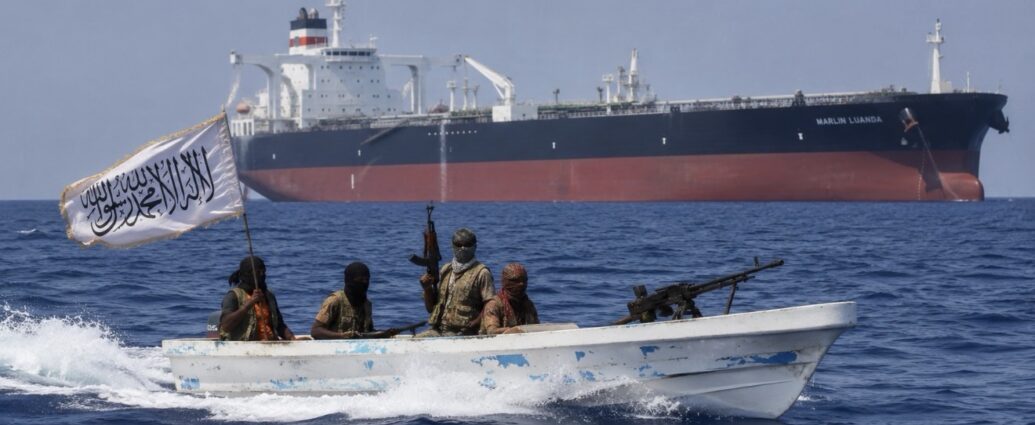
Piracy off Somalia has also begun rising again.
Several vessels have been seized this year, and criminal groups have again demanded multimillion-dollar ransoms from shipowners.
At its peak in 2011, Somali piracy cost shipping companies and governments roughly $7 billion a year through ransom payments, security costs, rerouting and higher insurance premiums.
The difference today is that piracy is returning at the same time that warships in the region are also dealing with missile and drone threats.
That divides naval resources.
A destroyer watching for incoming missiles cannot simultaneously patrol every stretch of coastline for small pirate boats.
What It Means for Shipping Companies
The immediate commercial response is familiar.
When the Red Sea becomes too dangerous, shipping companies send vessels around the Cape of Good Hope instead.
That route is much longer.
It can add roughly ten days to a voyage between Asia and Europe.
It also means more fuel, more crew time and higher insurance costs.
Every extra day at sea costs money.
Those costs eventually work their way into freight rates and, later, into the prices paid by businesses and consumers.
Two Chokepoints Are Under Pressure at Once
The timing is especially important because the Red Sea is not the only major maritime route under pressure.
The Strait of Hormuz is also under strain because of the broader conflict involving Iran and the Gulf.
That means two of the world’s most important shipping chokepoints are facing elevated risk at the same time.
Hormuz affects oil and gas shipments.
Bab el-Mandeb affects traffic moving between Asia, Europe and the Mediterranean.
Pressure on both creates a much bigger problem for global trade.
Why This Partnership Matters
The Houthi-al-Shabaab relationship is dangerous not because the groups suddenly became ideological allies.
They are not.
The Houthis are Shiite and backed by Iran.
Al-Shabaab is Sunni and affiliated with al-Qaeda.
Their cooperation appears to be transactional.
That can actually make it more durable.
They do not need to agree on religion, politics or long-term goals.
They only need to agree that weapons, money and training are useful.
What It Means for Businesses
For importers, retailers and manufacturers in the United States and Europe, the key risk is higher transportation costs.
Longer shipping routes mean higher fuel bills.
Higher risk means more expensive insurance.
Delays mean inventories arrive later.
And companies that rely on just-in-time supply chains have less room for error.
The Red Sea was already one of the most fragile parts of global trade.
If the threat expands from one coastline to both, the economics become much harder.
The question is no longer only whether a ship can safely get past Yemen.
It is whether the entire corridor between Yemen and Somalia can remain reliably open.
That is a much bigger problem.
JBizNews Desk | New York
© JBizNews.com All Rights Reserved. Reproduction or distribution without written permission is prohibited.