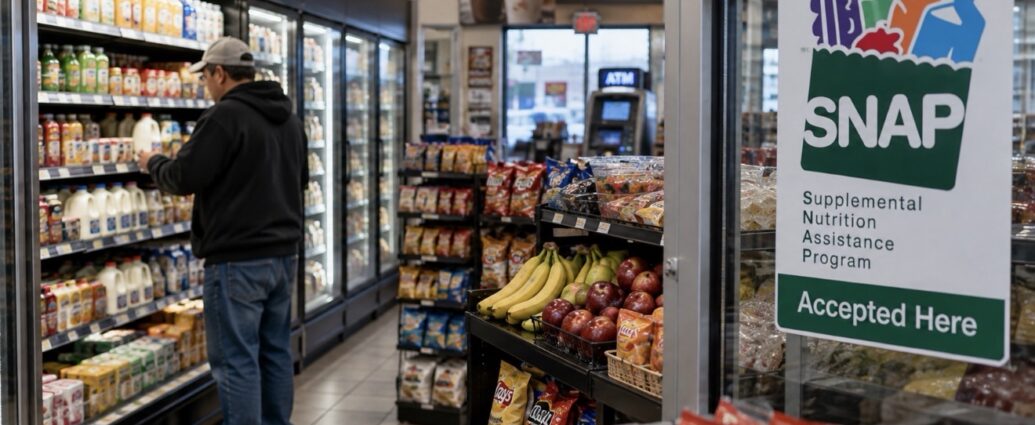
Thousands of convenience stores could face a difficult choice this fall:
Stock significantly more staple foods — or stop accepting SNAP benefits.
A new U.S. Department of Agriculture rule requires most SNAP-authorized retailers to carry at least seven varieties of staple foods in each of four food categories beginning November 4.
That means a minimum of 28 different staple-food varieties must be continuously available.
The four categories are:
- Protein
- Grains
- Fruits and vegetables
- Dairy
Stores must also carry at least three stocking units of each qualifying variety, bringing the minimum requirement to 84 individual stocking units.
And at least one perishable variety must be available in three of the four categories.
The goal is straightforward.
USDA wants customers using the Supplemental Nutrition Assistance Program to have access to a wider selection of nutritious foods wherever SNAP is accepted.
But convenience-store operators say the rule could have an unintended consequence:
Some smaller stores may simply stop accepting SNAP altogether.
Why Convenience Stores Are Worried
Nearly 250 convenience-store operators and trade groups have asked Agriculture Secretary Brooke Rollins to delay enforcement for six months.
Their argument is not necessarily that stores oppose carrying healthier food.
It is that small stores operate very differently from supermarkets.
A neighborhood convenience store may have limited refrigeration.
It may have only a few aisles.
It may receive smaller deliveries and have less storage space.
Fresh products can also spoil quickly if customer demand is not high enough.
That creates a simple business problem.
A supermarket selling large volumes of milk, produce, meat and bread can move those products quickly.
A small convenience store may buy the same products and end up throwing some of them away.
That waste becomes another operating cost.
What Changes on November 4
Today, many SNAP retailers qualify by stocking at least three varieties in each of four staple-food categories.
The new standard raises that to seven varieties per category.
That means the breadth requirement increases from 12 varieties to 28.
The required number of stocking units also rises substantially.
USDA says the rule will ensure that participating stores offer meaningful food choices rather than qualifying for SNAP while carrying only a very limited grocery selection.
The department finalized the regulation in May.
It became legally effective in July.
Retailers have until November 4, 2026 to comply.
What Happens if a Store Does Not Comply?
This is the part that matters most.
USDA says a store that does not meet the new requirements can be withdrawn from SNAP participation.
That means it would no longer be allowed to accept SNAP benefits.
For some convenience stores, losing SNAP could mean losing a meaningful portion of their customer base.
That is especially important in lower-income neighborhoods and rural communities where a convenience store may also function as the nearest practical grocery outlet.
A customer might otherwise have to travel several miles to reach a full supermarket.
The Rule Does Not Change What SNAP Customers Can Buy
There is an important distinction.
This rule does not broadly change which products shoppers are permitted to purchase with SNAP.
It changes what a retailer must keep in stock in order to remain authorized to accept SNAP.
USDA has also changed how certain products are classified.
Items including butter, jerky, cheese dip, snack bars and fruit spreads will no longer count toward a store’s required staple-food inventory.
They can still generally be purchased with SNAP where otherwise eligible.
They simply cannot be used by the retailer to satisfy its stocking requirement.
Why USDA Is Doing It
The policy traces back to the 2014 Farm Bill, which directed USDA to raise SNAP retailer stocking standards.
Implementation was repeatedly delayed while USDA worked through how different foods should be classified.
The department’s new rule creates a clearer definition of what counts as a distinct variety.
USDA argues the result will provide SNAP households with better access to what it describes as whole, nutrient-dense foods.
For consumers, that could mean more choices.
For retailers, it means more inventory.
The Small-Business Tradeoff
This is where the policy becomes complicated.
A rule designed to improve food access could potentially reduce food access if smaller stores leave SNAP.
That is what the industry is warning about.
A store owner has to calculate whether the revenue generated by SNAP customers is large enough to justify buying more inventory, adding refrigeration, increasing deliveries and accepting additional spoilage.
For some stores, the answer will be yes.
For others, it may not be.
That decision becomes especially important for independently owned convenience stores, where margins are already tight.
What It Means for Businesses
For convenience-store owners, November 4 is now an important operational deadline.
They need to examine inventory category by category and determine whether they meet the new federal standard.
Stores that do not may need to:
Increase inventory.
Find new suppliers.
Add refrigerator or freezer capacity.
Reconfigure shelves.
Or decide whether staying in SNAP remains economically worthwhile.
For food distributors, the change could create new demand from thousands of smaller retailers that suddenly need additional dairy, produce, grain and protein products.
For consumers, the effect will depend heavily on where they live.
If stores comply, SNAP customers could gain access to a wider variety of food.
If significant numbers of smaller retailers leave the program, some communities could instead end up with fewer places where SNAP benefits can be used.
That is the tension Washington now has to manage:
Require better food choices without making the cost of participation so high that neighborhood stores decide not to participate at all.
With the November 4 deadline approaching, convenience-store operators are asking USDA for more time.
For thousands of small retailers, the question is no longer simply what they should stock.
It is whether accepting SNAP will still make business sense.
JBizNews Desk | Washington
© JBizNews.com All Rights Reserved. Reproduction or distribution without written permission is prohibited.