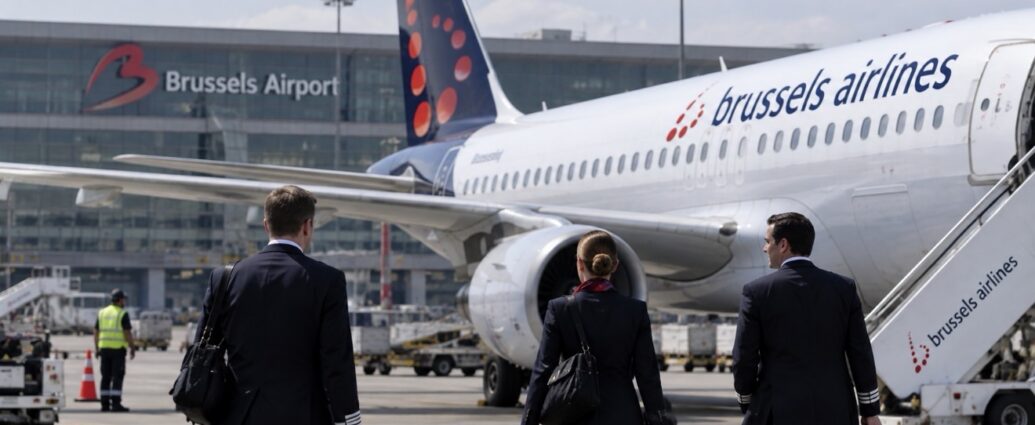
Brussels Airlines is facing a growing labor dispute over flights to Tel Aviv, with a Belgian union threatening strike action unless crew members are allowed to refuse assignments to Israel on safety or conscientious grounds.
The dispute centers on a question that goes far beyond one airline:
Can airline employees decline to work a specific international route because they object to the destination or believe it is unsafe?
Brussels Airlines resumed service to Tel Aviv on August 3 after a five-month suspension and is currently operating three flights a week.
The union representing flight crews says employees who object to flying to Israel should be allowed to refuse those assignments without losing pay or facing disciplinary action.
The airline disagrees.
Brussels Airlines says safety is its top priority and that route decisions are based on security assessments, operational conditions and passenger demand.
It also says employees are expected to carry out assigned duties under the terms of their employment.
Why This Matters
This is not simply a labor dispute.
It is a business-risk issue for airlines operating routes into politically sensitive or conflict-affected regions.
Airlines already have to manage:
- Security assessments
- Insurance costs
- Crew availability
- Passenger demand
- Airspace restrictions
- Government travel guidance
If employees also gain broad discretion to refuse specific destinations for political or ethical reasons, staffing could become much more difficult.
That could force airlines to cancel flights even when regulators and company security teams consider the route safe to operate.
The Volunteer Question
The union says Brussels Airlines previously relied more heavily on volunteers for Israel flights.
It argues that the company has moved away from that system because it could not find enough employees willing to operate the route.
Brussels Airlines disputes that characterization.
That disagreement is central to the dispute.
If enough crew members refuse assignments, the airline may not have enough staff to maintain its schedule.
And once staffing becomes unreliable, the financial consequences can grow quickly.
Cancelled flights mean refunds.
Aircraft may sit idle.
Passengers need to be rebooked.
Hotels and compensation costs can rise.
And travelers may begin booking with competitors instead.
A Broader Precedent for European Airlines
The larger concern is precedent.
Airlines operate routes to countries facing political controversy, war, sanctions, protests and security concerns all over the world.
If workers can decline assignments based on personal political or ethical objections, airlines could face similar disputes on many routes.
That would create a difficult line for management.
Safety concerns can be assessed through intelligence, government guidance and aviation-security professionals.
Political objections are much harder to standardize.
One employee may object to one country.
Another may object to another.
An airline cannot operate a global route network if every destination effectively becomes optional.
What It Means for Travelers
For passengers traveling between Belgium and Israel, the immediate risk is disruption.
If the union follows through with strike action, Brussels Airlines could be forced to cancel or reduce flights.
That would tighten capacity on a route that has already experienced repeated suspensions and resumptions because of regional security conditions.
Less capacity generally means higher fares and fewer backup options when flights are disrupted.
For business travelers, that unpredictability can be especially costly.
What It Means for Airlines
The dispute highlights how geopolitical conflict increasingly reaches directly into airline operations.
A route can be technically open.
Airports can be functioning.
Demand can exist.
But if crews do not want to fly it, the airline still has a problem.
That can affect staffing models, employment contracts and labor negotiations far beyond Brussels Airlines.
The commercial question is straightforward:
Who ultimately decides whether a route should be flown — airline management and safety professionals, or individual employees assigned to operate it?
Brussels Airlines is now being forced to answer that question in real time.
And if the dispute escalates into a strike, other European carriers will be watching closely.
JBizNews Desk | Brussels
© JBizNews.com All Rights Reserved. Reproduction or distribution without written permission is prohibited.