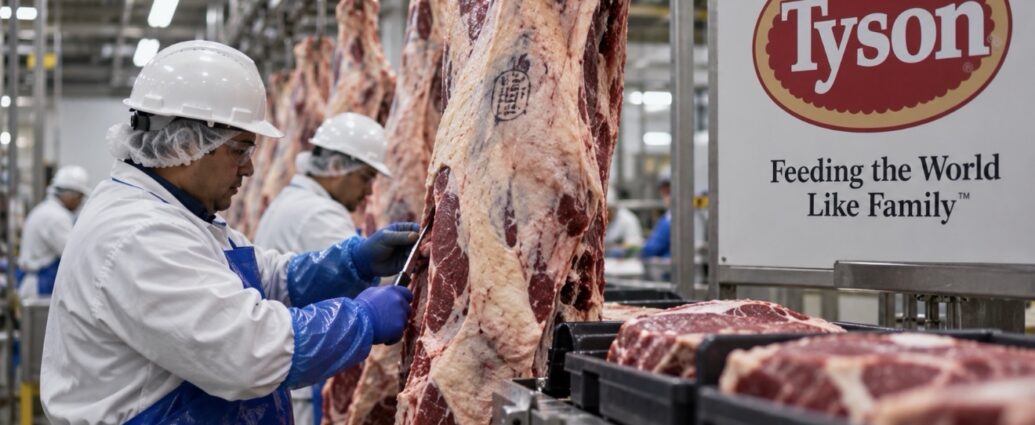
Tyson Foods has lowered its profit outlook for the second time in a month as America’s shrinking cattle supply drives up costs, squeezes meatpackers and keeps beef prices elevated for consumers.
Tyson Foods is warning that conditions in the U.S. beef business have become even tougher than it expected only weeks ago.
The company cut its fiscal 2026 adjusted operating-income forecast to between $1.85 billion and $2.05 billion, down from the $2.1 billion to $2.3 billion range it projected in August.
The problem is cattle.
America is dealing with one of its tightest cattle supplies in generations, following years of drought, herd reductions and disruptions to livestock imports from Mexico.
That shortage has pushed cattle prices sharply higher and left meatpackers fighting over a smaller pool of animals.
For Tyson, the math has become painful.
The company is paying more for cattle while having limited ability to fully pass those costs through to consumers, particularly as shoppers remain cautious about food prices and increasingly look for cheaper alternatives.
Tyson had already warned in August that its beef division could lose between $500 million and $650 million this fiscal year.
The company has since moved aggressively to shrink and restructure its beef network.
Tyson announced plans to end operations at its Joslin, Illinois beef facility and its Eagle Mountain, Utah case-ready facility.
It is also pursuing a sale of its beef facility in Pasco, Washington.
The company plans to concentrate more of its beef operations around larger facilities in Dakota City, Nebraska; Holcomb, Kansas; and Amarillo, Texas.
Tyson says those changes are necessary because the cattle shortage could persist.
Recent federal cattle data showed limited rebuilding of the U.S. herd, meaning the supply of animals available for slaughter may remain constrained even after prices rise enough to encourage ranchers to expand.
That rebuilding process takes time.
A rancher cannot simply produce more cattle next quarter.
Cows must be retained for breeding, calves must be born, and those animals then need months or years before they become part of the commercial beef supply.
That is why today’s cattle shortage can continue affecting supermarket prices long after the original drought or supply disruption ends.
The federal government is now trying to intervene.
President Trump recently expanded access to lower-tariff imported beef in an effort to reduce consumer prices, while the administration has also announced support for smaller meat processors and measures intended to help ranchers rebuild domestic production.
But those policies create their own tension.
More imported beef can help consumers in the short term.
It can also put additional pressure on American cattle producers at exactly the moment Washington wants them to invest in rebuilding the herd.
What It Means for You
This is one of those business stories that starts on a ranch and ends at the supermarket checkout.
When cattle supplies fall, ranchers can receive higher prices for animals.
But meatpackers such as Tyson must pay those higher prices before turning the cattle into steaks, roasts and ground beef.
If processors cannot raise retail prices enough to recover those costs, their margins collapse.
That is exactly what is happening now.
For consumers, the shortage means beef prices can remain elevated even while other parts of food inflation cool.
For restaurants, supermarkets and food distributors, it means continued pressure on one of their most important protein categories.
And for investors, Tyson’s latest warning shows that even one of America’s largest food companies cannot easily escape the economics of a 75-year-low cattle supply.
The beef shortage is no longer simply an agricultural problem.
It has become a consumer-price, corporate-profit and national food-supply problem — and Tyson is now paying the price.
JBizNews Desk | New York
© JBizNews.com All Rights Reserved. Reproduction or distribution without written permission is prohibited.