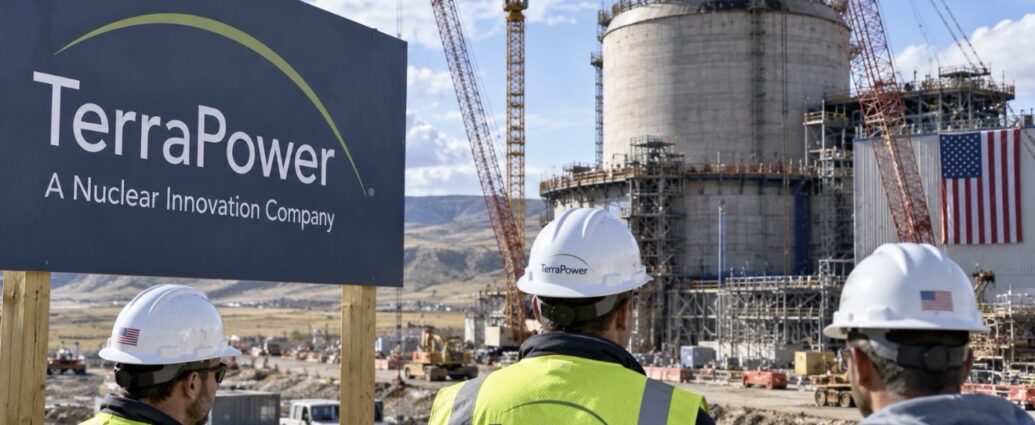
TerraPower is targeting 2034 to begin generating electricity in Britain, taking Bill Gates’ advanced nuclear company into its first international market as governments race to secure more reliable power for AI, industry and the grid.
TerraPower is planning to bring its Natrium advanced nuclear reactor to the United Kingdom by 2034, marking the company’s first commercial deployment outside the United States.
The company has already entered Britain’s formal regulatory review process and launched TerraPower UK, signaling that the expansion has moved beyond preliminary discussions.
Each Natrium unit is designed to provide 345 megawatts of continuous electricity, with an integrated energy-storage system capable of temporarily boosting output to 500 megawatts.
That ability to increase power when demand spikes is one of the technology’s biggest selling points.
Traditional nuclear plants are generally built to produce steady baseload electricity.
TerraPower’s design combines nuclear generation with large-scale molten-salt energy storage, allowing the plant to act more flexibly as electricity demand rises and falls.
That has become increasingly valuable as grids absorb more renewable energy and as data centers create enormous new around-the-clock power requirements.
TerraPower Chief Executive Chris Levesque said the company believes its reactors could produce electricity in Britain at a competitive cost of less than £100 per megawatt-hour.
A final UK site has not yet been selected.
The company has said its British operation could ultimately be based in Liverpool, while work continues with regulators and potential partners on the location of the first reactor.
The United Kingdom has been trying to accelerate new nuclear development as part of a broader effort to improve energy security, cut dependence on imported fossil fuels and replace aging generating capacity.
Britain is also encouraging privately financed advanced reactors through a new regulatory and investment framework.
TerraPower’s first Natrium project is already under construction in Kemmerer, Wyoming.
Construction formally began in April after the U.S. Nuclear Regulatory Commission issued a construction permit.
That plant is targeted for completion around 2031.
TerraPower is simultaneously expanding the supply chain around the technology.
Last week the company announced another 12 supplier contracts supporting the Wyoming plant, including equipment needed for its reactor and sodium systems.
Fuel remains one of the most important challenges.
Natrium uses high-assay low-enriched uranium, or HALEU, a specialized nuclear fuel that historically relied heavily on Russian supply.
The United States and United Kingdom are now investing in domestic HALEU production as Western governments try to eliminate that dependency.
TerraPower also has major ambitions beyond Britain.
The company already has an agreement with Meta that could eventually support up to eight Natrium reactors in the United States, showing how closely advanced nuclear power is becoming tied to the growth of AI data centers.
What It Means for You
The nuclear revival is increasingly becoming an AI infrastructure story.
The biggest technology companies are planning data centers that require enormous amounts of uninterrupted electricity.
Wind and solar can provide cheap power when conditions cooperate.
But data centers operate 24 hours a day.
That is why companies including Meta, Microsoft, Amazon and Google have been looking increasingly seriously at nuclear energy.
TerraPower is betting that its smaller, more flexible reactor design can meet that demand faster and more efficiently than traditional giant nuclear projects.
For Britain, the project could mean new construction, engineering and manufacturing jobs.
TerraPower estimates each Natrium reactor could support roughly 1,600 construction jobs and 250 permanent positions.
For the broader energy industry, the significance is even larger.
If TerraPower can successfully move from its first Wyoming reactor to commercially operating plants overseas, advanced nuclear would begin transitioning from experimental technology into a repeatable global business.
And with AI power demand accelerating, that transition may be happening at exactly the moment the electricity market needs it most.
JBizNews Desk | New York
© JBizNews.com All Rights Reserved. Reproduction or distribution without written permission is prohibited.