
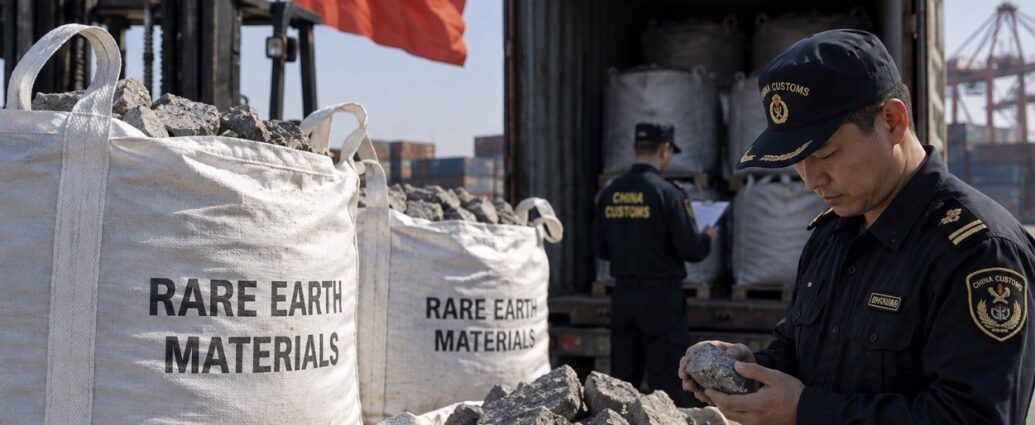
WASHINGTON — Some Chinese rare-earth suppliers are refusing to ship critical materials to American customers, reopening a supply-chain problem Washington thought it had partially stabilized and putting U.S. manufacturers back on alert ahead of President Xi Jinping’s planned visit to Washington later this month.
The refusals began after China imposed sanctions in August on the Responsible Business Alliance, a U.S.-based organization used by companies to monitor labor, sourcing and supply-chain practices.
Chinese suppliers now fear that dealing with American customers that use the alliance or related responsible-minerals programs could expose them to punishment from Beijing.
That means some exporters are choosing the safest option:
Do not ship to the United States at all.
The problem is especially serious because the materials involved are not ordinary commodities.
Rare earths and other critical minerals are used in semiconductors, fighter aircraft, missiles, medical equipment, electric motors, telecommunications systems, energy infrastructure and advanced manufacturing.
A shortage of one specialized material can stop production of an entire product worth thousands or even millions of dollars.
China Still Controls the Chokepoint
The United States has spent billions trying to reduce its dependence on China for strategically important minerals.
But China still dominates the processing and refining of many rare-earth materials.
That means an American company can build a semiconductor factory, defense plant or advanced manufacturing facility in the United States and still depend on a Chinese supplier for a small but essential ingredient.
That vulnerability is now showing up again.
Chinese suppliers have reportedly declined some American orders since early August, while other shipments remain delayed by export-license approvals.
One of the most important materials is yttrium, which is used in aerospace coatings, electronics, medical technologies and advanced industrial applications.
China resumed limited yttrium exports in July after a two-month halt, but American buyers are still struggling to receive enough material.
U.S. imports remain substantially below earlier levels.
Other materials facing restrictions or delays include gallium, terbium, tungsten and indium phosphide, all of which are important to high-technology and defense supply chains.
A Small Mineral Can Stop a Huge Factory
The business risk is easy to underestimate because rare-earth materials often represent only a tiny fraction of the cost of a finished product.
But they can be impossible to substitute quickly.
A semiconductor manufacturer may have billions of dollars of equipment and thousands of employees ready to produce chips.
If it cannot obtain one specialized mineral needed for a component, coating or manufacturing process, the entire production line can slow down.
The same applies to aircraft, missiles, medical equipment and electric motors.
That is why critical minerals increasingly resemble the semiconductor shortages companies experienced during the pandemic.
The missing item may be inexpensive.
The economic damage from not having it can be enormous.
American Companies Have Already Been Waiting Months
Some U.S. companies have reportedly waited six months or longer for Chinese export licenses.
Earlier this year, suppliers serving American aerospace and semiconductor customers were already turning away some buyers because they could not obtain enough material.
The latest refusals make the problem more complicated.
This is no longer simply Beijing delaying an export license.
In some cases, the Chinese supplier itself may decide an American customer is too politically risky to serve.
That makes traditional supply-chain planning much harder.
A company cannot solve the problem simply by submitting paperwork earlier if the supplier does not want the business.
Xi’s Washington Visit Just Became More Important for American Industry
President Xi is expected in Washington on September 24, and critical-mineral access is now expected to be part of the U.S. planning around the visit.
Washington has repeatedly pressed China to honor previous commitments to maintain a smoother flow of rare-earth export licenses.
The persistence of shortages shows those assurances have not removed the underlying problem.
China understands how valuable its mineral-processing dominance is.
The United States understands how dangerous that dependence has become.
That makes rare earths one of the most important pieces of leverage Beijing possesses in the broader U.S.-China relationship.
Tariffs can make a Chinese product more expensive.
A mineral restriction can make an American product impossible to manufacture.
That is a much more powerful weapon.
Washington Is Spending Billions to Build Alternatives
The United States is now financing new mines, processing plants, recycling operations and domestic supply agreements in an attempt to build alternatives.
The Defense Department has invested heavily in domestic rare-earth production, while private capital is increasingly moving toward companies capable of mining or processing strategic minerals outside China.
But those projects take years.
Opening a mine is difficult.
Building processing facilities is expensive.
Environmental reviews, financing, technical expertise and customer contracts all take time.
So even as billions are being committed to independence, American manufacturers remain dependent on Chinese material today.
That gap between the supply chain America wants and the supply chain America actually has is where the current risk sits.
What Businesses Should Be Watching
For manufacturers that depend on specialized minerals, this is no longer a procurement issue that can be left entirely to purchasing departments.
Companies need to know where their critical materials actually originate — including materials buried several layers deep inside components purchased from another supplier.
They also need to know whether alternative suppliers exist outside China and how long qualification of those suppliers would take.
Because the next shortage may not arrive with a formal government announcement.
It may simply arrive as an email from a supplier saying:
We cannot fill your order.
That is what makes the latest Chinese refusals so important.
The United States and China may still be negotiating tariffs, investment and trade balances.
But underneath those negotiations is a much more fundamental contest.
America wants to control the factories of the future. China still controls many of the materials those factories cannot operate without.
Until that changes, a small number of Chinese suppliers can continue holding extraordinary leverage over some of the most important industries in the American economy.
JBizNews Desk | Washington
© JBizNews.com All Rights Reserved. Reproduction or distribution without written permission is prohibited.




