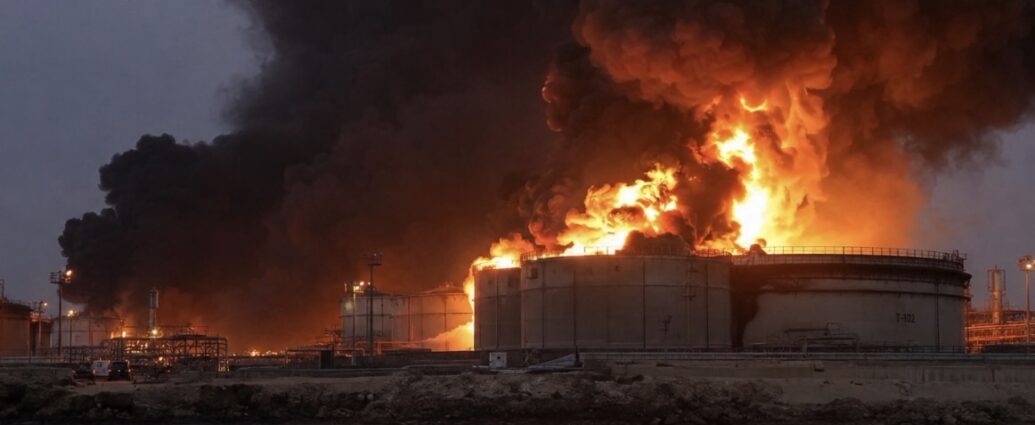
Oil crossed one of the market’s most important psychological lines Wednesday morning: $100 a barrel.
Brent crude climbed above $100 for the first time in nearly six weeks, trading around $100.70 a barrel, while U.S. crude rose above $95. Oil is now up roughly 25% since last month as the U.S.-Iran conflict increasingly moves from a geopolitical story into a direct global supply problem.
The biggest issue is no longer simply fear of what could happen in the Strait of Hormuz.
The oil is already not moving.
About 10 million barrels a day of global oil supply is currently offline, according to Reuters, while shipping traffic through the Strait of Hormuz remains severely disrupted. Only six commodity vessels passed through Tuesday, compared with a 10-day average of 12. Before the conflict, the strait handled roughly 125 commercial vessels a day and about 20% of global oil and LNG supply.
Now another major energy route is under pressure.
Iran-backed Houthi forces attacked Saudi oil facilities and utilities this week, igniting fires and injuring 73 people. The attacks shattered a four-year truce in Yemen and raised fears that instability could spread toward Saudi export infrastructure and the Red Sea shipping corridor.
At the same time, the United States and Iran are directly targeting energy shipping.
U.S. Central Command said American forces destroyed five Iranian crude-oil tankers after Iran fired missiles at a U.S. warship. Iranian state media later claimed its forces attacked multiple tankers and two U.S. vessels, although CENTCOM said the claims that American warships were hit were false.
That matters because the oil market is losing both production and transportation capacity at the same time.
For American businesses, $100 Brent does not stay on an oil trading screen.
Diesel moves trucks. Jet fuel moves airplanes. Bunker fuel moves cargo ships. Petrochemicals go into plastics, packaging, manufacturing and thousands of everyday products.
The average U.S. gasoline price has already climbed to about $4.22 a gallon, more than $1 higher than a year ago, while diesel has reached approximately $5.94 a gallon — a record.
That makes the math painful for nearly every business that moves something.
A trucking company buying 10,000 gallons of diesel a week is now spending almost $60,000 just on fuel. A distributor running hundreds of trucks cannot absorb those increases indefinitely. Eventually some of that cost moves into freight rates, grocery prices, construction materials and consumer goods.
Airlines face the same problem with jet fuel. Shipping companies face it with marine fuel. Manufacturers pay more both for energy and for moving raw materials into factories and finished products out.
And the higher oil goes, the harder the Federal Reserve’s job becomes.
Wall Street had spent much of the year debating when interest rates could come down. Now energy inflation is pushing the conversation in the opposite direction.
U.S. stock futures were lower Wednesday morning, with the Dow down roughly 0.5%, S&P 500 down 0.3% and Nasdaq down 0.4%, as investors worried that another energy shock could keep inflation elevated and interest rates higher for longer.
Markets are now waiting for the next U.S. inflation reports and the Federal Reserve meeting next week.
The supply cushion is also thin.
The U.S. Strategic Petroleum Reserve is sitting at its lowest level since 1982, limiting Washington’s ability to offset a prolonged disruption with emergency barrels. The International Energy Agency expects global oil supply to decline by roughly 4.3 million barrels a day this year, even with additional production coming from countries including the United States, Canada and Guyana.
That makes every additional attack more consequential.
The world has already seen significantly higher oil prices during this conflict, so $100 is not itself a worst-case scenario.
But Wednesday’s move is important because of what it signals.
The market is no longer pricing this as a short-lived Middle East scare.
It is beginning to price the possibility that millions of barrels of oil remain unavailable for much longer — while the world simultaneously loses confidence in the shipping routes needed to move the barrels that are still being produced.
For businesses, that means one of the largest costs in the global economy is rising again.
And unless supply starts moving normally through the Gulf, $100 oil may be the beginning of the problem, not the end of it.
JBizNews Desk | New York
© JBizNews.com All Rights Reserved.
Reproduction or distribution without written permission is prohibited.