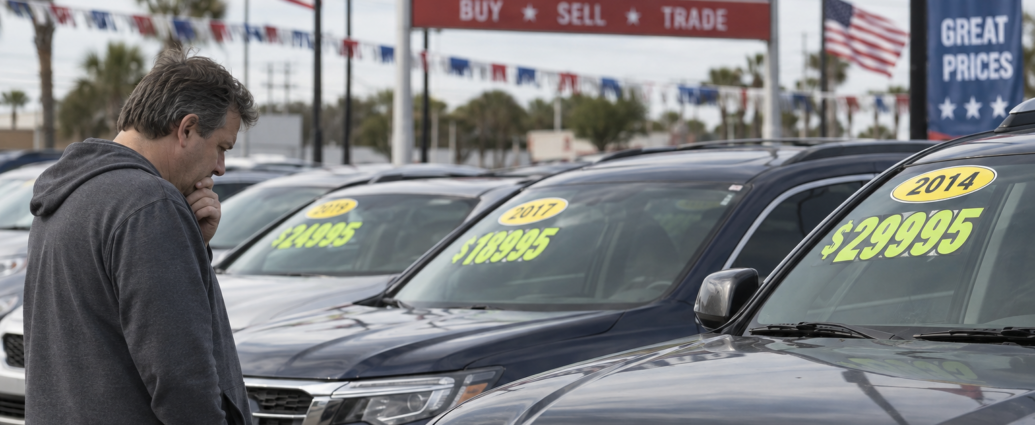
Americans turning to used cars to escape record-high new-vehicle prices are discovering an uncomfortable reality: buying used isn’t nearly as cheap as it used to be.
A shopper with $10,000 to $15,000 now typically gets a vehicle nearly nine years old with close to 100,000 miles — a dramatic deterioration from what the same budget bought before the pandemic.
According to Edmunds, the average vehicle purchased for between $10,000 and $15,000 during the second quarter of 2026 was 8.7 years old with 98,222 miles.
Back in the second quarter of 2019, that same amount of money bought a vehicle averaging just 4.7 years old and 58,250 miles.
In practical terms, today’s buyer is getting a car that’s about four years older with nearly 40,000 additional miles for the same budget.
That’s becoming a major problem for working families, first-time buyers and commuters who traditionally relied on the used-car market when new vehicles became too expensive.
Affordable Used Cars Are Disappearing
The problem isn’t simply that individual vehicles cost more. The entire lower end of the used-car market has shrunk.
Vehicles priced below $20,000 accounted for 55.2% of used-car sales in the second quarter of 2019, according to Edmunds.
By the second quarter of 2026, that share had fallen to just 31.8%.
Meanwhile, vehicles priced above $30,000 grew from 16.8% of the used market to 35.8% during the same period.
Three-year-old vehicles — traditionally one of the sweet spots for shoppers looking for relatively new cars without paying new-car prices — averaged $32,461 in the second quarter, a record for that quarter and 15.5% higher than in 2021.
The result is an increasingly difficult choice for consumers: spend considerably more money or accept an older vehicle with substantially more mileage.
New Cars Above $50,000
Part of the pressure begins on new-car lots.
The average transaction price for a new vehicle reached $50,089 in August, according to Kelley Blue Book data published by Cox Automotive. That was 1.9% higher than a year earlier and marked the first month of 2026 in which the industry average crossed $50,000.
As new vehicles become more expensive, the cars eventually entering the used market also carry higher prices.
At the same time, the supply of affordable late-model used vehicles remains constrained following years of disruption that began during the pandemic.
That combination has fundamentally changed what Americans can expect when walking onto a used-car lot with a limited budget.
Financing Adds Another Expense
For buyers who don’t have enough cash to purchase a vehicle outright, financing can make the affordability problem considerably worse.
Edmunds reports that used-car buyers financed an average of $30,414 during the second quarter of 2026, up from $29,080 a year earlier.
The average used-car payment reached $576 a month, while the average annual percentage rate stood at 10.5%.
Even more striking, 6.3% of financed used-car purchases carried monthly payments of at least $1,000 — a record in Edmunds’ data.
Higher borrowing costs could remain another obstacle.
The Federal Reserve on Sept. 16 raised its benchmark federal funds target range by a quarter percentage point to 3.75% to 4%, saying inflation remained elevated.
The federal funds rate doesn’t directly determine an individual auto loan, but broader interest-rate conditions influence lenders’ funding costs and ultimately the rates consumers encounter when financing vehicles.
Buyers Are Paying More — and Keeping Cars Longer
The affordability squeeze can create expenses beyond the dealership.
An older, higher-mileage vehicle may have a lower purchase price than a newer alternative, but buyers also have to consider potential maintenance and repair costs.
A car approaching or exceeding 100,000 miles can require tires, brakes, suspension work, batteries and other maintenance that may not appear in the monthly loan payment.
That makes comparing vehicles based only on monthly payments increasingly risky.
Edmunds recommends that consumers consider the total cost of financing and test different combinations of loan length, interest rate and down payment before committing to a purchase.
The same principle applies to the vehicle itself: purchase price is only one part of what a car ultimately costs.
Insurance, fuel economy, expected repairs, maintenance history and financing expenses can dramatically change whether an apparently inexpensive vehicle is actually affordable.
The Used-Car Safety Net Is Getting Weaker
For generations, the standard financial advice for someone unable or unwilling to pay new-car prices was simple: buy used.
That option still exists.
But the numbers show that it increasingly comes with compromises.
A $10,000-to-$15,000 budget that once put a shopper into a roughly five-year-old vehicle now commonly means buying one approaching nine years old and 100,000 miles.
And even shoppers willing to spend substantially more are competing in a market where three-year-old used vehicles average more than $32,000.
For American households already dealing with elevated housing, insurance, food and borrowing costs, transportation is becoming another place where the same paycheck simply doesn’t buy what it once did.
The used-car market may still offer savings compared with buying new.
But increasingly, America’s affordable used car isn’t disappearing because consumers don’t want one — it’s disappearing because fewer of those cars exist at prices families can afford.
JBizNews Desk | New York, N.Y.
© JBizNews.com All Rights Reserved. Reproduction or distribution without written permission is prohibited.