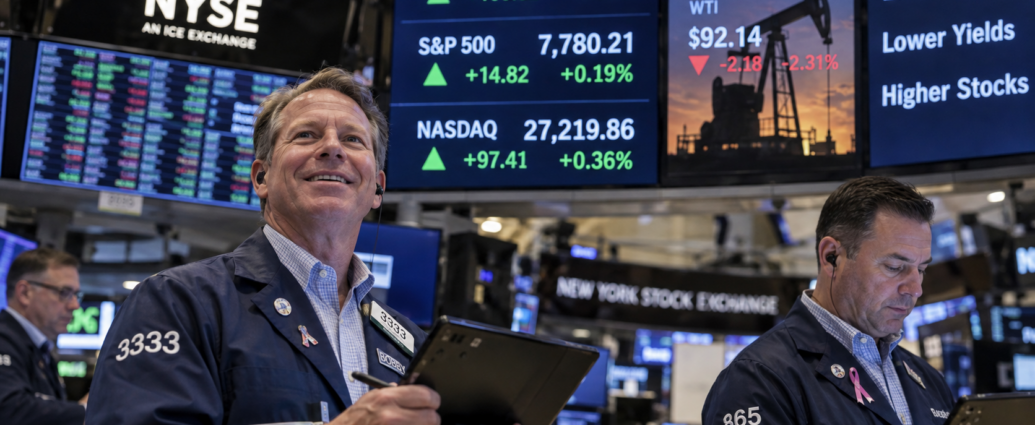
U.S. stocks opened modestly higher Tuesday as another drop in oil prices and easing Treasury yields gave investors some relief from the inflation and borrowing-cost pressures that have weighed on markets in recent weeks.
The Dow Jones Industrial Average, S&P 500 and Nasdaq Composite all moved higher after the opening bell, with the technology-heavy Nasdaq reaching a fresh intraday record, according to Reuters. The gains followed Monday’s strong session, when the S&P 500 climbed 1.5% to 7,764.70, the Dow gained 0.7% to 52,048.83 and the Nasdaq surged 2.3% to a record closing level of 27,122.09.
For consumers and businesses, the biggest development may be happening outside the stock market: oil is getting cheaper again.
Oil Drops Below $100
Brent crude fell about 2.1% Tuesday to roughly $98.23 a barrel, while U.S. West Texas Intermediate crude also declined, taking oil prices to their lowest levels in roughly two weeks.
The decline comes as fears of a severe supply disruption in the Persian Gulf have eased. Iran has offered to reopen the Strait of Hormuz within seven days under certain conditions, while Saudi Arabia has resumed operations on its East-West Pipeline and increased crude shipments through the strait.
That matters far beyond energy markets.
Cheaper crude can eventually translate into lower gasoline and transportation costs, while also reducing expenses for airlines, manufacturers and companies that depend heavily on petroleum-based products.
It could also take some pressure off inflation if the decline lasts.
Treasury Yields Give Stocks Another Boost
Bond yields have also retreated from their recent highs.
The benchmark 10-year Treasury yield finished Monday around 4.95%, after recently touching the psychologically important 5% level.
Lower Treasury yields can ease pressure on borrowing costs throughout the economy and make stocks relatively more attractive to investors. Mortgage rates are particularly sensitive to movements in longer-term Treasury yields, although individual mortgage rates do not move in lockstep with the 10-year note.
The combination of falling oil and softer yields has therefore removed two of the market’s biggest recent pressures at the same time.
AI Rally Keeps Technology in Focus
Technology and artificial intelligence stocks remain another major driver.
Meta has attracted substantial investor attention following the launch of its Muse AI assistant. Reuters reported Tuesday that Meta shares have risen more than 20% since Muse debuted Sept. 8, adding more than $200 billion to the company’s market value. The app recorded approximately 2.8 million downloads during its first 12 days.
That enthusiasm has helped fuel a broader rally in semiconductor and AI-related companies and contributed to the Nasdaq’s recent record-setting run.
U.S.-China Talks Add to Market Focus
Investors are also watching diplomacy between Washington and Beijing.
Treasury Secretary Scott Bessent and Chinese Vice Premier He Lifeng held talks in New York ahead of an expected meeting between President Donald Trump and Chinese President Xi Jinping. The discussions included trade and artificial intelligence, with Bessent publicly describing the engagement as successful.
Markets will be watching for any developments involving tariffs, trade restrictions, artificial intelligence and critical minerals.
What Consumers Should Watch
For households, oil and Treasury yields remain especially important.
If crude prices continue falling, consumers could eventually see some relief in fuel and transportation costs. If Treasury yields continue moving lower, borrowing conditions for mortgages and other loans could also become somewhat less restrictive, though actual consumer rates depend on more than Treasury yields alone.
Neither trend is guaranteed to continue.
Oil markets remain highly sensitive to developments involving Iran, Saudi Arabia and the Strait of Hormuz, while Treasury yields could quickly reverse if investors become more concerned about inflation or additional Federal Reserve rate increases.
For Wall Street, that leaves Tuesday’s modest gains resting on a straightforward equation: lower energy prices, lower bond yields and continued enthusiasm around artificial intelligence are giving stocks room to move higher — but geopolitical and inflation risks remain close behind.
JBizNews Desk | Wall Street
© JBizNews.com All Rights Reserved. Reproduction or distribution without written permission is prohibited.