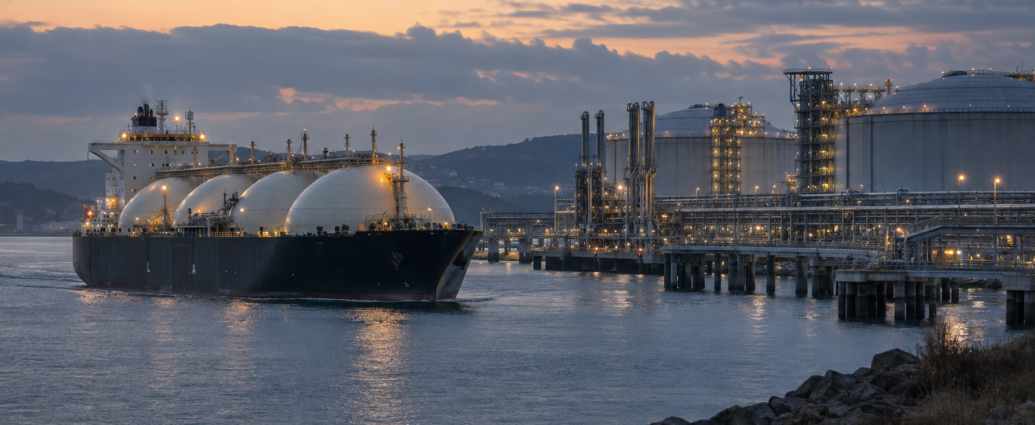
European natural-gas prices fell Tuesday as signs of possible U.S.-Iran diplomacy offered utilities and manufacturers some relief, but severely restricted Qatari shipments and unusually low storage levels kept the market far above where it traded before the Middle East supply crisis.
The benchmark Dutch TTF contract declined approximately 2.5% to €71.44 per megawatt-hour in afternoon trading. That was a smaller decline than earlier market readings suggested, showing how quickly prices were changing as traders reacted to diplomatic developments surrounding the Strait of Hormuz.
The strait is the only practical export route for Qatar, one of the world’s largest suppliers of liquefied natural gas. Unlike Saudi oil, which can reach the Red Sea through an alternative pipeline, Qatari LNG cannot be redirected around the waterway through a comparable land route.
Only a small portion of Qatar’s normal LNG supply is reaching international markets while Hormuz remains officially closed, according to Commerzbank analyst Norman Liebke. That loss has kept European gas expensive even as prices retreat from their recent highs.
Diplomatic signals provided the reason for Tuesday’s decline. President Donald Trump said he would be open to meeting Iranian President Masoud Pezeshkian during the United Nations General Assembly in New York.
A senior Iranian official subsequently said Iran could reopen the strait within seven days if Washington eased military pressure and lifted its blockade of Iranian ports. The official said Iran’s delegation had authority to resume negotiations, although no direct meeting between Trump and Pezeshkian was planned.
That means the market is reacting to a conditional proposal—not a confirmed reopening. Until ships can move through the strait normally, European buyers must continue competing for LNG cargoes from the United States and other Atlantic suppliers.
The timing is particularly difficult because Europe’s underground gas inventories are only about 68% full, approximately 16 percentage points below their five-year seasonal average. European Union storage was recently reported at a record low for this point in the year and remained well short of the bloc’s 80% target for December.
Storage functions as Europe’s winter reserve. Utilities inject gas during warmer months and withdraw it when heating demand rises. Entering winter with fewer stored supplies leaves the market more dependent on steady imports and more vulnerable to cold weather, shipping delays or additional infrastructure failures.
Europe may need roughly 16 billion cubic meters of additional LNG from the open market if Qatari shipments remain severely restricted, according to an estimate from the European Union Agency for the Cooperation of Energy Regulators. That would equal almost 5% of annual EU gas demand.
Norwegian pipeline gas remains another critical source, but planned and unplanned maintenance can temporarily reduce deliveries. Even relatively small outages matter more when storage is low and LNG supplies from the Middle East are constrained.
The pressure is already reaching government policy. French President Emmanuel Macron has asked the European Commission to postpone new methane-reporting requirements for oil and gas imports, arguing that the rules could further restrict supply during an already tight market. More than a dozen EU member states have also sought a delay or suspension.
Industrial companies face the most immediate financial consequences. Fertilizer, chemicals, glass, steel, ceramics and paper manufacturing all require large quantities of gas or electricity. Sustained prices above €70 per megawatt-hour can squeeze margins, force production cuts and make European plants less competitive against facilities operating in lower-cost energy markets.
Households may not see wholesale changes immediately because retail contracts, taxes and government protections delay the impact. Persistent high wholesale prices, however, eventually influence heating bills and the cost of products made in energy-intensive factories.
American gas producers and LNG exporters stand to benefit as Europe bids for additional cargoes. U.S. gas now supplies roughly 22% of total European demand, up from less than 5% before Russia’s invasion of Ukraine reshaped the continent’s energy system.
The same export demand can support U.S. natural-gas prices by increasing competition for domestic production, although American household bills are also determined by weather, regional pipeline capacity, storage and local utility regulation. The effect is therefore real but not automatic or uniform across the country.
Tuesday’s price remains far below the extraordinary levels reached during the 2022 energy crisis, when Dutch TTF briefly exceeded €300 per megawatt-hour. The comparison matters: Europe is facing a serious supply squeeze, but the verified data do not yet support claims that prices have returned to the worst levels of that crisis.
The next decisive development will be physical rather than diplomatic. Traders will be watching whether the United States and Iran agree on a negotiating timetable, whether the Strait of Hormuz actually reopens and whether Qatari LNG carriers resume normal departures.
Until those ships return, Tuesday’s decline offers temporary budget relief—not proof that Europe’s winter energy risk has passed.
JBizNews Desk | Brussels
© JBizNews.com. All rights reserved. This article is original reporting by JBizNews Desk. Unauthorized reproduction or redistribution is strictly prohibited.