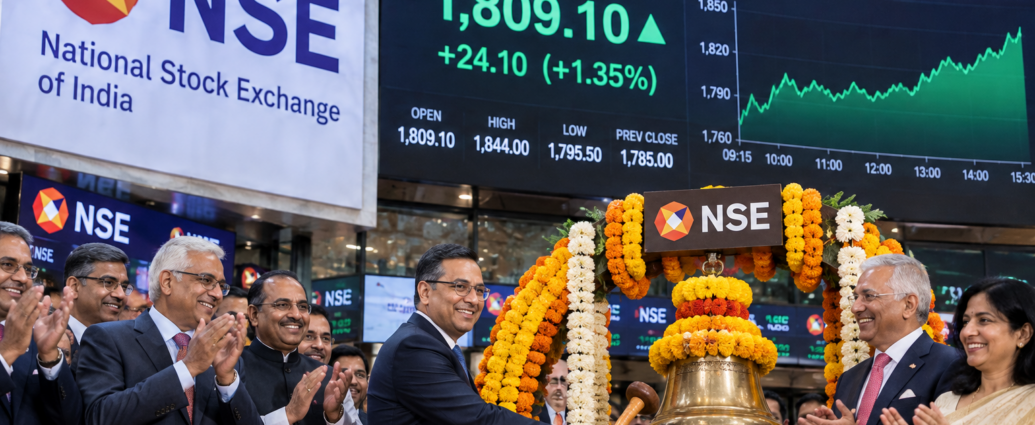
India’s largest stock exchange finally became a publicly traded company Thursday, ending a roughly decade-long wait with a modest gain in its first minutes of trading.
Shares of the National Stock Exchange of India opened at 1,809.10 rupees on rival BSE, 1.35% above their IPO price of 1,785 rupees. The stock then climbed as high as 1,844 rupees, putting it about 3.3% above the offering price in early trading.
The debut follows a ₹22,561.57 crore, or roughly $2.5 billion, initial public offering that ranks as the second-largest in Indian history.
Only Hyundai Motor India’s 2024 offering was larger.
For investors who received shares in the IPO, the opening produced a small immediate profit rather than the explosive first-day jump sometimes associated with heavily anticipated Indian listings.
What Investors Made at the Open
NSE priced its IPO at the top of its range of ₹1,700 to ₹1,785 per share.
Retail investors had to purchase a minimum lot of eight shares, requiring an investment of ₹14,280 at the final offering price.
At Thursday’s opening price, that eight-share investment was worth ₹14,472.80 — an increase of ₹192.80.
At the early high of ₹1,844, the same eight shares were worth ₹14,752, producing a paper gain of ₹472.
Those are modest returns compared with some blockbuster IPO debuts, but they still meant investors who received shares entered the public market in positive territory.
NSE Isn’t Keeping the IPO Money
One important detail separates this offering from IPOs in which companies sell new shares to finance expansion.
NSE itself isn’t receiving the ₹22,561.57 crore raised through the transaction.
The IPO consisted entirely of an offer for sale, meaning existing shareholders sold their shares to new investors rather than NSE issuing new stock. The exchange’s total number of shares therefore did not increase as a result of the offering.
Among the selling shareholders were major financial institutions and investors including State Bank of India, Canada Pension Plan Investment Board and several Indian insurance companies.
For NSE, the significance is not a new pile of cash for expansion. It is becoming a publicly traded company with shares that investors can buy and sell on the open market.
Investors Wanted More Shares Than Were Available
Demand exceeded supply.
The IPO was subscribed approximately 5.7 times, with investors bidding for about 505.8 million shares against roughly 88.6 million shares available during the public bidding process.
Institutional investors were particularly aggressive. Qualified institutional buyers subscribed for more than 12 times the shares reserved for them.
Before public bidding, NSE also allocated roughly 37.8 million shares to 189 anchor investors at ₹1,785 each, raising approximately ₹6,746 crore from that group.
Those investors included major domestic and international institutions.
Why NSE Is Such a Big Business
The excitement surrounding the IPO reflects NSE’s enormous position inside India’s financial system.
The exchange operates markets for stocks, equity derivatives, currencies, mutual funds, commodities and debt. Its broader ecosystem includes clearing, market data, indices and international trading services.
As of fiscal 2026, NSE had approximately 261 million registered investor accounts, more than 132 million unique registered investors and roughly 3,005 listed entities.
Its dominance is particularly striking in stock trading.
Reuters reported ahead of the listing that NSE controlled approximately 93% of India’s cash-equities market and about 75% of the options market.
That matters because exchanges can generate revenue from multiple parts of the same financial ecosystem — including transactions, clearing, data and index-related businesses.
A Decade-Long Wait Ends
Thursday’s listing also closes one of the longest-running IPO stories in India’s financial sector.
NSE’s effort to become publicly traded stretched for roughly a decade and encountered regulatory and legal complications along the way.
Its rival BSE reached the public markets much earlier, listing in 2017.
NSE’s eventual IPO was dramatically larger.
At approximately ₹22,562 crore, the offering became India’s second-largest IPO ever and attracted about ₹90,000 crore worth of bids from investors.
The listing also creates an unusual situation: India’s dominant stock exchange is trading on one of its principal competitors.
NSE shares made their debut on BSE, rather than NSE’s own trading platform.
Why This Matters Beyond India
The IPO gives investors direct exposure to one of the institutions at the center of India’s rapidly expanding capital markets.
India has experienced enormous growth in individual stock-market participation, while domestic institutions and foreign investors continue pouring money into its markets.
NSE sits in the middle of much of that activity.
But its dominance does not eliminate risk.
Regulatory changes affecting derivatives trading are particularly important because options have been a major source of NSE’s transaction revenue. Recent tightening of India’s derivatives rules has already raised questions about future trading volumes and earnings growth.
That makes Thursday’s opening price only the beginning of the story.
After waiting roughly a decade to reach the public market, NSE will now face the same test as every other listed company: convincing shareholders that its future earnings justify what they are paying for the stock.
Its first day started with a gain.
Whether India’s extraordinary expansion in stock-market participation can translate into sustained returns for NSE’s new shareholders will be determined well beyond opening day.
JBizNews Desk | Mumbai
© JBizNews.com All Rights Reserved. Reproduction or distribution without written permission is prohibited.