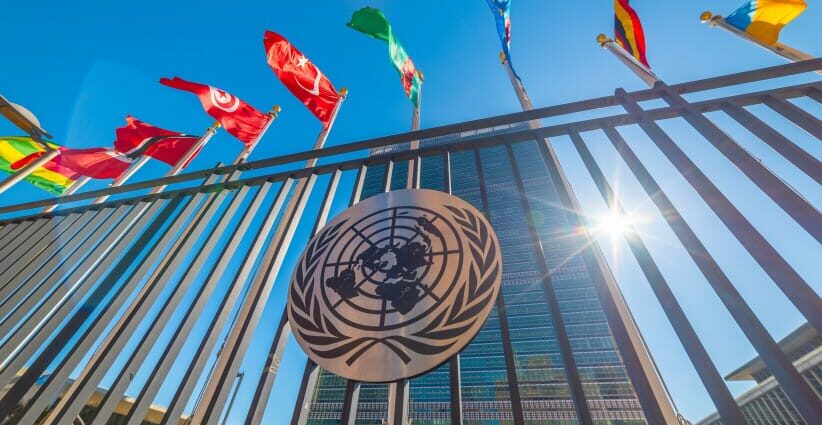
Prime Minister Benjamin Netanyahu’s speech at the UN reflected Israel’s growing isolation on the international stage, an isolation embraced and even claimed by a prime minister campaigning for reelection and prepared to do whatever it takes to remain in power.
Netanyahu’s visit to New York for the United Nations General Assembly was a succession of rebuffs and humiliations. Even before his trip, the images of US President Donald Trump and New York City Mayor Zohran Mamdani chatting and smiling together must have sent him into a rage, while Trump did not deign to receive him and has made New York’s mayor his personal enemy.
Israel’s isolation was further illustrated by Netanyahu’s rather pathetic public-relations efforts, posing with broad smiles alongside the leaders of Greece and Slovenia, the only ones, apart from Argentina’s President Javier Milei, who agreed to meet with him during his visit.
This isolation was most visible in the UN chamber during Netanyahu’s speech, when delegations left en masse – a theatrical and hypocritical gesture given the actions of other leaders whose countries have never faced condemnation at the UN but nevertheless deserved better than the prime minister’s childish reaction.
He proceeded to harangue the few delegations still present, challenging them to leave the room in a defiant and ridiculous provocation utterly unworthy of the diplomatic stakes facing Israel.
One scene perfectly illustrated the grotesque nature of his approach: Someone from the Israeli delegation was seen pointing out all those who were absent, like a schoolteacher taking attendance and threatening to report the absentees to the principal.
In Netanyahu’s case, however, the usual “principal,” the United States, is conspicuously absent, because of both its president’s incompetence and the considerable deterioration of Israel’s image in the US, for which the Israeli prime minister bears significant responsibility.
Believing himself to be at a Likud campaign rally, Netanyahu pulled out a beeper to boast about the operation against Hezbollah, like a child proudly showing off his latest gadget. He accused Mamdani of the worst possible offenses, as though the UN chamber were an appropriate venue for campaign rhetoric.
He also turned the accusation of colonialism, absurdly directed at Israel, back against France and the United Kingdom, which are today the two primary targets of his government, in a childish exercise of counter-accusation.
Whereas David Ben-Gurion spoke of integrating Israel into the community of nations in Israel’s declaration of independence, Netanyahu spoke of Israel as a self-sufficient Sparta confronted by a hostile world.
He is methodically working to make that vision a reality, actively reinforced by others, to the dismay of the country’s historic friends and the delight of its enemies.
Netanyahu has embraced the maxim, “If these mysteries are beyond us, let us pretend that we are the ones orchestrating them,” claiming this pariah status for himself, presenting it to Israeli voters as proof of strength, and telling them that the goal is not to escape it but to take pride in it – with him at the helm of the country to confront it.
‘A people that dwells alone’
In his 1992 inaugural address, prime minister Yitzhak Rabin said: “No longer are we necessarily ‘a people that dwells alone,’ and no longer is it true that ‘the whole world is against us.’ We must overcome the sense of isolation that has held us in its thrall for almost half a century.”
Three years later, he was assassinated by an Israeli extremist. Thirty years on, and without denying the sometimes-intractable nature of hatred toward Israel, which cannot be explained by its policies alone, the man who had fanned the flames of verbal violence against Rabin is now prime minister.
He is also the self-proclaimed self-fulfilling prophet, at least partly responsible for the very isolation of Israel that his predecessor sought to overcome. The October 27 election will therefore also be a choice between these two radically different visions.
Born and raised in France, the writer is the correspondent of French Jewish radio, Radio J, and of the French paper librejournal.fr in the US, where he has been living for 16 years. He is a contributor to the European review K. He also holds US and Israeli citizenships. His opinions are his only.