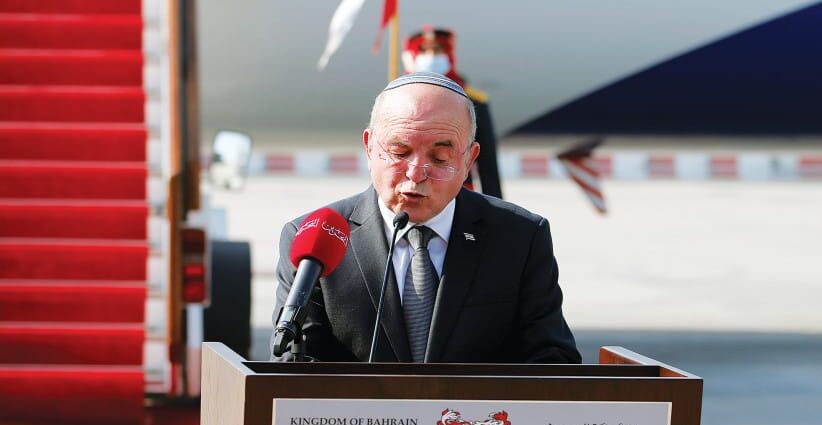
Former national security council head Meir Ben-Shabbat warned that mounting pressure on Iran could still push Tehran toward a direct attack on Israel, while arguing that a future agreement between Washington and Tehran could provide the Iranian regime with a strategic lifeline, he told Maariv in a Wednesday interview.
Ben-Shabbat, who was among the architects of the Abraham Accords, said the Iranian regime remained under severe pressure but had not yet reached a point of desperation.
“First, regarding Iran’s situation: despite the challenging reality it faces, the impression is that the regime in Tehran still does not have its back against the wall. In medical terms, its condition is serious but not critical.
The Iranians are probably counting on the American willingness to reach an agreement, continue to exist, and save them if they reach the edge of the abyss. In any event, Israel must always be prepared on the assumption that at a certain point in time, which will not necessarily be possible to predict, Iran will consider attacking it,” he said.
Ben-Shabbat also warned that a US agreement with Iran could have serious strategic consequences regardless of whether it formally restricted Israel’s freedom of action.
“Israel’s freedom of action to defend itself against an existential threat is a matter about which there is no dispute. The consequences of an agreement with Iran are very severe even if they do not have an effect on Israel’s freedom of action,” he said.
“Any agreement with the Iranians, even if it meets the parameters set by the American administration, will ultimately be a lifeline for the regime in Tehran; it will finance its recovery and preserve the dangers from it.”
“This clear and unequivocal position was voiced a few days ago by Gen. Jack Keane, who served as vice chief of staff of the US Army and received the Presidential Medal from Trump. He precisely defined the strategic trap placed before the American president and recommended making the creation of conditions that put the Iranian regime on a path to collapse a goal. Any additional word is unnecessary.”
Iran has been waging a campaign against Europe ‘for some time’
Asked whether an attempted attack on RAF Fairford, if linked to Iran or one of its proxies, would indicate that Tehran was expanding its campaign against the West into Europe, Ben-Shabbat said Iran had already been waging such a campaign for some time.
“Iran has been waging a campaign against Europe for some time. I remind you that Iran has already attacked European bases: Iranian UAVs, apparently launched from Lebanon by Hezbollah, directly struck the British Air Force base at Akrotiri in Cyprus.
“The confrontation between Iran and European countries is admittedly not being conducted as a frontal conventional war, but it certainly exists as a multidimensional hybrid campaign combining warfare in the ‘gray zone,’ terrorism through proxies, cyberattacks, and economic influence. German Chancellor Friedrich Merz said in June 2025 that Israel ‘is doing the dirty work for all of us’ in reference to the campaign against Iran. He was right then, and his words are also correct today.”
Asked whether Israelis and Jews abroad should prepare for an increase in attempts to target them amid rising pressure on Iran, Ben-Shabbat replied: “The system and the citizens must assume so.”
Netanyahu’s visit to the UAE tightens important relationship
Ben-Shabbat also addressed Prime Minister Benjamin Netanyahu’s reported secret visit to the United Arab Emirates, saying coordination with Abu Dhabi was particularly important given the possibility of either military escalation with Iran or a diplomatic agreement.
“I remind you that we are in the midst of the confrontation with Iran, with on the one hand – a possibility of military escalation, and on the other hand – a possibility of a diplomatic arrangement. A common position and alignment by Israel and the Emirates are things that require discussion and coordination.”
On the possibility of expanding the Abraham Accords, including through Saudi normalization, Ben-Shabbat said the current regional uncertainty reduced the chances of a breakthrough.
“In general, the chances of this during periods of uncertainty, election campaigns or fighting, are not high. Israel’s value as a security and technological-economic partner is clear. Israeli’s interest in expanding the agreements is clear, but it must come from Israeli strength. Under no circumstances should we court them or pay compensation.”
When will the Hezbollah conflict be over?
Turning to Lebanon, Ben-Shabbat said Hezbollah had suffered a strategic blow but that the campaign against the group was far from over.
“The pager operation and the Israeli attack that followed it two years ago were a turning point in the war between Israel and Hezbollah, which led to the elimination of the person who had ruled southern Lebanon and the Shi’ite terrorist organization for 40 years, cut off Iran’s strongest and most important proxy arm that it had in the region, enabled the collapse of the Assad regime and the shattering of the perception of Syria as Iran’s backyard, and created significant shock waves in the Middle East.
“Above and below the surface, the signs of the change that occurred can be seen in every field: Hezbollah lost the control it had over the territory and the line of villages along the border with Israel, it also lost commanders, fighters, infrastructure, and strategic assets; and beyond that, its status in the Lebanese arena.
“Naim Qassem is finding it difficult to step into Nasrallah’s shoes and fill the military, political, or social vacuum he left behind. Lebanese voices expressing deep frustration over the heavy price of Hezbollah’s war, which is not necessarily Lebanon’s war, are growing, and alongside all of these – the Lebanese government, despite its weakness, is trying to establish a new order.
“The Lebanese-American researcher and commentator Hussein Abd al-Hussein determined in an article he published recently that Hezbollah suffered a strategic defeat but refuses to acknowledge it. From Israel’s point of view, these are significant achievements, but the work is not complete and it is too early for summaries.
“All the players in the system understand that the way Iran emerges from the current confrontation will directly shape Hezbollah’s power, status, and future policy. Therefore, Israel must tighten its control over the areas it has defined, maintain a continuous offensive initiative, block every attempt at renewed force buildup, and not ease the pressure on the enemy’s throat for even a moment.”
Israel continues to strive to destroy Hamas
Ben-Shabbat rejected the idea that Israel had shifted from seeking to destroy Hamas to merely weakening the organization.
“I am not aware of a change in the goals of the war regarding Gaza, and in my opinion there is no room for such a change. Determination, patience, and persistence are the key to success. Israel must complete the task until the military and governing capabilities of the Hamas organization in the Strip are completely eliminated, the territory is completely demilitarized, and there is Israeli security control.
“From the perspective of the State of Israel, it is not enough to settle only for removing the security threat; it should have an interest in the area in which the cruel monster that carried out the October 7 massacre grew, becoming eternal testimony to the prices that anyone who thinks in the future about attacking Israel will pay.”
Asked about European measures targeting goods from the West Bank, east Jerusalem, and the Golan Heights, and their possible economic impact on Palestinians, Ben-Shabbat said he did not have the exact figures but accused some international actors of prioritizing pressure on Israeli settlements over Palestinian economic welfare.
“I am not familiar with the precise economic data, but among some of the players in the international system, the desire to harm the settlement enterprise in Judea and Samaria outweighs the interest in ensuring the economic well-being of the Palestinians there. This is another expression of the double standard and hypocrisy on their part.”
Turkey: A growing power in the Middle East
Ben-Shabbat also focused on Turkey, which he described as a growing regional power taking advantage of changes in Syria, Africa, and the eastern Mediterranean.
“The Greek defense minister, Nikos Dendias, said a few months ago: ‘If we ask the United States and Turkey how they see the future of the world and the region in ten years, we will receive two completely opposite answers – and that is the whole story.’ His words capture the abyss between the American vision and Erdogan’s ambitions for the Middle East and the international system.
“More than any other country, Turkey knows how to exploit global great-power competition and the changes in the Middle East in order to establish its status as a dominant regional power. It dances at every wedding and collects diplomatic brokerage fees from all the players. Following the collapse of the Assad regime and the forced withdrawal of the Iranian military presence, Turkey became the dominant player in Syria. From local territorial control in northern Syria, it moved to exercising broad influence across the entire country.
“Syria is only part of Erdogan’s broader vision of ‘neo-Ottomanism.’ He seeks to restore Turkey to the status of a regional superpower and expand its influence far beyond its official borders. The implementation of this concept was recently evident in the signing of the ‘Mecca Joint Defense Agreement’ with Saudi Arabia and Pakistan, but even before that, in its efforts to open intercontinental trade corridors, in its deep involvement in Africa, and in the adoption of the ‘Blue Homeland’ doctrine (Mavi Vatan), which expresses its ambitions in the eastern Mediterranean.
“When these trends are added to Erdogan’s overt hostility toward Israel, it is difficult to ignore the potential for friction and strategic confrontation with him, and this is even without mentioning the Palestinian issue and his support for Hamas. Turkey continues today as well to host senior members of the Hamas leadership on its territory and is conducting a legal and information campaign accusing Israel of war crimes.
“And despite all this, Turkey is not Iran: it is a member of NATO, Erdogan has a close relationship with Trump, and relations with Israel, despite the deep crisis, are still not severed. Precisely in order to prevent this rivalry from turning into a military confrontation, Israel acted correctly when it clarified its red lines in Syria and in general.
“In addition, Israel is also acting correctly when it deepens and expands its security relations with Greece and Cyprus, and also when it enters Africa, into strategic areas that Turkey has its eyes on. In my opinion, beyond all these actions, Israel needs to lead an international move to declare the global Muslim Brotherhood organization an illegal organization, and it must also act systematically to push the Turks out of operating in Jerusalem or in connection with it. With determination, but not necessarily demonstratively.”