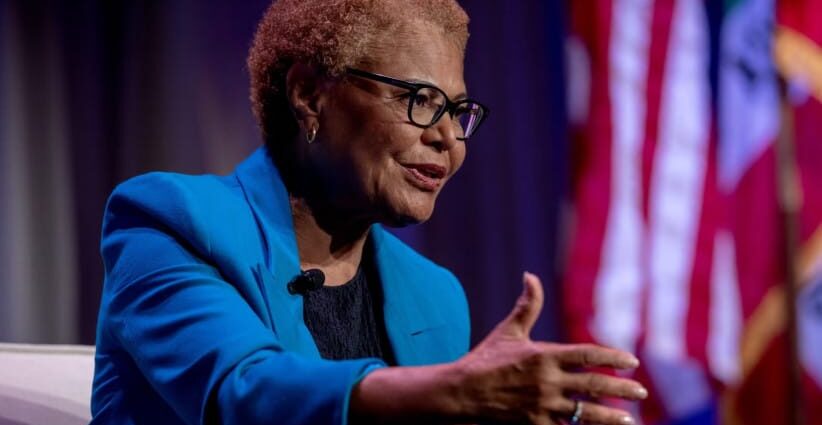
Mayoral candidates grappled with the use of the word “genocide” to describe the Gaza war and how Israel’s foreign policy intersects with domestic issues as they vied Tuesday night for votes at an event organized by the Jewish community.
City Council member Nithya Raman told the packed audience at the Skirball Cultural Center that she understood that the word “genocide” was painful to many Jewish people.
“I understand its historical context and the weight of that historical context for the world, not just for the room but for the entire world,” said Raman, who is a member of the Democratic Socialists of America, a group that has campaigned for candidates who are strongly critical of Israel.
“I used it because other experts have used it to describe what’s happening and because I felt compelled to speak out about issues that we saw, the images that are coming, the targeting of hospitals, the deaths of children.” Israel denies deliberately targeting hospitals, and rejects the charge of genocide.
With mail-in ballots headed to voters this week and the Nov. 3 runoff election approaching, the forum gave Jewish voters a chance to hear directly from Raman and her Democratic incumbent opponent Karen Bass. California has a “jungle primary” system, in which the top two candidates in the primary – whatever their party – advance to the runoff, which means Democrats frequently face off in the general election.
Candidates further discuss homelessness, disaster preparedness, social safety net
Alongside issues like Jewish safety, antisemitism, and Israel, the candidates also spoke of their views on homelessness, disaster preparedness, and the city’s strained social safety net.
Raman is vying to unseat Bass, a Democrat who has led America’s second-largest city since 2022. A recent poll showed Raman leading Bass by 11 points, though roughly a third of voters remain undecided.
The forum – organized by the Jewish Federation Los Angeles – featured back-to-back 45-minute conversations between each candidate and the local journalist Alex Cohen. About 1,000 people attended the event, which was also livestreamed.
The sharpest exchanges centered on Israel and antisemitism. Raman, as she has in the past, called the war in Gaza a genocide. Bass said she rejected that characterization.
When asked to define genocide, Raman said she was “not an expert on those issues,” but added that she had relied on genocide scholars, including Israeli scholars, who have used the term.
Raman, interviewed first, was asked about her characterization of Israel’s actions and her appearance on left-wing streamer Hasan Piker’s show. Piker has been a vocal critic of Israel and has made derogatory statements about the country, such as calling it “Jewish ISIS.”
Raman said political candidates need to reach voters wherever they are, noting that Piker’s audience includes many young Angelenos.
Raman went on to discuss her response to the Oct. 7, 2023, Hamas attack on Israel, saying she was the first person at LA City Hall to condemn what happened. Raman said she wants Jewish and Israeli-American residents to feel safe in Los Angeles. Los Angeles is believed to have the largest Israeli-American population in the country.
“This city deserves to feel safe for every single resident,” said Raman, who represents Council District 4, which includes neighborhoods such as Silver Lake and Los Feliz as well as portions of the San Fernando Valley, one of Los Angeles’ major Jewish population centers.
Asked about Boycott, Divestment and Sanctions, a protest movement targeting Israel’s economy, Raman said, “I think boycott, divestment and sanctions, the BDS movement, is a legitimate form of peaceful protest. I support people’s ability to protest,” and she cited the First Amendment.
Bass, when asked what she would do if an Israel sanctions policy came before the City Council, said, “the pencil would hit,” an apparent reference to a veto.
Asked if she thought Israel’s actions in Gaza constituted genocide, Bass said, “No, I don’t.” But she also emphasized the limits of the mayor’s role in international affairs. “When I think of foreign affairs, especially conflicts, my focus is on how they impact the city of LA,” she said, adding that her responsibility as mayor is to keep Angelenos safe.
She also referenced her personal connections to Los Angeles’ Jewish community, noting that growing up she attended public schools alongside many Jewish peers, where she encountered her friends’ Holocaust survivor parents and grandparents with numbers tattooed on their arms.
Mayoral candidates discuss antisemitism, Jewish communal security
The candidates also addressed antisemitism and Jewish communal security.
Bass said Los Angeles does not have enough police officers and described public safety as “the No. 1 issue” she must address as mayor. She said her administration has pursued LAPD recruitment while also expanding alternative responses for situations that do not require armed officers.
Asked specifically about implementing California’s new Safe Worship Zone Act, which bars protests within 100 feet of religious institutions, Bass said she would convene the city’s working group on Jewish community safety and its interfaith council, then work with LAPD to determine how to implement it. Much of the organized Jewish community began advocating for the state law after a pro-Palestinian protest targeted Los Angeles’ Wilshire Boulevard Temple, while children were on campus.
Bass said her administration had already called for increased patrols and security around Jewish holidays and community events. Raman similarly condemned the rise in antisemitism, including in her own district, and said antisemitic hatred comes from “every side of the political spectrum.”
Raman said, “As a progressive elected representative, as someone who’s more on the leftward side of the spectrum, I never want progressive politics to be conflated with antisemitism.”
Throughout her 45-minute conversation, Raman repeatedly sought to shift the discussion toward local issues, including housing, homelessness and disaster response.
Bass devoted much of her time to those same issues, including lessons from the January 2025 Palisades wildfire and the need for better disaster prevention. She called the fire one of the worst moments she had experienced and said the city of Los Angeles and Los Angeles County had not been adequately prepared for the extreme weather event. Bass was out of town when the fire started, and her initial response to it has drawn widespread criticism.
She also acknowledged shortcomings in her administration’s handling of homelessness, saying she entered office knowing the system was dysfunctional but did not realize “how profoundly dysfunctional” it was. She said she now supports making the city more independent from the county on homeless services.
Rabbi Noah Farkas, president and CEO of Jewish Federation Los Angeles, said the forum “gave attendees a deeper understanding of where the candidates stand on key priorities facing our city and community,” and “will help them make the most informed choice at the ballot box on Nov. 3.”
Los Angeles is home to the nation’s second-largest Jewish community, with about 600,000 Jews residing in the metro area. The local Jewish federation organized Tuesday’s forum in partnership with Skirball and the local branches of the American Jewish Committee, the Anti-Defamation League, and Jewish Family Service.