Denver’s sports franchises are no longer just building venues – they are building neighborhoods. That was the takeaway from a walking tour as part of the CREDA Conference that explored how these districts are reshaping the city’s urban core.
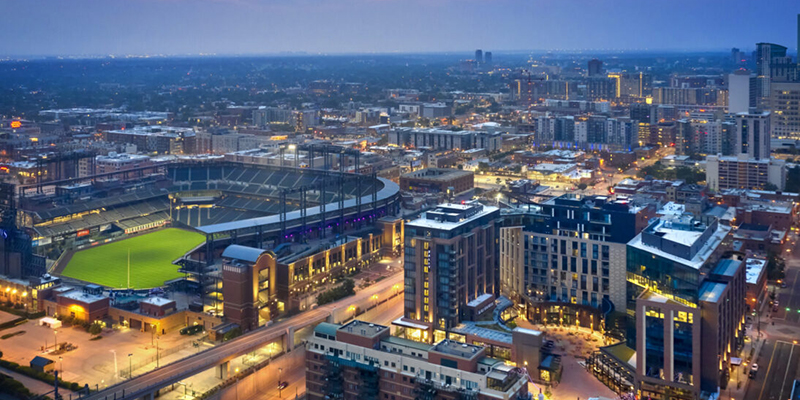
The tour began with a walk through McGregor Square, a vibrant mixed-use development across from Coors Field. Opened in 2021, it includes The Rally Hotel, 103 for-sale condominiums, an 11-story office building and ground-floor restaurants and retail arranged around a 17,000-square-foot plaza. The plaza’s stadium-sized LED screen anchors watch parties (televised World Cup games brought 2,000-plus attendees on multiple occasions), concerts and seasonal ice skating.
A panel discussion followed, moderated by Matthew Breest, principal, Populous, with Damani Leech, president, Denver Broncos; Matt Mahoney, senior vice president of development, Kroenke Sports & Entertainment; and Brian Mirakian, senior principal, Populous.
Two Districts, Two Starting Points
The Broncos are planning a stadium district at Burnham Yard, about a mile from their current stadium and still in the urban core. Full build-out will total about 4 million square feet, roughly 60% of it housing, with office, retail and entertainment making up the rest. About 58 acres of the site is a former rail yard that includes a 140,000-square-foot locomotive shop.
Leech said the team wanted to control the fan experience outside the stadium for its 10 home games and roughly 15 other major events each year – and saw a better use for the land. “A 50-acre parking lot throws off a little bit of cash, but not that much,” he said.
The Kroenke team is building around an established venue. Ball Arena and the adjacent River Mile together cover about 130 acres downtown, and the company has committed to keeping the Nuggets (NBA) and Avalanche (NHL) at Ball Arena through 2050. A $140 million arena renovation is the first step. The initial phase of surrounding development calls for a 5,000-seat performance venue, a 300-key hotel, about 190 apartments and potentially a 145,000-square-foot office building – “our version of McGregor Square,” Mahoney said.
Programming the Everyday
Mirakian, whose firm has designed 23 major league ballparks, said few of its current projects are separate from the overall district strategy. “For most of these ownership groups, the vast majority, actually, the revenue is going to come from the district over the [sports] anchor itself,” he said.
That revenue depends on year-round programming. Working with the Chicago Cubs, Mirakian said, the firm learned that the most important activation “oftentimes is … the Wednesday afternoon, the Thursday morning” – yoga in the park, summer concerts, holiday markets.
Transit and open space also matter. Mahoney noted that the Ball Arena plan includes a three-acre park and two light rail stations on the property, and that the Broncos site will have a Front Range rail stop. Each district also aims to open access to the South Platte River. “Denver has an incredible asset with the South Platte River, and we’ve never embraced it,” he said.
A Neighborhood First
Both executives said their districts must succeed on days without games. “This neighborhood has to stand on its own,” Leech said.
Mahoney applies a simple test to his master plans: covering the arena and asking whether it’s a neighborhood he would live in.
Community input shaped both projects. Mahoney said residents asked for a range of housing types and price points, as well as job opportunities. Leech described two community meetings – one filled with Broncos fans in orange and blue, the other with neighbors focused on construction impacts, light rail access and connections to the river. “All things that have nothing to do with touchdowns,” he said.
That commitment to the neighborhood reflects a long-term view held by both ownership groups. “It’s forever holds. It’s not a build and sell perspective,” Mahoney said. Leech noted that Broncos home games can bring four generations of the ownership family together in one suite, while Mahoney said Josh Kroenke joins every planning meeting, preparing to see the project “to the finish line and beyond.”

This post is brought to you by JLL, the social media and conference blog sponsor of the CREDA Conference 2026. Learn more about JLL at www.us.jll.com or www.jll.ca.
The post Beyond Game Day: How Denver’s Sports Districts Are Building Neighborhoods appeared first on Market Share.