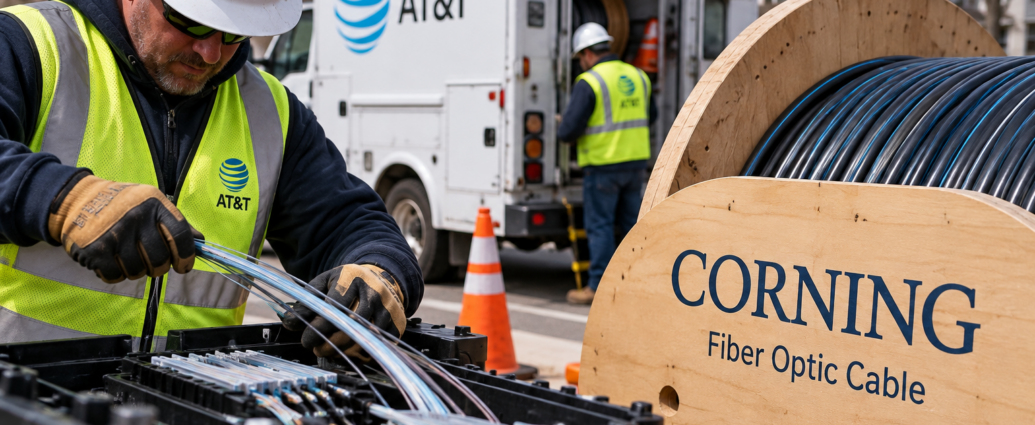
Telecom giant secures American-made fiber and cable as internet usage surges and AI puts new pressure on network infrastructure
DALLAS — AT&T is locking in billions of dollars worth of fiber-optic cable as Americans consume more data and the artificial intelligence boom creates new competition for the infrastructure that carries it.
AT&T and Corning have signed a multi-year agreement valued at more than $3 billion that will have Corning supply the fiber and cable AT&T needs to continue expanding its high-speed internet network across the United States.
The companies announced the agreement Sept. 29. Corning will manufacture the products in the United States, while AT&T technicians will use them to connect additional homes, businesses and communities.
For consumers, the deal ultimately comes down to something simple: Americans are using dramatically more internet than they did a decade ago.
One Terabyte a Month — and Rising
The average AT&T Fiber household now consumes more than 1 terabyte of data every month, about five times as much as in 2016.
AT&T expects monthly consumption to reach roughly 2 to 2.5 terabytes by 2030 as streaming, gaming, video calls, cloud computing, connected cameras and artificial intelligence become an even larger part of everyday life.
That creates an enormous infrastructure challenge.
Fiber-optic networks transmit information using pulses of light through extremely thin strands of glass. Unlike older copper infrastructure, fiber networks are designed to handle enormous amounts of data at high speeds and over long distances.
AT&T says its fiber service can offer maximum advertised speeds about three times those of satellite services.
The company wants that capacity available to far more Americans.
AT&T has set a goal of reaching 60 million fiber locations by the end of 2030. Its investor-relations data currently shows about 38.6 million consumer and business locations reached with fiber, illustrating the scale of construction still ahead.
AI Is Making Fiber More Valuable
The timing of the Corning agreement is particularly important because AT&T is not the only company that wants fiber.
Artificial intelligence is driving massive investment in data centers filled with thousands of powerful computer chips. Connecting those facilities requires huge amounts of high-capacity network infrastructure.
That is putting pressure on the physical materials needed to construct those networks.
Corning itself has said AI infrastructure growth is accelerating demand for fiber-optic cable and increasing pressure on supplies needed for new network construction.
Other telecommunications companies are moving to secure supplies as well.
Verizon signed its own multi-billion-dollar agreement with Corning in September covering more than 80 million miles of high-density optical fiber and connectivity products from 2027 through 2032, intended both for broadband expansion and infrastructure serving generative AI computing.
For AT&T, a long-term agreement gives the company greater certainty that it will have the physical cable needed to keep building while demand across the technology industry accelerates.
Billions Going Into American Infrastructure
The agreement also carries a U.S. manufacturing component.
Corning will produce the fiber and cable through its American operations, including manufacturing facilities in North Carolina. AT&T says its technicians — part of what the company describes as the industry’s largest union-represented workforce — will build and maintain the networks.
Corning Chairman and CEO Wendell Weeks said combining the company’s U.S. manufacturing base with AT&T’s network expansion could support thousands of skilled jobs while strengthening domestic supply chains.
The deal fits into a much larger investment plan.
AT&T has committed more than $250 billion over five years toward U.S. connectivity infrastructure. The company also said the financial impact of its agreement with Corning was already reflected in the outlook and capital-allocation plan it provided investors with its second-quarter results.
Fiber, Wireless and Satellite
AT&T’s longer-term strategy does not rely on fiber alone.
The company sees fiber as the high-capacity foundation for homes and businesses, wireless networks as the connection people carry with them, and satellite technology as a way of reaching particularly remote areas.
AT&T estimates satellite connectivity will complement those networks in roughly 2% of remote locations where fiber and wireless service may not be available.
The result is an infrastructure race increasingly shaped by two forces happening at the same time.
American households are consuming far more data, while AI companies are building enormous computing systems that require still more network capacity.
For AT&T, securing more than $3 billion worth of fiber from Corning is a bet that both trends have much further to run.
And for consumers, the physical result should eventually be visible much closer to home: more fiber running through neighborhoods and more households gaining access to high-speed broadband.
JBizNews Desk | Dallas
© JBizNews.com All Rights Reserved. Reproduction or distribution without written permission is prohibited.