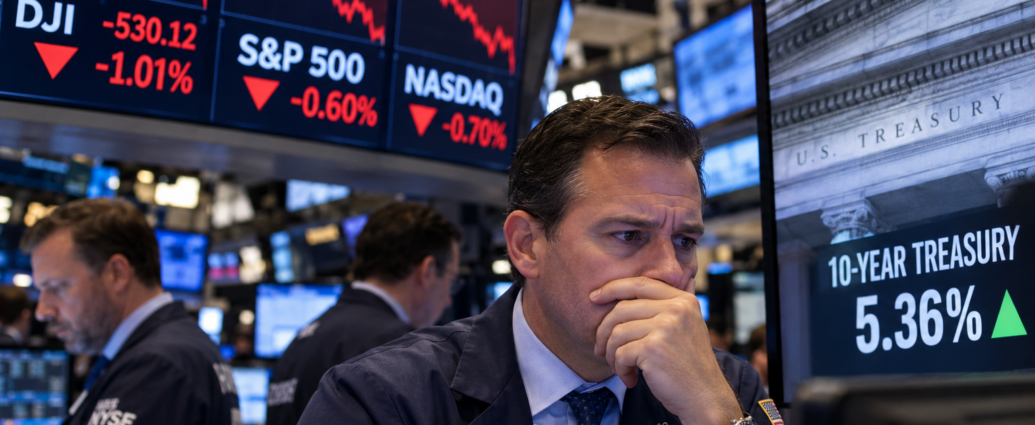
The interest rate the U.S. government pays to borrow money for 10 years hit its highest level since April 2002 on Wednesday, and stocks slid from record highs as investors bet that rising prices will keep pushing borrowing costs up.
The 10-year Treasury yield climbed as high as 5.36% in morning trading before easing back to around 5.31%. The 30-year yield touched 5.73%, its highest since May 2002. By late morning, the Dow Jones Industrial Average was down about 530 points, or roughly 1%. The S&P 500 fell 0.6% and the Nasdaq Composite slipped 0.7%, one day after both closed at all-time highs.
Here is what is happening in plain terms. When investors expect prices to keep rising, they demand more interest before lending money to Washington, because every dollar they get paid back later will buy less. That extra interest is the yield. Treasury yields are the starting point for mortgages, car loans, credit cards and business loans, so when they jump, borrowing gets more expensive for nearly everyone.
Oil is the biggest reason for the inflation worry right now. Brent crude, the global benchmark, moved back above $101 a barrel and pushed toward $102, while U.S. crude traded close to $90. Prices climbed after a fresh wave of attacks on ships in the Strait of Hormuz tied to the ongoing U.S.-Iran conflict. Closer to home, a tropical storm is heading for the Gulf Coast and could make landfall as a hurricane by Friday. Chevron is pulling nonessential workers off its Gulf of Mexico platforms ahead of the storm, which puts American offshore oil production at risk.
Higher oil means higher prices for gasoline, diesel and trucking, and those costs show up in everything from groceries to delivered packages. That is exactly the kind of inflation bond investors are bracing for.
The clearest hit to American households is in home loans. The average 30-year fixed mortgage rate stood at 7.28% as of Oct. 1, according to Freddie Mac, up from 7.03% a week earlier and 6.34% a year ago. Rates crossed 7% in late September for the first time since January 2025. On a $300,000 loan, the gap between last year’s rate and today’s comes to about $188 more every month, or roughly $2,250 more a year, for the exact same house. With the 10-year yield climbing again this week, buyers are unlikely to see relief in the next weekly reading.
Stocks feel the squeeze in two ways. First, when safe government bonds pay more than 5%, investors have less reason to take risks in the stock market. Second, companies pay more to borrow, which eats into profits. Smaller companies, which lean more heavily on loans, fell hardest Wednesday, with the Russell 2000 index of small stocks down about 1.3%.
The recent run to record highs has also been narrow. Nvidia, Apple and Microsoft together make up about 1 of every 5 dollars in the S&P 500, meaning a handful of giant tech names have been carrying the market while rising rates weigh on everyone else.
The main tool being used against inflation is the Federal Reserve. The Fed raised its benchmark interest rate by a quarter point at its Sept. 15-16 meeting. Fed Chairman Kevin Warsh framed the move as pulling back some support from the economy at a time when inflation had stalled above the Fed’s 2% target. Raising rates makes borrowing costlier, which slows spending and is meant to cool prices over time.
Investors are now waiting for the minutes from that September meeting, which the Fed is releasing at 2 p.m. Eastern today. The notes will show whether officials see September as a one-time move or the start of more hikes. As of Tuesday, traders saw roughly a 1 in 5 chance of another increase at the Fed’s October meeting. Some Fed officials have sounded less aggressive since last week, when the Fed’s preferred inflation gauge and the monthly jobs report both came in softer than expected.
The bond market also faces two big tests this week. The Treasury is selling $39 billion in 10-year notes today and will auction 30-year bonds on Thursday. In simple terms, the government is asking investors to lend it more money. If buyers show up in force, yields can ease. If demand is thin, Washington has to offer higher rates to attract lenders, and those higher rates flow straight through to mortgages and other consumer loans.
For now, the message from the bond market is clear: as long as oil stays above $100 and inflation refuses to cool, borrowing money in America is going to keep getting more expensive.
JBizNews Desk | Wall Street
© JBizNews.com All Rights Reserved. Reproduction or distribution without written permission is prohibited.