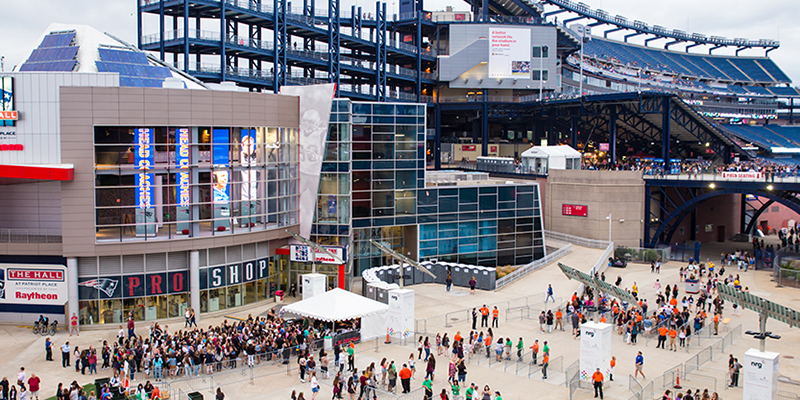
Yes, a sports venue can launch a district, but only great placemaking, strong market fundamentals and year-round activation will make a sports-anchored development succeed. Those were among the insights shared by panelists discussing the new playbook for sports-anchored development at the CREDA Conference in Denver.
Moderator Yvette Roman, founder and owner of Denver-based Ellipsis Construction, was joined by Matthew Breest, principal at global design firm Populous, where he co-leads the venue-anchored mixed-use group, and David Cannon, executive vice president of commercial real estate at Larry H. Miller Real Estate.
Larry H. Miller Real Estate is focused on three mixed-use districts in the Salt Lake City market. The first is the Power District, a roughly 100-acre brownfield redevelopment project that the company hopes will eventually become home to an expansion Major League Baseball franchise. The second is Jordan Commons, adjacent to the Salt Lake County Convention Center in Sandy, Utah. It serves as home to the state’s two professional soccer teams, Real Salt Lake in Major League Soccer and the Utah Royals of the National Women’s Soccer League. The third project is Downtown Daybreak, which has already hosted two seasons of Triple-A baseball with the Salt Lake Bees in an 8,000-seat ballpark. At full buildout, the district will offer 200 acres of urban-scale, mixed-use development in Salt Lake County’s highest growth corridor, with a master-planned community approved for 20,000 homes.
Populous worked on the recently opened Kai Tak Sports Park in Hong Kong, where a decommissioned municipal airport was replaced with a 50,000-seat stadium across 70 acres, with outdoor recreation “kind of pinwheeling around the stadium,” Breest said. “You have waterfront, you have park frontage, and it’s just this wonderful kind of love letter back to the city.” Populous is also in the process of delivering the new Aloha Stadium Entertainment District in Hawaii, the largest mixed-use development in the Southern Hemisphere currently underway. It involves roughly four million square feet of phased development.
Cannon and Breest shared numerous lessons learned in their work with sports-anchored developments and candidly discussed ongoing challenges. Among their insights:
The venue is the catalyst, not the product. Both panelists emphasized that a district will be judged 20 to 50 years out as a neighborhood, not a sports destination. Breest said success would mean the stadium ultimately becomes “invisible” because it resides inside the city’s most desirable neighborhood. Cannon cited the test of putting a thumb over the sports venue on a master plan and asking, “Is this still a great place that I would want to come visit with my family?” if the venue didn’t exist.
Sports can’t fix weak fundamentals. Cannon said a sports venue cannot overcome a market that is missing population growth, job growth or rents that justify new multifamily construction. “Sport venues alone can’t solve problems and change gravity. There’s got to be another story than just sport,” he said.
Plan for “low tide,” not just game day. Cannon said a district must handle thousands of people arriving and leaving at high tide on event days yet still feel inviting on a weekday afternoon. He admitted that his firm hasn’t fully solved this issue yet. To create a destination that remains active on non-game days, Breest said a district must offer “tertiary downstream attractors. Like great restaurants, these kind of things. … how do you bring families in? How do you make [the district] compact? How do you make it walkable? How do you solve for all the parking but entice people to be like, ‘I’m going to leave my car and I’m just going to be able to walk through this district.’”
Someone must own activation. Larry H. Miller Real Estate keeps one shared calendar across sports, the community association and entertainment venues, updated monthly with a 12-month rolling view. Cannon said relying on the pro sports schedule alone is inadequate, especially early on.
Open with more than the venue. Cannon’s biggest regret at Downtown Daybreak is that the ballpark, built in 14 months, opened before enough else was in place, so it felt like it was “on an island.” His advice is to sell more of the vision for the larger district from day one.
Design the public realm before the building. Breest said his team no longer jumps straight to venue design; it starts with district layout, programming and urban design, treating the stadium as a placeholder. Each site must be tailored to its own specific market and community. “Once you get the public realm and this vision set, it’s actually going to influence the greatest outcome for a ballpark or a stadium,” he said.
Community engagement starts early and never stops. Breest warned that without real buy-in, including from city council, a project faces years of delay or stoppage. Community benefits work must be authentic, he added. “Otherwise, you’re just not going to reach the full potential of the project. And you don’t want to disenfranchise people in the process.” Added Cannon, “You’ve got to share the vision and the excitement, the emotion. That’s why the renderings are so important. Those renderings are exciting. … You truly have to have a story in the market, data that says, yes, this is a net positive for our region.”
Housing and daytime population make it a real neighborhood. Daybreak’s first multifamily building puts 200 units directly overlooking the ballpark, within a plan for 5,000-plus homes and over one million square feet of commercial space. Cannon wants office to create lunch crowds that sustain restaurants. Breest tied this to affordability: If people can’t live there, they commute in and the district never becomes a 24/7 community.
Sports venues clear the way. Breest said sports projects tend to net large land assemblages, horizontal infrastructure and public-private cooperation that parcel-by-parcel development rarely achieves. “I just love that it clears the way for action and results,” he said. “All our cities need a lot of housing. All our cities need more grocery stores. They need more [child care facilities]. Sports districts pave the way to create ancillary opportunities for all those businesses.” Added Cannon, “Sports just have a way of uniting and bringing people together like nothing else.”

This post is brought to you by JLL, the social media and conference blog sponsor of the CREDA Conference 2026. Learn more about JLL at www.us.jll.com or www.jll.ca.
The post Lessons Learned from Sports-anchored Development appeared first on Market Share.