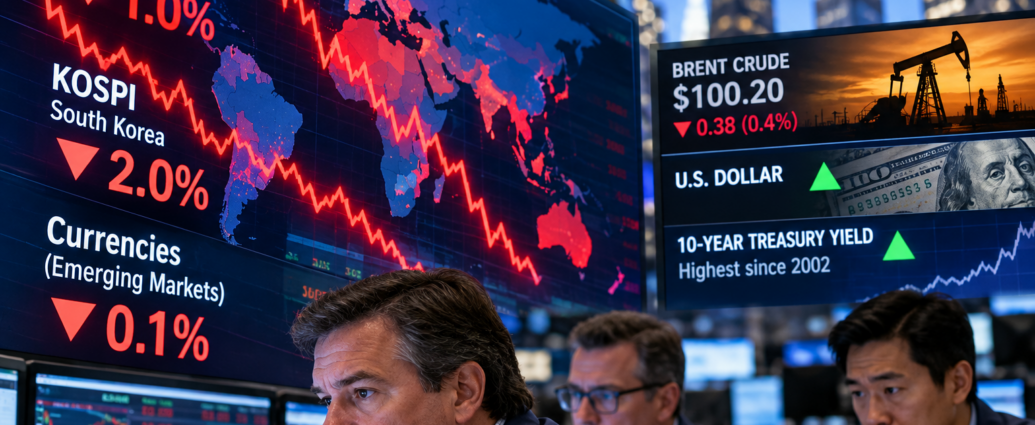
Stocks and currencies in developing countries pulled back on Wednesday, ending a short winning streak as a flare-up in the Middle East pushed oil prices higher early in the day and the U.S. dollar strengthened.
MSCI’s index of emerging-market stocks fell 1%, only its second decline in five trading days. South Korea’s Kospi index dropped 2%, its worst day so far this month. A matching index that tracks developing-nation currencies slipped 0.1%, with oil-importing countries such as Hungary leading the retreat.
Here is the simple version. Emerging markets are fast-growing economies like South Korea, India, Brazil, South Africa and Hungary. Many of them buy most of their oil from abroad and pay for it in U.S. dollars. When oil prices rise and the dollar gets stronger at the same time, those countries get hit twice: they need more dollars to buy each barrel, and each dollar costs more in their own currency.
That pressure showed up quickly. Brent crude, the global oil benchmark, climbed toward $102 a barrel in morning trading after a fresh wave of attacks on ships in the Strait of Hormuz tied to the U.S.-Iran conflict. Prices later reversed after the International Energy Agency agreed to speed up the release of emergency fuel stockpiles, and Brent settled down 38 cents at $100.20. But by then the damage to emerging-market assets had been done.
The selloff also tracked a broader move in global bonds. The yield on the 10-year U.S. Treasury hit its highest level since 2002 on Wednesday. When safe American government bonds pay more, investors have less reason to put money into riskier markets overseas, and money tends to flow back into dollars.
The pullback broke a strong run. On Monday, emerging-market stocks rose as much as 1.1%, their biggest gain in about two weeks, after softer-than-expected U.S. jobs data eased fears that the Federal Reserve would keep raising interest rates aggressively. On Tuesday, they rose again as oil slipped below $100 and bond yields eased. Brazilian assets also got a lift after a conservative sweep in the first round of the country’s presidential election, and South Africa’s rand gained 0.8% against the dollar after strong demand at a government bond sale.
The pattern has repeated for months. Each time oil climbs toward or above $100, emerging-market currencies and stocks stall, and countries that import most of their energy take the biggest hit. A weaker currency makes everything those countries buy from abroad more expensive, which pushes up inflation at home and makes it harder for their central banks to cut interest rates.
To fight back, several central banks have stepped into currency markets this year, using their reserves to buy their own currencies and slow the slide. That is the main tool they have in the short term. Over the longer run, the biggest relief would come from lower oil prices, which depend largely on whether shipping through the Strait of Hormuz keeps recovering.
For American investors, these moves matter more than they might think. Many retirement accounts and target-date funds hold a slice of emerging-market stocks for growth. South Korea alone is home to chipmaking giants such as Samsung, which sit at the center of the artificial intelligence boom. When those markets swing, so do the international funds inside millions of 401(k) plans.
There is also an upside for Americans when the dollar is strong. A stronger dollar makes foreign travel cheaper and helps hold down the cost of imported goods, from electronics to clothing, at a time when gasoline is still averaging well over $4 a gallon.
Not everyone on Wall Street sees the dollar’s strength lasting. BlackRock’s investment institute said in its latest weekly commentary that it expects the dollar to stay around current levels or weaken somewhat, and it remains overweight emerging-market stocks, meaning it holds more than a standard portfolio would. The firm said a stable or modestly weaker dollar would support that position.
What happens next likely hinges on three things: whether oil holds near $100, whether U.S. bond yields keep climbing, and what the Federal Reserve signals about further rate hikes. For now, emerging markets remain caught between strong long-term growth and short-term pressure from a war that keeps oil prices on edge.
JBizNews Desk | Wall Street
© JBizNews.com All Rights Reserved. Reproduction or distribution without written permission is prohibited.