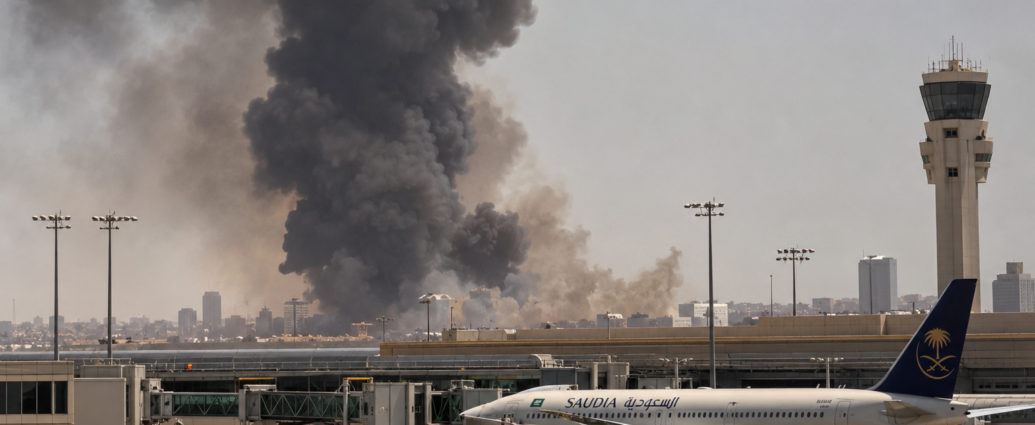
Attacks on two Saudi Arabian airports, including the main international airport in the capital, Riyadh, killed three people and injured 36 this week, Saudi aviation authorities said Wednesday, as Yemen’s Iran-backed Houthi rebels widened their campaign against the kingdom.
King Khalid International Airport in Riyadh and Abha International Airport in the country’s southwest were hit on Tuesday and Wednesday, according to Saudi Arabia’s General Authority of Civil Aviation. Both strikes caused some damage to the airports. The Houthis claimed responsibility for both attacks.
The strike on Abha killed two women who lived in Saudi Arabia, one from Morocco and one from Algeria, and injured 28 others. The attack on the Riyadh airport killed a Sudanese man and injured eight people: five Saudi citizens, two Egyptians and a Pakistani resident.
It was the second time this week the Houthis claimed to have targeted Riyadh’s main airport. A day earlier, Saudi authorities said at least three people were wounded in attacks on the airports in Jazan and Najran, two cities near the Yemeni border. In September, a large fire broke out in a fuel storage area at the Riyadh airport.
Saudi Arabia and its allies hit back quickly. Maj. Gen. Turki al-Maliki, spokesman for the Saudi-led coalition fighting the Houthis in Yemen, said its forces shot down a ballistic missile north of Riyadh and destroyed the launcher used in the attack on the capital in Yemen’s capital, Sanaa, while it was being prepared for another strike. The coalition said it destroyed 82 Houthi military targets in response to the attacks.
In plain terms, a long-running civil war inside Yemen is now spilling directly into Saudi Arabia’s biggest cities, and the Houthis are aiming at places where ordinary travelers and workers gather. The Houthis are fighting Saudi-backed government forces in Yemen and are aligned with Iran, which remains in a conflict with the United States. The group also fired missiles and drones at the airport in Aden, the seat of Yemen’s government, on Wednesday, with no casualties reported.
The attacks matter far beyond the region because of oil. Saudi Arabia is one of the world’s largest oil exporters, and Saudi Aramco, the state-controlled oil giant, has itself come under Houthi attack in recent weeks. Every strike on Saudi soil raises the risk that oil facilities, ports or shipping routes could be hit next, and traders price that risk into the cost of every barrel.
That risk showed up in markets this week. Brent crude, the global oil benchmark, settled at $100.20 a barrel on Wednesday. Analysts said attacks in the Middle East kept Brent from falling as far as U.S. crude, even as governments agreed to speed up the release of emergency oil stockpiles. Shipping through the nearby Strait of Hormuz has also faced at least nine attacks so far in October.
For American households, the connection runs straight to the gas pump. The national average for regular gasoline was $4.41 a gallon at the start of October, according to AAA, about $1.25 more than a year ago. Diesel, which powers the trucks that deliver groceries and goods, topped $6 a gallon nationally for the first time in September. As long as fighting threatens Gulf oil supplies, it will be hard for those prices to fall much.
The attacks also raise concerns for travel and business. Riyadh’s King Khalid International Airport is a major hub for international flights and for the growing number of foreign companies and workers in the kingdom. Airlines and travelers will be watching closely to see whether the strikes disrupt flight schedules or lead to new safety warnings.
For now, Saudi Arabia is relying on its air defenses to intercept incoming missiles and drones, and on strikes inside Yemen to destroy launch sites before they can be used again. Whether that is enough to stop the attacks, or whether the fighting pulls the kingdom deeper into the wider conflict with Iran, will shape oil markets and fuel prices in the weeks ahead.
JBizNews Desk | Riyadh
© JBizNews.com All Rights Reserved. Reproduction or distribution without written permission is prohibited.