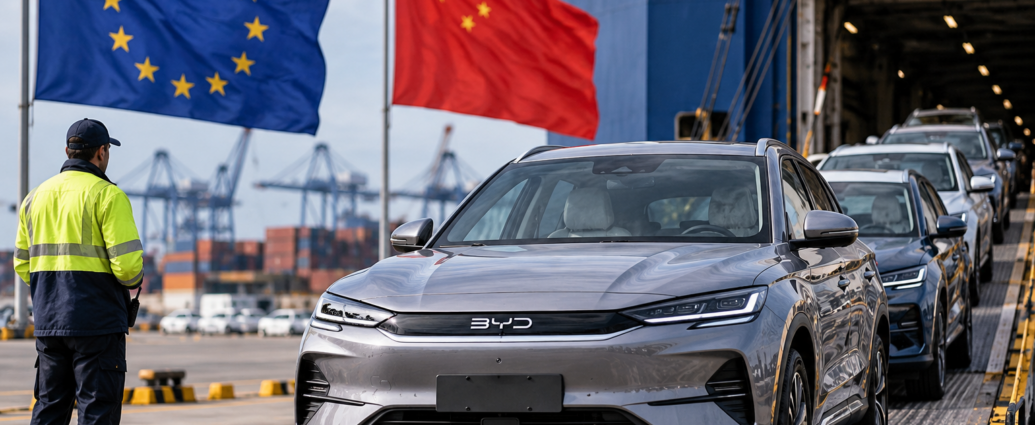
BRUSSELS — The European Union is considering new restrictions on Chinese-made hybrid vehicles as automakers from China expand their presence in Europe, raising concerns about competition, factory jobs and the future of the region’s automotive industry.
The European Commission is preparing potential safeguard measures that could limit hybrid vehicle imports from China, according to a Bloomberg News report citing people familiar with the discussions.
The proposal would reportedly introduce a temporary tariff-rate quota, allowing a specified number of vehicles to enter Europe at existing tariff rates while imposing higher duties on imports exceeding that limit.
No final decision has been announced, and the restrictions remain under consideration.
Chinese Automakers Gain Ground
The potential restrictions follow the EU’s decision in October 2024 to impose additional tariffs on battery-electric vehicles manufactured in China.
Those measures did not extend to hybrid vehicles, which generally remain subject to the EU’s standard 10% automobile import duty.
Chinese manufacturers have increasingly focused on hybrid and plug-in hybrid models as they seek to expand sales in Europe.
Companies including BYD have gained attention by offering vehicles at competitive prices, putting pressure on established European manufacturers such as Volkswagen, Renault and Stellantis.
The rapid expansion has raised concerns among European policymakers about the ability of domestic manufacturers to compete while maintaining production and employment.
Trade Tensions Continue
The proposed restrictions could become another source of friction between Brussels and Beijing.
European officials have expressed concerns about China’s growing trade surplus with the EU, while Chinese authorities have criticized European trade barriers targeting their automotive industry.
The dispute extends beyond automobiles, with agricultural products and other manufactured goods also affected by trade tensions.
Any new restrictions would require careful consideration of potential Chinese retaliation, particularly against European manufacturers with significant business operations in China.
What It Means for Consumers
For European drivers, limiting Chinese hybrid imports could reduce the availability of lower-priced vehicles.
Chinese manufacturers have increased competition in Europe’s automotive market, particularly among consumers seeking more affordable alternatives to traditional gasoline-powered cars.
Higher import duties could raise vehicle prices or encourage manufacturers to absorb additional costs.
European automakers, meanwhile, could benefit from reduced pricing pressure and greater opportunities to protect domestic production.
The impact would depend on the final structure of any import restrictions and how automakers respond.
Chinese Manufacturers Expand European Production
Import limits may also accelerate Chinese investment in European manufacturing.
BYD has been developing production operations in Hungary, while other Chinese automakers are exploring ways to manufacture vehicles closer to European customers.
Vehicles manufactured within the EU would generally fall outside restrictions specifically targeting imports from China, although applicable trade and origin rules would still matter.
For European policymakers, this creates a difficult balance between protecting domestic manufacturers and attracting foreign investment that supports local employment.
Global Auto Competition Intensifies
The potential EU action reflects a broader shift toward trade protections in the global automotive industry.
The United States has also imposed substantial tariffs on Chinese electric vehicles, limiting their competitiveness in the American market.
As major economies introduce new trade barriers, Chinese manufacturers may increasingly target emerging markets in Asia, Latin America and the Middle East.
For consumers, the central question is whether protecting domestic production will come at the expense of affordable vehicle choices.
For European manufacturers, the challenge remains competing with Chinese automakers that continue expanding their global reach.
The European Commission’s next steps will determine whether the proposed restrictions become another major turning point in international automotive trade.
JBizNews Desk | Brussels
© JBizNews.com All Rights Reserved. Reproduction or distribution without written permission is prohibited.