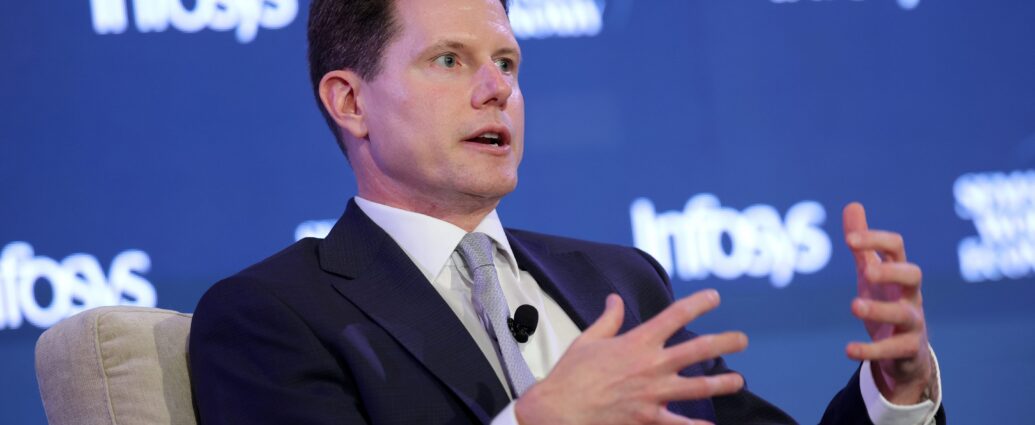
- In today’s CEO Daily: An interview about all things grocery with Jason Buechel
- The big leadership story: What Linda Yaccarino learned from Elon Musk
- The markets: In the red globally
- Plus: All the news and watercooler chat from Fortune
Good morning. How much do consumers value convenience, cool technology, and low cost? It’s not an easy answer. Just ask Jason Buechel, the CEO of Whole Foods and vice president of Amazon Worldwide Grocery Stores. In a new Fortune video segment called CEO Source, he talks about the tough decisions in expanding Amazon’s grocery business, which last year generated more than $150 billion in sales. His mission is clear: “Amazon has been known as the everything store, and I believe with grocery we are going to be the everyday store,” he told me, noting the goal is “greater engagement, not only just within grocery, but the broader store.”
But everything comes at a price. Among the questions that we discussed.
How much do you pay your people? We live in an era where business leaders can be billionaires as their colleagues struggle to pay the bills. Buechel talked about Amazon’s recent $230 million pledge to offer higher pay, benefits, and college perks to more than 100,000 Whole Foods workers. In many ways, it’s a return to Whole Foods’ roots: co-founder John Mackey famously capped executive salaries at 19 times the average worker pay before selling the chain to Amazon in 2017. Buechel comes from that culture. The eldest child of a cheese maker in Wisconsin who grew much of the family’s produce, he was Whole Foods’ CIO and Mackey’s chosen successor prior to the acquisition.
What is the cost of convenience? A European friend who’s in town from a Red Cross stint in the Democratic Republic of Congo was shocked at the number of vans, three-wheelers, e-cargo bikes and other delivery vehicles cluttering the streets of New York, often delivering products that people could buy themselves if they walked across the street. She found it chaotic. New York Mayor Zohran Mamdani does, too. In addition to securing a record $131.5 million from DoorDash for delivery workers last month, he’s backing the Delivery Protection Act to “rein in Amazon’s power over New York City streets.” Many may disagree with the premise and proposed solution, but I did ask Buechel if letting me order a banana for quick delivery is a quest worth pursuing. He says he’s aiming for predictability over speed.
How much technology do shoppers really want? I loved being able to flash my palm over a sensor to pay my bill at Whole Foods. In other parts of the empire, such as Amazon Go, customers didn’t love walking into a retailer with no formal checkout. Both are no longer offered. “In some cases, I think we’re also just a little bit ahead of what customers were looking for in a physical store, whether it be a grocery store or convenience store that we had brought to bear,” Buechel told me. “We’re going to pivot to our same-day focus on grocery. We’re going to get this right.”
My interview with Buechel will run on today’s episode of Fortune Daily. You can watch at 4 p.m. on YouTube.
Quick note: Fortune Brainstorm AI returns to San Francisco Dec. 7-8 to convene technologists, entrepreneurs, Fortune Global 500 executives, investors, policymakers, and the brilliant minds in between to interrogate the most pressing questions about AI. We will explore how organizations are deploying and scaling AI in their industries. Register now
Contact CEO Daily via Diane Brady at diane.brady@fortune.com
This story was originally featured on Fortune.com