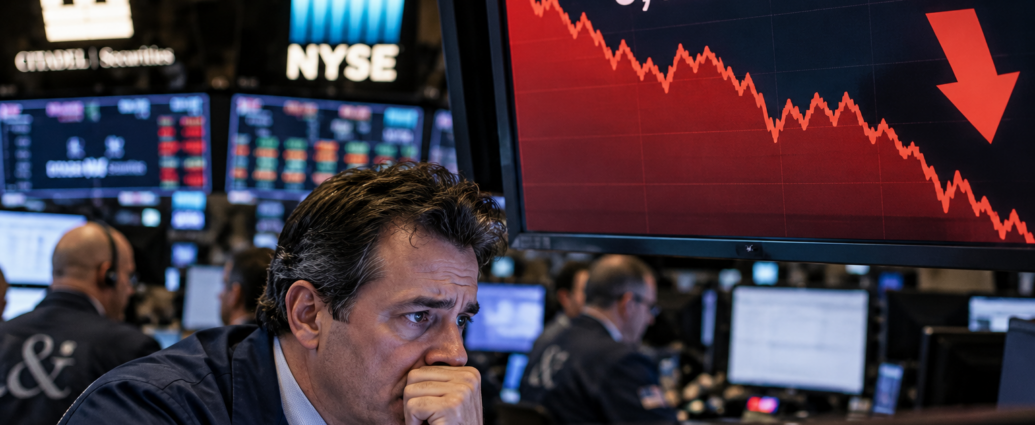
NEW YORK, Oct. 8, 2026 — Wall Street’s artificial intelligence boom could end in a major stock market collapse within the next two years, according to a prominent investment strategist who warns that soaring technology spending, growing corporate debt and increasingly expensive stock valuations are creating dangerous conditions for investors.
Joachim Klement, head of market strategy at London-based investment bank Panmure Liberum, has forecast that the AI-driven market rally could unravel in 2027 or 2028, potentially sending the S&P 500 sharply lower.
His reported year-end 2027 target of 5,000 would represent a decline of approximately 36% from an index level near 7,800.
Such a decline would have serious consequences for retirement savings, investment portfolios and households whose financial security depends on the stock market.
For example, a $10,000 investment tracking the S&P 500 would fall to approximately $6,400 if the index declined 36%, excluding dividends, fees and other factors.
The warning comes as technology companies continue investing heavily in artificial intelligence infrastructure, including advanced computer chips, data centers and the electricity systems needed to operate them.
Major technology companies have committed enormous amounts of capital to expanding AI capabilities, betting that demand for artificial intelligence products and services will eventually generate substantial returns.
However, Klement’s concern centers on whether those investments can produce enough revenue to justify their costs.
One important measure is free cash flow, the money a company retains after covering operating expenses and capital investments.
When businesses spend heavily on expansion, their available cash can shrink, potentially forcing them to rely more on borrowing or other financing.
Higher borrowing costs can create additional financial pressure, particularly if anticipated AI revenue takes longer than expected to materialize.
That combination could become a significant problem for technology companies whose stock valuations already reflect expectations of rapid future growth.
The broader market is also vulnerable because a relatively small group of major technology companies has contributed substantially to stock market gains.
When investors concentrate heavily on a single industry or investment theme, disappointing financial results can trigger selling that spreads beyond the companies directly involved.
Klement’s forecast raises comparisons with the 2008 global financial crisis, when the S&P 500 lost approximately 57% of its value from its 2007 peak to its March 2009 low.
A 36% decline would be smaller than that historic collapse but would still represent a severe bear market capable of erasing trillions of dollars in stock market value.
However, a forecast of a major market decline is not evidence that another financial crisis is inevitable. The 2008 collapse involved widespread banking failures, mortgage-related losses and severe disruptions to credit markets, conditions that are not automatically comparable to today’s AI investment boom.
For investors, Klement has reportedly emphasized preparing for a potential downturn rather than immediately abandoning the stock market.
His suggested approach involves monitoring the S&P 500’s 200-day moving average, a widely followed indicator that tracks the index’s average closing level over approximately 10 months of trading.
A sustained decline below that level can indicate weakening market momentum, although the indicator does not reliably predict every recession or stock market crash.
Klement has also expressed a preference for defensive sectors, including consumer staples and healthcare, which often experience steadier demand during economic downturns.
Companies producing food, medicine and other essential products may be less vulnerable to changes in consumer spending than businesses dependent on discretionary purchases or aggressive expansion.
For American households, the warning carries particular importance because stock market performance affects retirement accounts, pension investments and long-term savings.
Workers approaching retirement could face greater financial challenges from a prolonged downturn because they have less time to recover investment losses before beginning withdrawals.
Younger investors generally have longer investment horizons, although their portfolios can still experience significant short-term losses.
The outlook remains contested. Supporters of the AI investment boom argue that artificial intelligence could transform productivity, reduce business costs and create substantial new sources of revenue across industries.
They believe the enormous spending on AI infrastructure could eventually be justified by growing commercial adoption.
Skeptics, meanwhile, question whether those benefits will arrive quickly enough to support today’s valuations and investment commitments.
The difference between those expectations will become increasingly important as technology companies report earnings, disclose capital spending and demonstrate whether their AI businesses are generating sustainable profits.
For now, Klement’s warning highlights a central risk facing Wall Street: Stock prices have risen partly on expectations of enormous future AI profits, but those profits still need to materialize.
If revenue growth fails to keep pace with spending, investors could begin reassessing what the world’s largest technology companies are worth.
The result could be a significant market correction, although the timing and severity remain uncertain.
For retirement savers and other investors, the key question is whether the AI revolution can deliver financial returns large enough to support the extraordinary investment already flowing into it.
JBizNews Desk | New York
© JBizNews.com All Rights Reserved. Reproduction or distribution without written permission is prohibited.