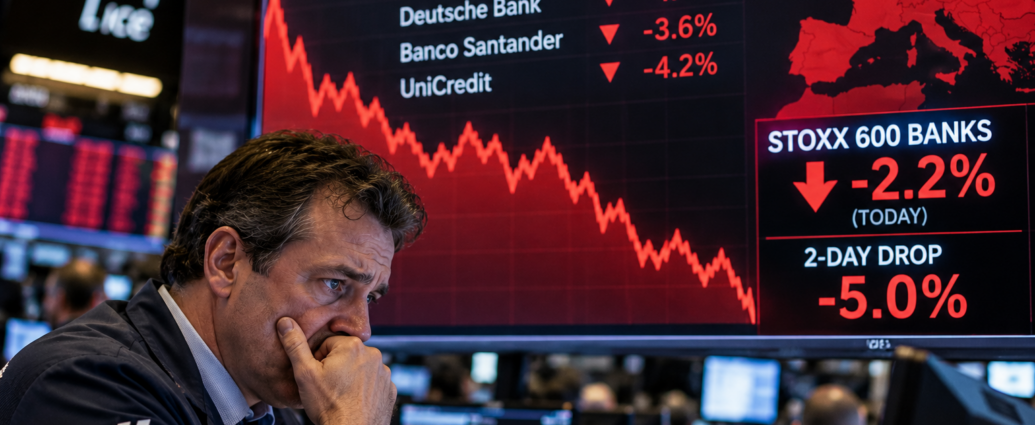
LONDON, Oct. 8, 2026 — European banking stocks extended their sharp decline Thursday, heading toward one of their worst two-day performances in months as mounting concerns over France’s government debt, rising borrowing costs and surging oil prices rattled financial markets.
The STOXX Europe Banks index fell nearly 2% in early Thursday trading after dropping approximately 3.5% Wednesday, according to Reuters. The combined losses pushed the sector to its lowest level in more than three months, threatening to erase billions of euros in market value.
Major lenders, including France’s Société Générale, Germany’s Deutsche Bank, Spain’s Banco Santander and Italy’s UniCredit, declined for a second consecutive session as investors grew increasingly concerned about the financial consequences of higher government borrowing costs.
The selloff reflects growing anxiety over Europe’s ability to manage its debt while inflation pressures and economic uncertainty make it more difficult for central banks to lower interest rates.
France has emerged as the center of those concerns.
The country faces a government budget deficit exceeding 5% of its gross domestic product, significantly above the European Union’s 3% limit. Its public debt has climbed above €3.5 trillion, raising questions about how the government will stabilize its finances without damaging economic growth.
Investors have responded by demanding higher yields on French government bonds, pushing the country’s benchmark 10-year borrowing costs toward 5%, levels not seen in nearly a quarter-century.
The gap between French and German government bond yields has also widened sharply. Germany’s debt is generally considered among the safest in Europe, making the difference between the two countries’ borrowing costs an important measure of investor confidence.
Higher bond yields create problems for banks because bond prices move in the opposite direction of yields.
European lenders hold substantial amounts of government debt as part of their investment portfolios and liquidity reserves. When bond prices fall, banks can face valuation losses, depending on how those securities are classified and managed.
Investors are also concerned that rising interest rates could weaken demand for mortgages, business loans and other forms of credit, potentially slowing economic growth and increasing the risk of borrowers falling behind on payments.
The pressure is spreading beyond France.
Government borrowing costs have risen in Italy and other eurozone countries, raising fears that financial instability in one major economy could spread across the region.
Reuters reported Wednesday that investors were increasingly concerned about contagion from France into the broader European banking system.
The latest losses mark a reversal for European banks, which had benefited from higher interest rates and stronger lending income during much of the recent market rally.
While higher rates can improve the difference between what banks earn on loans and pay on deposits, rapidly rising bond yields can reduce the value of their investments and increase financial uncertainty.
Energy prices are adding another layer of pressure.
Oil climbed more than 3% Thursday amid renewed concerns about supplies from the Middle East, intensifying fears that energy costs could drive inflation higher.
Higher oil prices affect transportation, manufacturing and household expenses, potentially forcing businesses to raise prices while leaving consumers with less money to spend.
That creates a difficult situation for the European Central Bank, which must balance inflation risks against signs of weakening economic activity.
If inflation remains elevated, policymakers may have less room to reduce borrowing costs, even as businesses and households face mounting financial pressure.
The broader European stock market also declined Thursday. The pan-European STOXX 600 fell approximately 0.8% to 625.44 points by 0833 GMT, while France’s CAC 40 dropped about 1% to its lowest level in more than six months, according to Reuters.
For American investors, the consequences could extend beyond European markets.
International stock funds, retirement portfolios and exchange-traded funds often hold shares in major European banks. A prolonged decline in the sector could reduce the value of those investments.
Financial instability in Europe can also affect currency markets and global bond yields, influencing borrowing costs for governments, businesses and households.
For consumers, higher borrowing costs can eventually translate into more expensive mortgages, car loans and business financing. Companies facing higher financing expenses may also delay investment, reduce hiring or pass additional costs to customers.
However, market analysts caution that falling bank shares do not necessarily mean Europe is heading toward another banking crisis.
Some major investment managers have begun looking for opportunities in European bonds and other assets following the selloff, suggesting that parts of the market may be pricing in more risk than current conditions justify.
The European Central Bank also maintains financial tools designed to address disorderly bond market conditions, although intervention depends on specific requirements and is not guaranteed.
The immediate focus remains on France’s ability to deliver a credible budget and reassure investors that its public finances can be brought under control.
A convincing fiscal plan could help stabilize bond markets and ease pressure on European lenders. Continued political uncertainty, however, could push borrowing costs higher and prolong the banking sector’s decline.
For now, Europe’s financial markets face a difficult combination of government debt concerns, expensive energy and rising interest rates.
The latest selloff underscores how quickly confidence can weaken when investors begin questioning whether heavily indebted governments can manage their finances without placing additional pressure on banks, businesses and consumers.
JBizNews Desk | London
© JBizNews.com All Rights Reserved. Reproduction or distribution without written permission is prohibited.