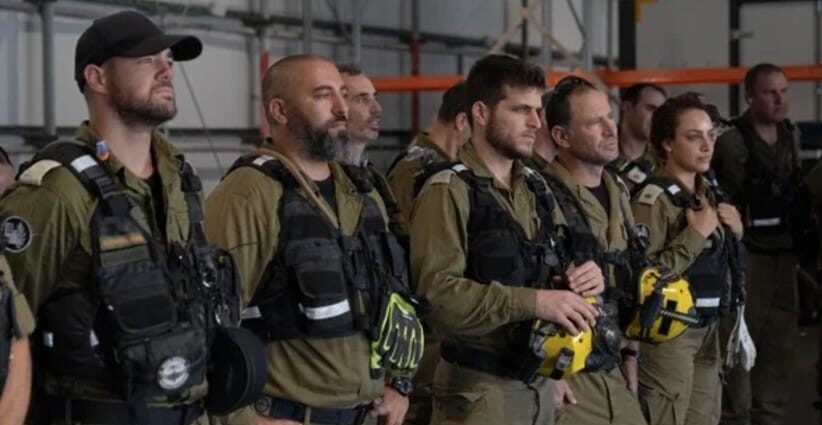
A deadly earthquake strikes Venezuela. Israeli and Jewish aid organizations rush to the scene, and tens of thousands of Jews worldwide open their wallets to help.
Weeks later, another powerful earthquake rocks Colombia, and days after that, a flash flood devastates communities along the Nepal-Tibet border. Again, Israeli and Jewish organizations mobilize.
We do this even as the global Jewish community is experiencing tremendous challenges, many of which have hit incredibly close to home.
A friend of a friend is attacked in Manhattan. A cousin of someone I know is killed during Yom Kippur services in the UK.
There are attacks in Australia, France, and Canada. People argue about whether the country I live in has the right to exist. And we are all still reeling from October 7.
And yet, when tragedy strikes in Venezuela, Colombia, or Nepal, we give. And we go.
Why do we keep going?
Of course, there are many good answers.
Humanitarian work demonstrates what Israeli and Jewish organizations can contribute to the world. It creates relationships and builds goodwill. More than anything else, it reminds people that Israelis and Jews are not defined by the political conflicts that so often dominate the headlines.
Through my work at OLAM, a network of Jewish and Israeli organizations doing precisely this kind of work, I’ve seen all of those things happen. Humanitarian and development work has opened doors that politics never could.
It has also created genuine partnerships between Israelis, Jews, and communities around the world.
In the days after October 7, one of OLAM’s partner organizations in India began every Friday staff meeting with a moment of silence for the Israeli hostages. The team is made up of Hindus, Muslims, Catholics, Jains, and Jews.
They continued that ritual every week while hostages were being held in Gaza as an expression of support for the Israelis they’d been working with for years.
But I’ve also seen cases where Israelis responding to humanitarian crises have had to conceal their nationality simply to be allowed to save lives.
So why do we insist on going when goodwill is not guaranteed? When we sometimes have to hide our identity in order to save lives?
The answer is almost embarrassingly simple: because it is the right thing to do.
Jewish ethics do not ask us to calculate what we will get in return before deciding how to act. Our tradition teaches that every human being is created in God’s image. It demands that we care for the stranger and commands us to save a life if given the opportunity.
These moral imperatives are ones many of us have encountered throughout our lives, whether through our tradition, our communities, or our rabbis. For some, the language may be tikkun olam. For others, it may be hessed, or the pursuit of justice.
Whatever words we use, whatever stream of Judaism we come from, they all point us in the same direction: toward a responsibility to the other, even when the choice is difficult and the outcome is uncertain. When another human being is suffering, we do what we can.
This doesn’t mean there aren’t strategic reasons to do humanitarian work. There are, and it is important to recognize them.
Goodwill matters. Humanitarian actions can strengthen Israel’s relationships around the world. We shouldn’t pretend otherwise. But there is a difference between a benefit and a motivation. If the benefit disappears, the obligation should not disappear with it.
When tens of thousands are injured, and hundreds of thousands have lost their homes, when survivors don’t have clean drinking water, the question cannot be what we might gain. It must be what we can give.
Beyond the life-saving work itself, that might be one of the most important things Jewish and Israeli humanitarian work has to offer right now: an example of what it looks like to act because human life has inherent value and because someone else’s suffering creates an obligation.
The real test of our values isn’t what we do when doing good will be noticed or rewarded. It’s what we do when no one promises us anything in return.
So, when an earthquake strikes and people need help, we go.
The writer is the communications manager of OLAM, a network of Jewish and Israeli organizations working in international development, humanitarian aid, and global service. She lives in Jerusalem.