
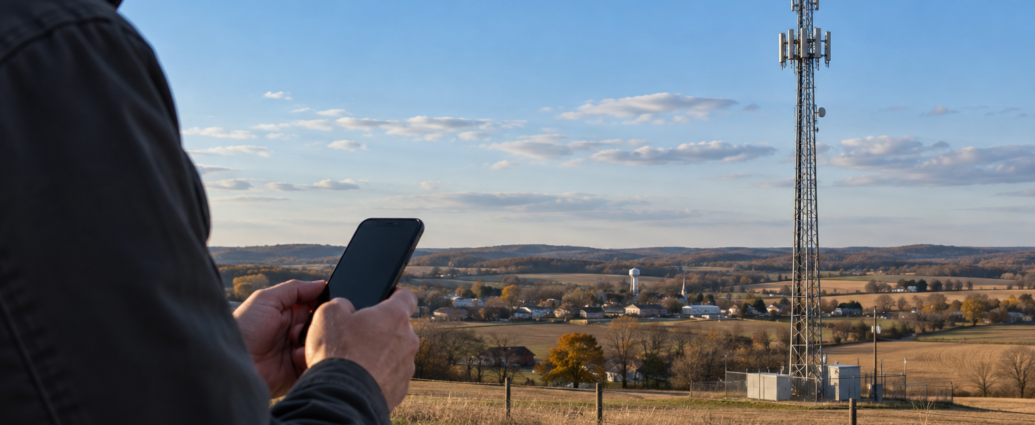
SpaceX moved closer to becoming a national cellphone carrier Thursday, agreeing to buy airwaves that could help Starlink Mobile reach phones inside homes and offices. The purchase strengthens its challenge to AT&T, Verizon and T-Mobile, but customers still have to wait for regulatory approval and the network to be built.
The company agreed to acquire all of investment firm Grain Management’s nationwide 800 MHz spectrum portfolio. The companies did not disclose a price. The transaction needs approval from the Federal Communications Commission and must meet other closing conditions.
The portfolio provides up to 14 megahertz of paired spectrum across the country. Paired means separate portions of the airwaves carry signals to phones and back from them. Grain acquired the licenses from T-Mobile in August.
The appeal is how these frequencies behave. Low-band signals generally travel farther and pass through walls more effectively than higher-frequency signals. That makes them useful for reaching rural communities and keeping phones connected indoors. Higher-frequency bands can offer more capacity, but their signals are more easily weakened by buildings and other obstacles.
SpaceX intends to combine its satellite-to-phone network with a ground-based network. The new low-band airwaves would supply a broad coverage layer alongside Starlink Mobile’s 2 GHz spectrum, which the company plans to use for higher-capacity service.
For a customer, the goal is a phone that stays connected while moving between places served by satellites and places served by equipment on the ground. That includes a problem satellite providers must solve to become everyday cellphone carriers: people need service inside their houses and workplaces, not only under an open sky.
The spectrum purchase does not establish that reliable indoor coverage is already available. SpaceX must deploy the equipment and demonstrate how the combined network performs. Buildings, network capacity and the strength of the signal sent back by a phone all affect whether a connection works.
The service is being developed for ordinary smartphones. SpaceX’s investor filings describe connectivity to unmodified phones, although the models and features supported by its future consumer offering will need to be confirmed when those plans are introduced.
Investors reacted quickly. Shares of AT&T, Verizon and T-Mobile each fell more than 5% in extended trading Thursday, Reuters reported. The selloff reflected concern that another national operator could compete for subscribers and put pressure on prices. Any effect on monthly bills will depend on the service SpaceX actually offers.
The acquisition follows another major regulatory step. On Oct. 6, the FCC approved SpaceX’s application for a separate mobile constellation of 15,000 satellites. Those spacecraft are intended to connect directly to phones using spectrum that includes the airwaves covered by SpaceX’s agreements with EchoStar.
The agency also granted a waiver allowing satellite service without a spectrum-leasing agreement with an existing terrestrial carrier. That creates a path for SpaceX to sell service using its own licensed airwaves, while retaining the option of working with other carriers.
Today’s U.S. satellite-to-phone offering is available through T-Mobile’s T-Satellite service. SpaceX’s existing mobile constellation has around 650 satellites. Executives have outlined a goal of speeds reaching 150 megabits per second with the next generation, but that is a future performance target rather than a speed customers can assume they will receive now.
SpaceX has been assembling the spectrum for that expansion since last year. Two agreements announced in 2025 with EchoStar totaled about $19.6 billion and covered 65 megahertz of U.S. airwaves. Its investor materials describe next-generation mobile satellite deployment beginning in 2027.
The Grain licenses have already changed hands once this year. T-Mobile completed their sale in August in exchange for $2.9 billion in cash and Grain’s 600 MHz licenses. Grain said its agreement with SpaceX advances the FCC’s conditions aimed at putting the spectrum to productive use and supporting satellite-to-phone deployment.
For households, the potential benefit is another choice of provider, particularly where coverage is weak. For businesses operating along rural roads or across farmland, a more dependable connection could make navigation, payments and communication easier.
The announcement did not provide a consumer price or a launch date for the full nationwide network combining satellites and ground equipment. The next milestones are FCC review of the purchase, deployment and service plans that show customers what coverage they will get and what they will pay.
JBizNews Desk | Wall Street
© JBizNews.com. All rights reserved. This article is original reporting by JBizNews Desk. Unauthorized reproduction or redistribution is strictly prohibited.




