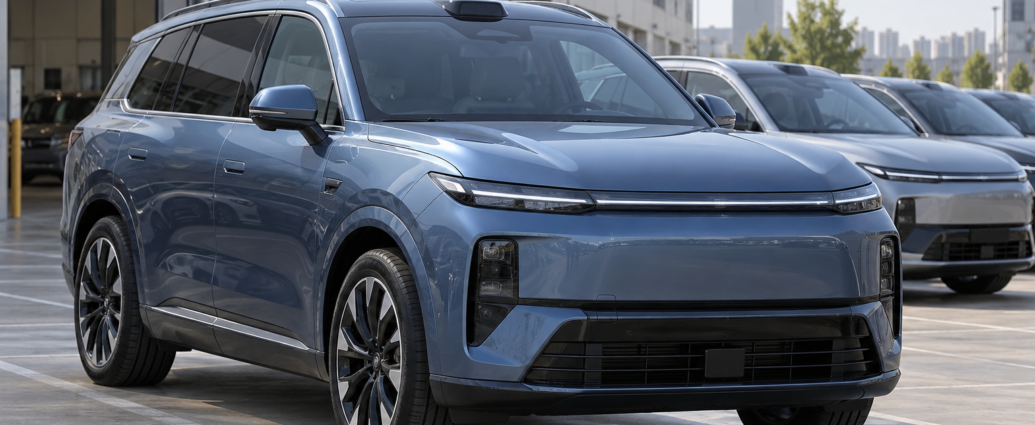
Xiaomi Auto reported more than 70,000 locked-in orders for its new SkyNomad sport utility vehicles during their first 30 days on sale, giving the company a substantial pool of customer commitments as it works toward an ambitious annual delivery target.
The company announced the milestone Oct. 8, covering the period from Sept. 7 through Oct. 7. The figures show demand for Xiaomi’s first extended-range SUV lineup, which combines electric driving with a gasoline-powered generator. The next test is how quickly those orders become delivered vehicles.
Locked-in orders represent finalized customer configurations, a more advanced stage in the purchasing process than an initial reservation. They remain distinct from deliveries, however, and do not establish how much revenue Xiaomi has collected from completed vehicle sales.
The company did not disclose how the orders were divided among the four SkyNomad variants. That leaves investors without a clear picture of which versions buyers favor or how the mix could affect revenue and profitability.
Deliveries have already begun. Xiaomi founder, chairman and chief executive Lei Jun said SkyNomad deliveries exceeded 10,000 vehicles in September. Xiaomi Auto’s total deliveries surpassed 40,000 that month, its highest monthly level so far in 2026.
Those disclosures establish that the new lineup is contributing meaningful volume. They do not establish its exact share of September deliveries: both figures are reported minimums rather than precise totals.
The SkyNomad expands Xiaomi’s automotive business beyond its battery-electric SU7 sedan and YU7 SUV. Its extended-range system uses a gasoline engine to generate electricity, while electric motors drive the wheels. That gives buyers a fuel-powered backup when charging is inconvenient.
For households, the appeal is flexibility. Drivers can use battery power for routine journeys and rely on the generator during longer trips. Actual fuel savings depend on how frequently owners charge, local electricity and gasoline prices, and driving conditions.
Xiaomi’s investor materials list an electric-only range of 505 kilometers, about 314 miles, for the N70 Max under China’s CLTC testing standard. The larger N90 Max is listed at 464 kilometers. These are advertised test figures, not guarantees of the distance drivers will achieve in everyday use.
Pricing positions the lineup across several family-vehicle budgets. The five-seat N70 Pro starts at 209,900 yuan, while the N70 Max costs 239,900 yuan. The seven-seat N90 Max is priced at 269,900 yuan, and the N90 Max Studio, featuring a lifting roof and configurable living space, costs 299,900 yuan.
The 90,000-yuan difference between the entry model and the most expensive version makes the undisclosed order mix commercially important. Strong demand alone does not reveal the average selling price or profit Xiaomi will earn on the vehicles.
The broader challenge is delivery scale. Xiaomi’s annual target is 550,000 vehicles. CnEVPost calculated that deliveries through September reached at least 286,475, using 40,000 as September’s disclosed minimum.
On that conservative basis, the remaining gap would be 263,525 vehicles, equivalent to roughly 87,842 a month during the final quarter. The actual requirement would be lower to the extent September deliveries exceeded the reported minimum. The calculation illustrates the scale of the challenge; it is not an exact production requirement.
Profitability also deserves attention. Xiaomi’s second-quarter investor presentation reported a 19.2% gross margin for its smart EV, AI and other new initiatives segment, down from 26.4% a year earlier. The company cited higher EV component costs, a lower contribution from the SU7 Ultra and increased AI-related costs.
The SkyNomad order book provides evidence of customer demand. October delivery figures will offer the next measure of whether Xiaomi can convert that demand into the sustained volume needed to approach its year-end target.
JBizNews Desk | Beijing
© JBizNews.com. All rights reserved. This article is original reporting by JBizNews Desk. Unauthorized reproduction or redistribution is strictly prohibited.