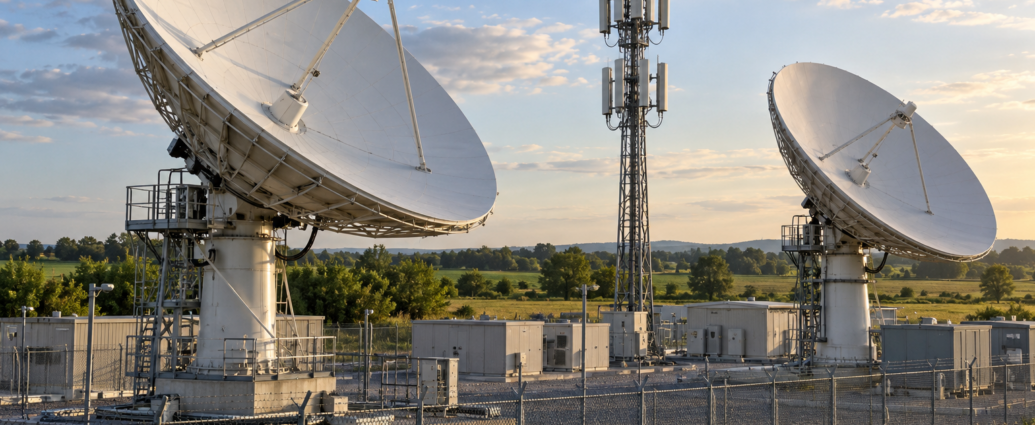
SpaceX has agreed to buy a nationwide set of airwave licenses that would let its Starlink service act like a full cellphone company, and shares of America’s three biggest wireless carriers dropped hard on the news. Before the opening bell Friday, T-Mobile was down about 7%, AT&T nearly 6% and Verizon more than 5%, as investors priced in the risk of a serious new rival for customers’ monthly phone bills.
Here is what actually happened. SpaceX announced Thursday that it is buying a spectrum portfolio from Grain Management, a digital infrastructure firm, covering up to 14 megahertz of paired airwaves in the 800 MHz band. Spectrum is simply the invisible radio lanes that phones use to send and receive calls and data. Whoever holds the license to a lane gets to run traffic on it. The deal still needs approval from the Federal Communications Commission.
The type of airwaves matters as much as the amount. Low-band signals like 800 MHz travel farther and push through walls and buildings better than the higher-frequency signals Starlink uses today. That has been Starlink’s weak spot: satellites work well under open sky but struggle to reach a phone sitting inside a house or office. SpaceX said this purchase fills one of the last major technical gaps standing between Starlink Mobile and becoming a major U.S. mobile carrier. Elon Musk, SpaceX’s CEO, called it the last critical piece needed to provide complete phone coverage in America.
There is a practical bonus for consumers. SpaceX says most phones already on the market support the 800 MHz band, which could let people switch to Starlink Mobile without buying a new device. It is not yet clear whether recent iPhones will work with the service when it launches.
The money at stake explains the selloff. On SpaceX’s second-quarter earnings call in August, President Gwynne Shotwell said AT&T, Verizon and T-Mobile together take in roughly $600 billion a year, and she said she expects SpaceX to win quite a few of their customers because she believes Starlink’s service will be better. Starlink already had 12 million subscribers as of June 30, adding 1.7 million in the second quarter alone, with the average customer paying $66 a month.
SpaceX’s own stock moved the other way. Shares rose about 4% in premarket trading Friday. The company, which trades under the ticker SPCX, began trading publicly in June.
The deal also landed alongside a second piece of good news for SpaceX. The FCC approved its next-generation Starlink Mobile network, authorizing 15,000 satellites built to connect directly to ordinary smartphones.
Timing is the key detail for anyone thinking about switching. Starlink Mobile as a full phone carrier is not available yet. Shotwell has said the next-generation satellites start flying in 2027 and the upgraded service goes live at the end of that year. SpaceX has not announced pricing, plans or service tiers. Neither SpaceX nor Grain disclosed what SpaceX is paying for the licenses.
There are real limits to how fast SpaceX can catch up. Industry analyst Tim Farrar notes the amount of spectrum is still small, and SpaceX would need ground-based equipment to deliver reliable coverage inside city buildings. SpaceX’s plan for that is unusual: instead of building traditional cell towers, Shotwell has described placing small, low-cost cellular stations on the same mounts that hold Starlink dishes, adding them only where demand calls for more capacity.
The big carriers are not standing still. On October 1, AT&T, T-Mobile and Verizon formally launched a joint venture to pool their airwaves and expand satellite coverage, aiming to nearly wipe out dead zones across the country. The venture named industry veteran Paul Roth as interim CEO, and the three companies said it will deliver more consistent satellite service across all their networks while leaving existing satellite partnerships in place. That move is the carriers’ direct answer to the same coverage gap Starlink is targeting.
For households, a fourth nationwide competitor is the part to watch. The U.S. wireless market has been dominated by three companies for years, and more competition has historically pushed carriers to cut prices, sweeten plans or throw in perks to keep customers from leaving. Whether that happens here depends on how quickly SpaceX can turn airwave licenses into working service that customers trust.
For now, the stock market has delivered its verdict on the threat. The next steps to watch are the FCC’s review of the Grain deal and any word from SpaceX on what Starlink Mobile will actually cost each month.
JBizNews Desk | Wall Street
© JBizNews.com All Rights Reserved. Reproduction or distribution without written permission is prohibited.