For a country separated from Israel by more than 11,000 kilometers, Paraguay has proved an unusually close friend over the Jewish state’s history.
While governments across the world have spent the past three years disassociating themselves from Israel’s war against Hamas, Hezbollah, and Iran, the South American nation has taken a different course, restoring its embassy to Israel’s capital, deepening security cooperation, and defending the Jewish state’s right to protect itself.
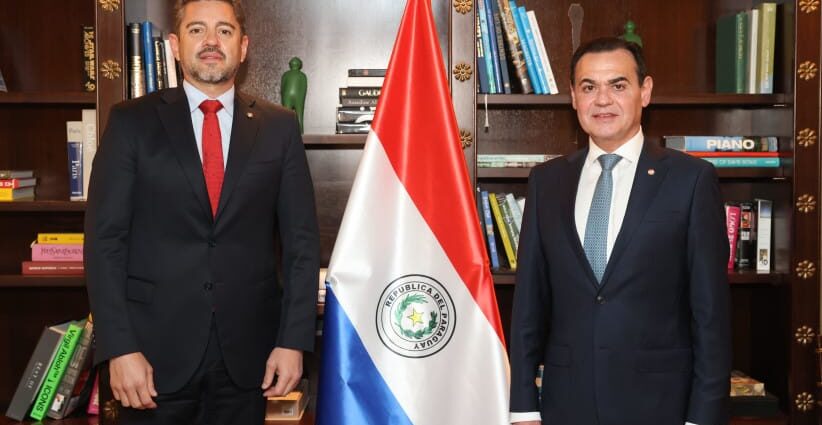
That friendship was on display yet again this week, when Paraguayan Vice President Pedro Alliana arrived in Israel alongside Foreign Minister Rubén Ramírez Lezcano and Environment Minister Rolando de Barros Barreto, and the timing of the delegation’s visit was intentional. Three years after the Hamas massacres of October 7, 2023, Paraguay wanted to make clear where it stood.
For Alliana, who sat exclusively with The Jerusalem Post during his visit, the relationship extends well beyond diplomatic gestures.
“Paraguay is building a strategic alliance with Israel in which we share values and principles of democracy, the rule of law, human rights, and freedom,” he told the Post. “Our relationship with Israel is founded on these values and principles, and we also defend Israel’s right to defend its territory.”
Paraguay, Israel discuss expanding cooperation in healthcare, technology, and security
On Wednesday, Alliana and Ramírez met with Foreign Minister Gideon Sa’ar in Jerusalem, where the two sides discussed expanding cooperation in healthcare, technology, security, and other fields. Meetings with Israel’s prime minister and president followed on Thursday.
The Paraguayan delegation also visited Yad Vashem, laying a wreath in the Hall of Remembrance, before participating in commemorations marking the anniversary of October 7.
“Since the October 7 massacre, Paraguay has stood firmly by our side,” Sa’ar said following the meeting. “We remember who stands with us in difficult times, and Paraguay has proven itself to be a true friend.”
Alliana was equally emphatic, stating, “Three years ago, Hamas carried out brutal acts of terrorism. The terrorist organization murdered, raped and kidnapped innocent Israelis.”
Paraguay’s support has not always been without consequences. Asked whether standing so firmly alongside Israel had carried a diplomatic or political cost, Alliana acknowledged that it had, telling the Post, “There are, evidently, political costs on many occasions. However, above the circumstances of the moment and any tensions that may arise are these values and principles, which Paraguay will not renounce.”
The relationship between Israel and Paraguay stretches back to the earliest years of the Jewish state. Paraguay voted in favor of the United Nations partition plan in November 1947, supporting the proposal to establish Jewish and Arab states in British Mandatory Palestine. Formal diplomatic relations followed in 1949.
Yet the friendship has faced political upheavals, most notably in recent years over the location of Paraguay’s embassy.
In May 2018, then-Paraguayan president Horacio Cartes moved the Paraguayan Embassy from Tel Aviv to Jerusalem, following the United States and Guatemala. Four months later, his successor, Mario Abdo Benítez, reversed the decision, prompting Israel to close its embassy in Asunción.
The diplomatic dispute lasted for years, until President Santiago Peña took office in 2023 and moved to restore the relationship. In December 2024, Peña personally attended the reopening of Paraguay’s embassy in Jerusalem, a powerful diplomatic gesture at a time when Israel was facing growing international criticism over the war in Gaza.
Israel has since reopened its embassy in the Paraguayan capital.
For Alliana, the challenge now is ensuring that the status quo survives changes of government.
The 52-year-old vice president, a former president of Paraguay’s Chamber of Deputies and longtime leader of the governing Colorado Party, intends to seek the presidency in the 2028 election.
His candidacy, the former national team basketball player and seasoned politician explained, is also a commitment to preserving the relationship with Israel.
“My candidacy for the presidency of the republic for the next term follows that same path: ensuring continuity in a close, firm, and lasting relationship,” he said.
Alliana pointed to Peña’s personal attendance at the embassy inauguration, the foreign minister’s visit earlier this year, and his own presence in Israel during the October 7 commemorations as evidence of that commitment.
The message was one of continuity. Having experienced how quickly diplomatic decisions can be reversed, Paraguay’s current leadership wants its relationship with Israel to endure beyond individual administrations.
There is another, less familiar dimension to Paraguay’s affinity with Israel, one rooted in the country’s own history of extraordinary suffering.
Shared history of national tragedy strengthens Paraguay’s bond with Israel
There is also a deeper historical dimension to Paraguay’s strong relationship with Israel, rooted in a national tragedy that continues to shape the country’s collective memory.
More than 150 years ago, Paraguay endured one of the most devastating conflicts in the history of the Americas: the War of the Triple Alliance, fought between 1864 and 1870.
The conflict, in which Paraguay fought an alliance of Brazil, Argentina, and Uruguay, remains one of the most devastating wars ever fought in the Americas.
By the time the fighting ended, Paraguay lay in ruins. Its economy was shattered, much of its territory had been occupied, and an enormous proportion of its population had perished.
The precise death toll remains a subject of historical debate. Some estimates suggest that Paraguay lost around 60% of its population, while others place the figure lower. What is not in doubt is that the destruction of the country’s adult male population was so severe that it left a demographic and social legacy that lasted generations.
For Paraguayans, the war remains a defining episode in their national history, a catastrophe that threatened the country’s very existence.
The conflict is seen among Paraguayans as an attempt to exterminate the Paraguayan people, and they draw analogies with the historical suffering of Jews and Israelis.
The circumstances of the War of the Triple Alliance and the Holocaust were, of course, very different, but the analogizing offers insight into how Paraguayans understand their country’s relationship with Israel.
Both nations carry memories of catastrophic loss within their national consciousness, alongside a determination to preserve their independence and ensure their survival.
For Paraguay, whose history includes the experience of seeing its population decimated and its future placed in jeopardy, Israel’s insistence on defending itself against threats to its existence has a particular resonance.
Against this historical backdrop, the Paraguayan delegation’s visit to Yad Vashem and its decision to commemorate October 7 in Israel is even more significant.
Israel’s bridge in Latin America
Paraguay’s ambitions extend beyond its own bilateral relationship with Jerusalem.
Across Latin America, Israel’s diplomatic position has undergone considerable changes in recent months. Argentinian President Javier Milei has long been one of Israel’s most outspoken international supporters, but recent developments in Colombia and Venezuela have opened the door to renewed engagement after years of strained relations. Colombia and Israel fully restored diplomatic, security, and economic ties after President Abelardo de la Espriella’s inauguration in August, while that same month, Israel and Venezuela agreed to resume consular relations after 17 years of severed ties under the Chavez and Maduro regimes.
Alliana believes Paraguay has an important role to play in encouraging Israel’s reintegration process on the continent.
“Paraguay has been promoting closer relations between Latin America and Israel, based on the strategic alliance that I have mentioned on several occasions,” he stated. “We have served as a bridge for dialogue, which has allowed us to bring Israel closer to the region.”
He pointed to a videoconference organized this year by Foreign Minister Ramírez, bringing together Israel’s foreign minister and his Latin American counterparts.
The initiative, Alliana explained, allowed Israel to present its position directly to regional governments, including during particularly challenging periods.
Paraguay is also part of a relatively small group of countries that maintain formal diplomatic relations with Taiwan rather than the People’s Republic of China, a long-standing foreign policy commitment that has occasionally placed it at odds with prevailing regional trends.
Asked whether Paraguay’s foreign policy was increasingly based on shared values rather than broader diplomatic consensus, Alliana rejected the suggestion that it was ideologically driven.
“The foreign policy of the Republic of Paraguay, and of our government, is based on the values and principles I have mentioned and is in no way aligned with ideological considerations,” he said.
For Paraguay, its relationships with Israel, the United States, and Taiwan form part of a diplomatic outlook that the current administration regards as consistent and principled.
The recent changes in Venezuela are of particular interest. For years, Caracas was among Iran’s closest partners in the Western Hemisphere, providing the Islamic Republic with a valuable political and strategic foothold in South America.
Alliana welcomed the developments following American intervention in Venezuela and President Peña’s engagement with interim Venezuelan President Delcy Rodríguez, but he also emphasized the need for a democratic transition based on respect for human rights, the release of political prisoners, and full participation in elections.
The objective, he said, is to establish a clear road map that would allow Venezuelans themselves to determine their country’s future.
Paraguay takes firm stance against Iran’s growing influence in Latin America
The changing political landscape of Latin America also raises questions about Iran’s influence in the region, a subject on which Paraguay has taken a particularly firm position.
Paraguay has designated Hamas, Hezbollah, and Iran’s Islamic Revolutionary Guard Corps as terrorist organizations. The country’s concerns are rooted partly in the long-standing activities of Hezbollah-linked networks in Latin America, particularly around the tri-border region shared by Paraguay, Brazil, and Argentina.
The region has attracted international attention for decades over allegations of illicit financing, smuggling, and activities linked to terrorist organizations.
For Alliana, the response requires close intelligence and security cooperation with Israel, the United States, and neighboring countries.
“Paraguay has been taking a series of measures,” the vice president said. “First, we have significant intelligence cooperation with Israel, the United States, and other allied countries in our region.”
He highlighted a status of forces agreement with the United States, which he linked to military cooperation and support for Paraguay’s armed forces and police, while also referencing regional security initiatives involving Chile and Bolivia, including cooperation with the government of Bolivian President Rodrigo Paz.
These arrangements, he said, have allowed Paraguay to work more closely with its neighbors on operations against terrorist organizations, transnational organized crime, and Iranian activities in the region.
His remarks suggest that Paraguay regards the Iranian threat as an operational security concern requiring international coordination, rather than simply a matter of diplomatic disagreement. The relationship with Israel is therefore important in practical terms, particularly in intelligence sharing, cybersecurity, and counterterrorism.
“The fight against terrorism is one of the areas in which Israel is at the forefront and is the first line of defense against terrorist groups that are causing so much harm around the world,” he said.
Security cooperation may dominate much of the political relationship, but Paraguay also sees substantial opportunities in Israeli technology and expertise.
In meetings with Sa’ar, the Paraguayan delegation discussed cooperation in cybersecurity, water management, agriculture, healthcare, and technological development.
Paraguay possesses major freshwater resources, yet the efficient management of those resources, particularly for agriculture and irrigation, remains an area where Israeli expertise could prove valuable.
Healthcare is another priority for the landlocked South American country. During Wednesday’s meeting, the two countries signed a memorandum of understanding on health cooperation, opening the way for technology transfer and further professional training.
“[The MOU] will enable technology transfer, the specialization and training of Paraguayan doctors in Israel, and the training of technicians in various technological fields in Israel to become part of this broader agenda,” Alliana explained.
Educational exchanges have also become an important component of the relationship. Israel’s MASHAV international development cooperation agency has provided training and scholarships to Paraguayan professionals, with Alliana’s delegation emphasizing the participation of nearly 400 people over the past two years.
Trade is another bilateral area which continues to expand. Paraguay has become an increasingly important supplier of beef to Israel, with Alliana citing growth from $85 million to $300m. annually over the past three years.
“Our vision is clear: Paraguay and Israel must work together to significantly expand the bilateral relationship,” he said.
For Paraguay’s leadership, the relationship with Israel also fits into a wider vision of the country’s place in international affairs.
Alliana pointed to Peña’s participation in the Sharm el-Sheikh peace summit in Egypt, where he said the Paraguayan president was the only Latin American head of state invited to witness the signing of the ceasefire agreement between Israel and Hamas.
The vice president cited US President Donald Trump’s personal invitation to Peña to participate in the event as evidence of Paraguay’s growing diplomatic standing and its potential role in international efforts involving Israel.
“We have been and continue to be a bridge for engagement in the region,” he said.
The country’s friendship with Israel has already survived diplomatic reversals, regional disagreements, and mounting international pressure, but its current leaders now want to ensure the relationship becomes a permanent feature of the country’s foreign policy.
As Alliana looks toward the 2028 presidential election, he is presenting that continuity as part of his political vision.
Meanwhile, his government’s efforts to deepen cooperation in security, healthcare, technology, and regional diplomacy reflect how much Paraguay values its friendship with Israel and the strength it sees in that relationship.
“Paraguay is working with Israel on a long-term relationship that extends into the future,” the vice president said. “We have a shared view of the challenges we face.”
For Israel, in a world where genuine friends have sometimes seemed in short supply over the past three years, Paraguay’s friendship is one worth cherishing.