Ein Gedi is not a secret. It’s one of the most visited nature reserves in the country, and after years of closures, it’s filling up again.
Just before Sukkot, the Parks Authority reopened the lower Nahal David trail to David Waterfall, the last major piece of a long restoration. The tour buses, school groups, and families lined up for ice cream are back, and almost all of them head for the same place: Nahal David and its waterfalls.
Most of them never learn that Ein Gedi reaches far beyond that one canyon. Above the crowds are quieter trails, climbing into the cliffs toward springs, ancient ruins, and pools that see only a handful of hikers a day.
The most beautiful of these is Dodim Cave.
On our last visit there, we pulled up to the gate just before 8 a.m., before it had even opened. Below us, the Dead Sea lay flat and blue in the morning haze. We had been to Dodim Cave years earlier. But this time we were approaching it from a different trail, because the way we used to get there was closed.
A reserve that keeps changing
Ein Gedi has had a hard few years. In August 2023, a deadly rockslide struck the Nahal David trail, and the Parks Authority closed it for months. Then, in May 2025, a sudden flood tore through the David and Arugot streams, washing away trails, stairs, and bridges. Since then, the reserve has reopened piece by piece: first Nahal Arugot, then the route to Ein Gedi Spring, and now the lower Nahal David trail.
The old path to Dodim Cave used to break off from Nahal David and climb from there. When we went, that route was closed. Thankfully, there is another way in, from a trail near Nahal Arugot on the other side of the reserve.
The Parks Authority describes this trail as suitable only for experienced hikers. We were warned that the two-kilometer climb would take at least three hours. So we came prepared to suffer.
But it wasn’t difficult at all. The trail climbed steadily through open desert, with the Dead Sea spread out below, and in less than 20 minutes we reached Ein Gedi Spring. It was uphill, and it was hot, but for any reasonably fit hiker, it’s a short and very manageable walk.
From spring to cave
Ein Gedi Spring is a small patch of green and shade in an otherwise bare landscape, with a shallow, pretty pool. It’s also the only place along the route where you’re officially allowed to picnic.
A little farther on, we began to hear water rushing beneath us. We followed the ridge, caught a glimpse down into the canyon, and then the first waterfall appeared. It poured over the white cliffs as if out of nowhere, water from white desert rock. We climbed down a few metal rungs, stopped for a dip in a deep pool, and kept going. One last set of rungs, and there it was.
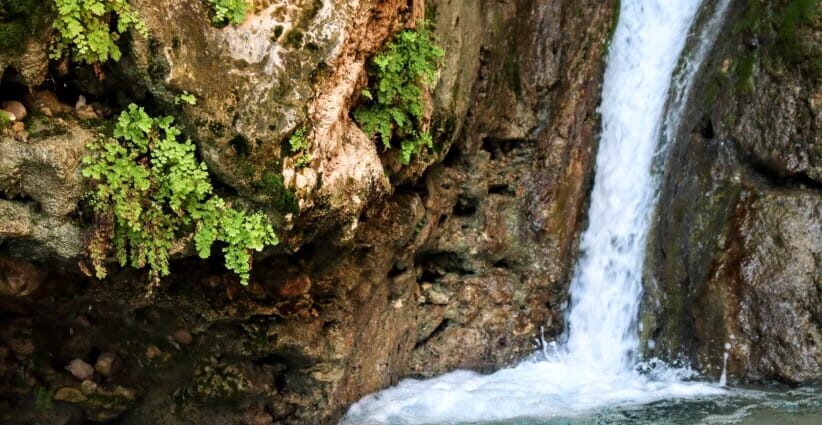
At Dodim Cave, the waterfall crashed with real force into a shallow pool. Moss and hanging plants grew thick over the gray rock. Behind the falling water was the cave itself, dark and cool and misty, with clear water at its floor. Part of the pool sat in shade and part in the sun. It felt like a pirate’s cove somehow dropped into the Judean Desert.
We stood under the waterfall until we were completely soaked, then climbed up into the cave to explore. Afterward we spread a blanket on a dry ledge beside the falls to enjoy the view.
The name Dodim means “beloved” or “lovers.” It comes straight out of the Song of Songs, where the beloved is compared to “a cluster of henna in the vineyards of Ein Gedi.” Even 3,000 years ago, this oasis was shorthand for something rare and lovely.
The history here is older than the poetry. Just beyond Ein Gedi Spring are the ruins of a Chalcolithic temple, built more than 5,000 years ago on a ledge overlooking the Dead Sea. Its builders likely chose the spot for its view and its water.
Later came David, hiding from King Saul “on the rocks of the wild goats” at Ein Gedi, the ibex’s ancestors presumably watching from the cliffs. Later still, a Jewish town thrived below these springs, famous for its date palms and its precious balsam perfume. The town’s ancient synagogue floor still bears an inscription cursing anyone who reveals “the secret of the town” to outsiders. No one knows for certain what the secret was, but many scholars believe it was how the perfume was made.
Sitting at those falls, it was easy to understand why people kept coming back to this place, and why they wanted to keep it to themselves.
The Ein Gedi beyond Ein Gedi
Now that Nahal David is open again, the parking lot will be full on any good morning. Hundreds of people a day will visit Ein Gedi, see David Waterfall, and drive home feeling they’ve seen the place.
But they’ll miss the best part. Some of Israel’s most famous parks still hold corners that almost no one reaches, and they’re usually only a short climb from the crowds.
Location: Ein Gedi Nature Reserve, off Route 90 on the Dead Sea. About an hour and 20 minutes from Jerusalem. Start from the small trailhead parking area on the road toward Nahal Arugot, but pay or register at the Nahal Arugot entrance first, even if you have a parks card.
The route: Follow the black trail markers and signs toward Ein Gedi Spring, then to Dodim Cave, and return the same way. You’ll get a map at the entrance, and rangers can point out the route. It’s about 3.5 km. Round trip.
Difficulty: Moderate. There is a short, steady climb and a few metal handholds near the cave. Despite the official warnings, it’s well within reach of any normal hiker and of kids who like to hike.
Best season: Fall through spring. In summer, start at opening time.
What to bring: Good shoes, a bathing suit, plenty of drinking water, and sun protection. Picnicking is allowed only at Ein Gedi Spring. No dogs.
Before you go: Ein Gedi has reopened in stages since the 2025 flood, and trail access can change quickly, especially after rain. Check the Parks Authority website for current openings and hours.
The writer is the founder of Hiking the Holyland. Follow her hikes on Instagram @hikingtheholyland. This is the third in a series of columns exploring the lesser-known corners of Israel’s nature reserves and national parks.