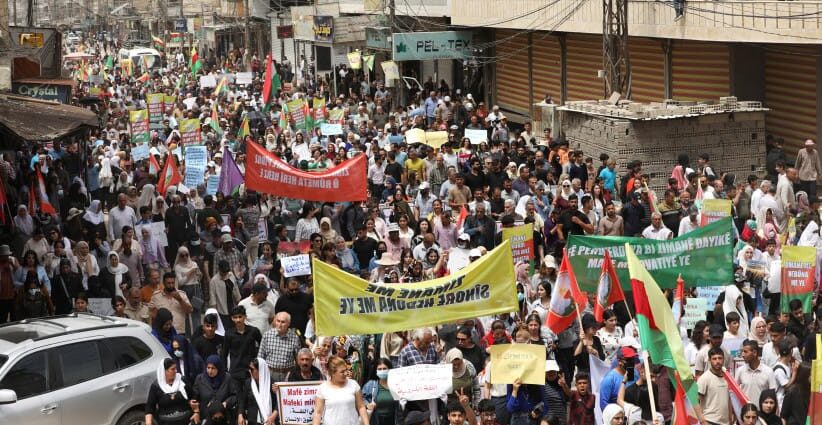
Concerns are mounting over protests and clashes in Syria’s Hasaka, where Arab demonstrators have confronted Kurdish residents. The US has expressed concern over the escalating unrest, Kurdish media outlet Rudaw reported.
The US is urging all sides to refrain from violence and resolve their differences through dialogue. The State Department made the comments in response to questions from Rudaw.
“The United States is closely monitoring and concerned by reports of unrest in Hasakah and urges all parties to exercise restraint, reject violence and incitement, and resolve differences through peaceful dialogue,” a US State Department spokesperson told Rudaw’s Diyar Kurda.
Wladimir van Wilgenburg, an author, journalist, and expert on Kurdish affairs, also highlighted the tensions, noting that the Kurdish National Council in Syria (KNC) had issued a statement addressing the unrest.
The KNC “affirmed that the future of the Syrian Jazira region cannot be built through exclusion or the fueling of divisions, but rather through partnership and the safeguarding of the dignity and rights of all its people. It emphasized that this approach strengthens the prospects of building a democratic, pluralistic Syria founded on freedom and justice.” The statement was distributed to Welat TV.
“The Council stressed that preserving relations among the region’s inhabitants requires respect for ethnic and cultural distinctiveness, the rejection of accusations of treason, arrogance, and exclusion, and the prioritization of dialogue and national responsibility.”
Arab-Kurdish tensions threaten Syria’s integration efforts
The unrest in Hasaka has involved Arab demonstrators protesting against the Kurdish population. The Kurdish-led Syrian Democratic Forces (SDF) previously controlled the city until an agreement was reached with the central government in January 2026.
That agreement followed clashes between the SDF and Damascus. The SDF had received US backing since 2015 and played a central role in the campaign against ISIS, defeating the terrorist organization and liberating areas such as Hasaka from its control.
Hasaka has a mixed Arab and Kurdish population, making it a potential flashpoint for ethnic tensions. Some Arab residents have long resented Kurdish rule.
According to reports, Arab protesters are demanding control of the city’s governing institutions. A compromise arrangement currently allows Kurdish officials to retain influence and authority in Hasaka and other areas previously administered by the SDF.
“Tensions escalated after protesters targeted Kurdish symbols, including flags and an image of a woman’s braid, which has recently emerged as a symbol of Kurdish resistance in northeast Syria (Rojava),” Rudaw noted.
“Kurdish residents subsequently staged counter-protests, leading to confrontations with state-affiliated security forces. Footage circulated by the UK-based Syrian Observatory for Human Rights (SOHR) showed security forces firing into the air to disperse demonstrators.”
Several issues are contributing to the tensions, including Kurdish-language instruction in schools and the use of Kurdish on government signs. Relations between Arab tribes and former SDF members have also remained strained.
In September, a Kurdish soldier was murdered, while other Kurds died in a prison riot in Kobane.
Damascus and local authorities have generally sought to reduce tensions. However, efforts to preserve stability have often meant that perpetrators on either side have not faced charges.
The Syrian government has also sought to integrate the SDF into the new Syrian army, with some Kurdish commanders retaining senior positions. Sipan Hamo, a prominent SDF commander, became a deputy defense minister.
Hasaka Governor Nour al-Din Ahmed, who is Kurdish, said on Friday that individuals and groups opposed to the integration agreement between the Kurdish administration in northeastern Syria and the central government were responsible for fueling unrest.
“His remarks came amid rising tensions in Hasaka city, where pro-government protesters have attacked Kurdish symbols, prompting counter-protests by Kurdish residents,” Rudaw noted.
Meanwhile, the US said it “supports a unified, sovereign Syria in which Kurds and all other communities enjoy equal citizenship, security, and meaningful participation in governance.”
The US State Department went on to say, “We urge the Syrian government, which includes Kurdish leaders, and local authorities to uphold their commitments, address legitimate concerns, and take practical steps to rebuild trust,” Rudaw added.
Ahmed also addressed opposition to the integration process.
“Some figures and parties oppose the agreement [between the SDF and Damascus] and do not want it to be implemented. So they have sought to play with the emotions of the community by finding pretexts to mobilize the public.”
Ahmed was appointed governor by the SDF and approved by Damascus. He is a key figure in efforts to reconcile the former SDF-held areas with the central government and integrate their institutions.
Former SDF commander Mazloum Abdi also spoke in Hasaka province on Friday, reiterating his commitment to integration.
It remains unclear when the tensions will subside.
Saddam Hussein imagery highlights deeper ethnic divisions
Some protesters carried an image of former Iraqi dictator Saddam Hussein during a demonstration on Friday.
Several Arab tribes in the Middle Euphrates River Valley near Hasaka have longstanding ties to Iraqi tribes and historically tended to support Saddam Hussein.
Many Kurds are aware of the genocide Saddam committed against the Kurdish population in Iraq. Displaying his image therefore sends a message of hostility toward Kurds.
The use of Saddam’s image also highlights the continuing sentiments of some Arab tribes, whose historical connections to Iraq may be stronger than their ties to Syria.
Syrian state media appears to be ignoring the clashes in Hasaka. North Press, a media outlet based in eastern Syria, has also largely avoided covering the unrest.
This may reflect a belief that avoiding publicity will help tensions dissipate.
Meanwhile, the Syrian government announced on Sunday that it was seeking to develop a national approach to combating hate speech.
The initiative brought “together relevant national institutions and experts from the Office of the United Nations Special Envoy for Syria to discuss priorities, coordination and preparations for a national policy.”
Syrian state news agency SANA reported that the meeting was “organized by the Ministry of Foreign Affairs and Expatriates at the Golden Mazzeh Hotel; the workshop examines public discourse in Syria, international principles and standards, approaches adopted in other countries, and the existing national framework and challenges in addressing hate speech.”
The tensions in Hasaka illustrate that combating hate speech requires more than holding meetings.