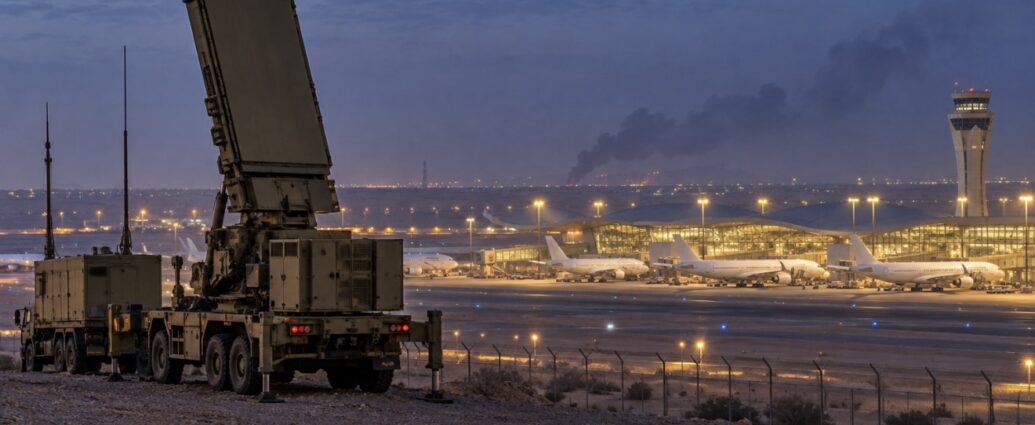
Repeated attacks on Riyadh’s international airport are disrupting flights and a major energy gathering while exposing a critical question: how are incoming weapons reaching civilian infrastructure despite Saudi Arabia’s sophisticated air defenses?
The kingdom is facing a broader campaign involving missiles and drones. Saudi Arabia has not been confirmed to have exhausted its interceptor missiles, but the Associated Press reports that supplies are running low and that Riyadh has requested additional air-defense support from allies.
The distinction matters. Saudi defenses are still intercepting weapons. They are also failing to prevent damaging airport impacts.
On Sunday, October 11, Saudi authorities reported an unidentified projectile striking Terminal 4 at King Khalid International Airport, causing a fire and injuries. The Saudi-led coalition separately announced that a cruise missile had been intercepted nearby.
Authorities have not publicly established whether the terminal was hit by an intact weapon or debris from an interception. Saturday’s deadly airport attack was reported as a missile strike. It killed 13 people and wounded more than 300.
The airport remained closed Sunday, complicating travel as the WPC Energy Congress began its October 11–15 gathering. Some international oil executives canceled attendance, while other participants switched to remote appearances.
The attacks illustrate why possessing advanced interceptors does not guarantee protection. A defense must detect a threat, identify it, track its flight and destroy it before it reaches a vulnerable target. A failure at any stage can allow damage.
Different weapons challenge different parts of that process. Ballistic missiles climb high before descending rapidly. Cruise missiles use powered flight and can approach at low altitude. Attack drones are unmanned aircraft carrying explosives, often presenting smaller targets.
Low altitude is especially difficult for ground-based radar. The curvature of the Earth and intervening terrain limit what a radar can see. A cruise missile can remain outside its line of sight until relatively close, shortening the time available for an interception.
CSIS research identifies elevated sensors—including aircraft and tethered radar platforms—as a way to extend detection range. Earlier warning gives defenders more time to engage and civilians more time to take protective action.
But an airport impact does not prove that the weapon flew entirely undetected. It could have been detected late, unsuccessfully engaged or intercepted without eliminating the danger below. Saudi authorities have not released enough technical evidence to determine which happened in the latest attacks.
Multiple simultaneous threats create another problem. Combined missile and drone attacks can strain radar tracking and interception capacity. That is a documented vulnerability of air defenses, rather than a verified explanation for Sunday’s strike.
Ammunition availability adds pressure during prolonged attacks. Interceptor stocks must be replenished while defenders protect airports, cities, military facilities and energy infrastructure. The reported Saudi shortage is therefore significant, but no verified public inventory establishes how many interceptors remain or whether a particular battery ran out.
Israel’s defenses differ in their architecture. Arrow forms the upper layer against ballistic missiles. David’s Sling covers threats including missiles, cruise missiles, aircraft and drones. Iron Dome provides another layer against shorter-range threats.
Saudi Arabia also possesses advanced capabilities. The U.S. Missile Defense Agency describes Patriot as capable of engaging short-range ballistic missiles and cruise missiles, while THAAD is designed for ballistic-missile interception. THAAD’s high-altitude role does not make it a substitute for protection against low-flying drones.
The comparison is therefore about the combination of sensors, weapons, command systems and coverage—not simply whether one country has an “Iron Dome.” Israel’s layered approach provides different interception options, but it does not establish that Saudi Arabia’s latest failures resulted from inferior equipment. Nor does any layered system guarantee that every threat will be stopped.
Strengthening airport protection requires earlier detection, overlapping defensive coverage, reliable interceptor replenishment and systems suited to the incoming weapons. Saudi requests for allied support address part of that need.
Civilian protection remains essential while those measures are assessed. Airport closures, timely warnings and sheltered areas reduce exposure. EASA also warns that interception activity and falling debris can endanger aircraft, meaning a successful shootdown does not automatically make operations safe.
The immediate task is to establish what struck the airport and where the defensive chain failed. Until that assessment is available, claims that Saudi Arabia has no ammunition left—or that a single additional weapon system would solve the problem—go beyond the evidence.
JBizNews Desk | Riyadh
© JBizNews.com. All rights reserved. This article is original reporting by JBizNews Desk. Unauthorized reproduction or redistribution is strictly prohibited.