
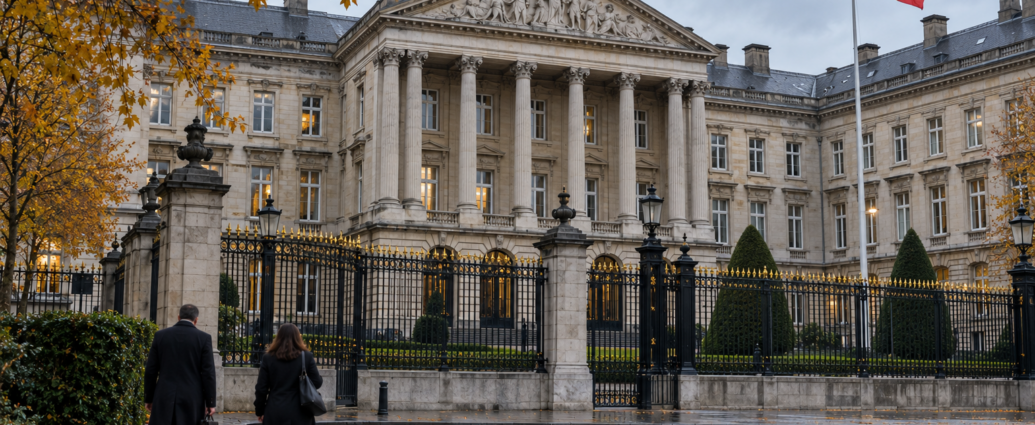
Belgian Prime Minister Bart De Wever has postponed his October 13 policy address after his coalition failed to agree on a budget, prolonging uncertainty over taxes and spending as the government tries to contain rising debt and borrowing costs.
The five-party government is seeking roughly €10 billion in savings and additional revenue by 2029. The dispute now extends beyond a missed parliamentary speech: businesses and households still do not know which tax changes or spending restraints will form the final package.
Belgian reporting on October 11 said De Wever’s office confirmed that the address would not proceed as scheduled because no agreement had been reached. He also rejected a return to temporary, month-by-month spending authorizations, citing the seriousness of the fiscal situation and pressure from financial markets.
Known as provisional twelfths, that mechanism generally allows spending based on a fraction of the previous annual budget while lawmakers work on a replacement. De Wever’s opposition is a political position, rather than the abolition of that fallback.
The financial backdrop has deteriorated. European Commission figures put Belgium’s general-government deficit at 5.2% of economic output in 2025, up from 4.4% in 2024. Public debt reached 107.9% of gross domestic product at the end of 2025.
In plain terms, the country borrowed the equivalent of €5.20 for every €100 its economy produced last year, and its accumulated government debt exceeded a full year of national output. The annual deficit is well above the European Union’s 3% reference limit.
The Commission’s May forecast projected a deficit of 5.2% again in 2026 and 5.4% in 2027, with debt rising further. Those figures are forecasts based on policies known at the time, rather than final results for either year.
One major obstacle is a proposed overhaul of value-added tax, the consumption tax included in many retail prices. Reporting describes a plan to raise the standard rate from 21% to 22% and combine the reduced 6% and 12% rates into a 9% rate, with exceptions and compensating changes.
That would create different outcomes across products. Before any exemptions or changes in retailers’ margins, an item priced at €100 before tax would rise from €121 to €122 under the proposed standard-rate increase. An item moving from 6% to 9% would rise from €106 to €109. One moving from 12% to 9% would become cheaper.
None of those changes is settled policy.
Georges-Louis Bouchez, leader of the French-speaking liberal MR party, has opposed a VAT increase, arguing that it would weaken purchasing power and economic growth. He has also said VAT is not the coalition’s only disagreement.
De Wever has warned that delay carries its own cost. Speaking in parliament on October 8, he said an adverse combination of debt, interest rates and economic conditions could produce a debt-interest spiral by 2029, or sooner in a worse scenario.
He told lawmakers that federal interest spending in 2026 amounted to €16.7 billion. His warning describes the risk that rising financing costs consume an increasing share of public resources, leaving less room for services, investment or tax relief.
Credit ratings reinforce the pressure. Belgium’s Debt Agency lists S&P Global’s sovereign rating at AA- and Moody’s at A1, following their April rating actions. Both remain investment grade. A downgrade can increase borrowing pressure, although market interest rates also reflect inflation, monetary policy and investors’ wider assessment of risk.
The uncertainty matters outside Belgium. USAFacts’ compilation of Bureau of Economic Analysis data puts U.S. exports of goods and services to Belgium at $42.8 billion in 2025 and imports at $33.7 billion, a U.S. surplus of about $9.1 billion.
A Belgian spending slowdown could weaken demand for foreign products, including American exports. The scale would depend on the eventual measures and the economy’s response; a political deadlock alone does not establish an export loss.
The immediate test is whether coalition leaders can agree on a package and secure parliamentary approval in time for 2027. Until then, the proposed VAT changes, spending restraints and distribution of the burden remain unresolved.
JBizNews Desk | Brussels
© JBizNews.com. All rights reserved. This article is original reporting by JBizNews Desk. Unauthorized reproduction or redistribution is strictly prohibited.




