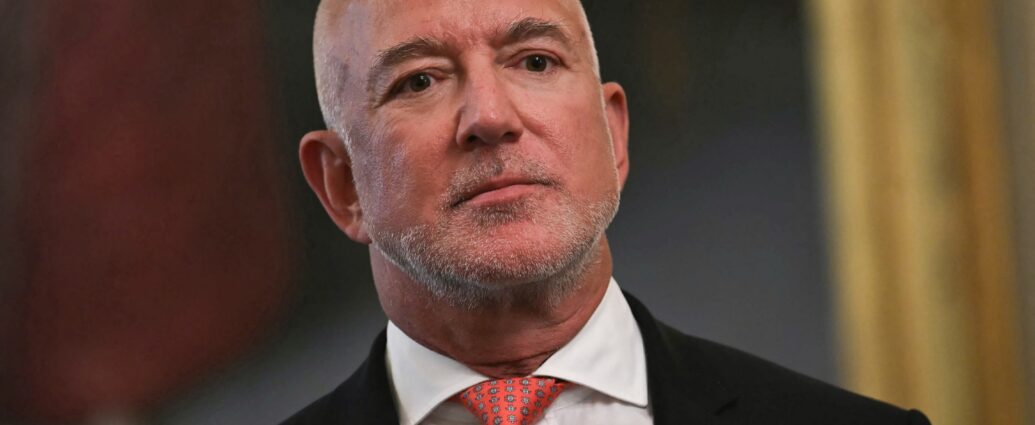
Jeff Bezos says he understands why socialism is gaining traction in America. The affordability crisis is real, especially when it comes to housing. But the Amazon and Blue Origin founder argues that some politicians are blaming the wrong culprit.
In an interview with Fox News’ Bret Baier that aired Wednesday on Special Report, Bezos said government intervention has often been counterproductive in housing, while some politicians point fingers at “greedy landlords” instead of addressing what he called a basic supply-and-demand problem. “It’s econ 101,” he said. In the same interview, Bezos predicted AI could usher in a three-day workweek, as Fortune reported. He has also argued that raising taxes on billionaires won’t fix affordability.
Americans are growing more receptive to socialism, even as their views of big business sour.
Capitalism still has broader appeal, with 55% of Americans viewing it positively, according to a Gallup poll released in September. But a record 43% now view socialism positively, the highest share since Gallup began tracking the question in 2010. Meanwhile, positive views of big business have fallen from 49% in 2010 to just 35%.
The generational divide is stark. Among Americans ages 18 to 34, 57% view socialism positively, compared with 43% who view capitalism favorably. For Americans 55 and older, the picture is reversed: 65% view capitalism positively, versus 34% for socialism.
In a separate Gallup survey, 26% of Americans cited a stronger safety net and more affordable essentials, including housing, healthcare and education, as benefits of socialism. Still, 45% either said nothing was good about socialism or couldn’t name anything.
Americans need $120,000 at minimum
Even Vice President JD Vance warned in July that young Americans priced out of homeownership could be drawn to socialism, as Fortune previously reported.
At the end of 2025, a household needed $120,800 a year to afford payments on the median-priced U.S. home, up from $68,700 five years earlier, according to Harvard University’s Joint Center for Housing Studies. Only 32% of U.S. households met that income threshold, including just 16% of renter households.
An earlier report from the same Harvard center found that rising homebuying costs between 2021 and 2024 effectively priced out about 8 million renter households that previously earned enough to afford a median-priced home. Most were between 25 and 44, in their prime homebuying years. First-time buyers made up just 21% of home purchases in the National Association of Realtors’ latest annual survey, a record low, and Zillow’s CEO doesn’t expect that to change soon.
Bezos cites Austin as a case study
Bezos took aim at “government programs that subsidize demand and constrain supply.” He pointed to Austin, Texas, where he said policies have made it easier to build homes and housing prices have fallen. “Some politicians are governing correctly on this issue,” he said.
Austin has numbers to back at least part of his argument. The city added 120,000 housing units between 2015 and 2024, while median monthly rent fell from $1,546 in December 2021 to $1,296 in January 2026, according to the Pew Charitable Trusts. In the broader Austin metro area, the median home listing price fell 9.8% year over year to $446,450 in September, according to Realtor.com.
But Austin isn’t the only place where prices are falling. Nationally, the median listing price fell 1.4% year over year in September, the 11th straight month of annual declines, according to Realtor.com’s September housing report. A record share of sellers for this time of year have also been cutting asking prices, as Fortune previously reported, including about 26% of listings in the Austin metro. The broader slowdown makes it harder to pin Austin’s price drop on new construction alone.
Austin’s housing push involved more than one policy. Starting in 2015, the city loosened zoning rules to allow more apartments, and in 2023 it scrapped minimum parking requirements citywide. Voters approved $250 million in bonds in 2018 to help build and repair affordable housing, followed by another $350 million in 2022. Yet despite the construction boom and falling rents, Pew noted that housing gaps remain even larger for lower-income residents, especially those hoping to buy a home. With apartment completions slowing, Pew also warned that rents could start rising again.
This story was originally featured on Fortune.com