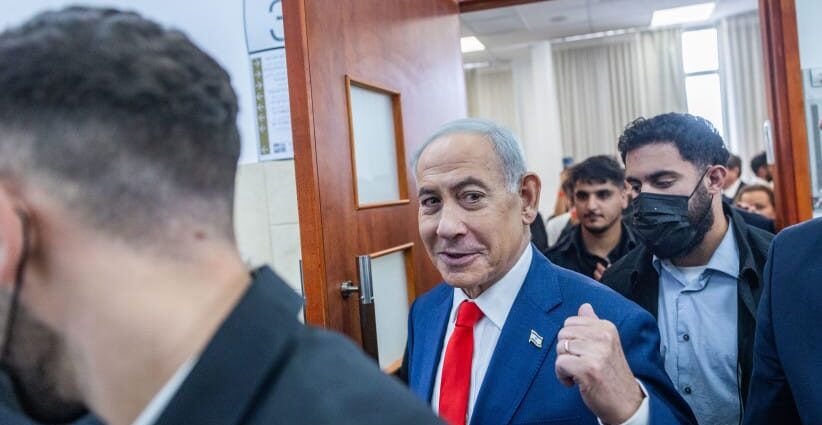
Former attorney-general Avichai Mandelblit said Monday that he would be “very surprised” if prosecutors had deliberately concealed information from him, as he continued testifying in Prime Minister Benjamin Netanyahu’s corruption trial. The exchange came as Netanyahu’s lawyer, Amit Hadad, questioned whether investigators had obtained the required approvals for inquiries that led to charges against the prime minister.
The trial, which began in May 2020, combines three cases. Prosecutors allege that Netanyahu received gifts from wealthy businessmen in Case 1000; discussed a possible exchange of favorable coverage for steps against the rival newspaper Israel Hayom with publisher Arnon Mozes in Case 2000; and advanced regulatory measures benefiting Bezeq in exchange for favorable coverage on the Walla news site in Case 4000. Netanyahu denies wrongdoing. The combined trial also includes former Bezeq controlling shareholder Shaul Elovitch and his wife Iris, and Mozes.
The dispute in Mandelblit’s testimony concerns how the investigations were authorized and whether investigators stayed within those approvals. Israeli law requires the attorney-general’s consent to open an investigation against a sitting prime minister. Hadad argues that investigators pursued new lines of inquiry without Mandelblit’s approval or went beyond its scope. The prosecution says Mandelblit authorized the investigations, including orally.
“I have full trust in the prosecution, including the people sitting here,” Mandelblit told the Jerusalem District Court. Hadad had said that he believed Mandelblit had been “set up” and that information had not been disclosed to him. Mandelblit said he would be surprised if the prosecution had deliberately hidden anything. When Hadad said no one had told him that investigators were looking for material against Netanyahu, Mandelblit replied that if that had happened, “that would be serious.”
Netanyahu lawyer accuses prosecutors of hiding information
Hadad focused on the origins of Case 4000, which grew out of an investigation involving Bezeq, the telecommunications company then controlled by Elovitch. He pointed to a 2015 Haaretz article by journalist Gidi Weitz that reported allegations of favorable coverage for Netanyahu on Walla in return for regulatory benefits.
Mandelblit said the article had been “a catalyst” for starting the investigation. He testified that he did not know it was on the desk of Israel Securities Authority investigator Eli Levy, or that Levy had printed it and collected Walla articles mentioned in it. Hadad argued that investigators had begun gathering material connected to Netanyahu before Mandelblit authorized an investigation into him.
Hadad also asked whether Mandelblit had approved the collection of emails from Elovitch’s account, including messages from Netanyahu associate Ze’ev Rubinstein about photographs of Sara Netanyahu. Mandelblit said he did not approve every email or investigative step. He distinguished between individual actions taken during an investigation and the decision to open an inquiry into the prime minister or pursue a new suspicion. The judges cautioned Hadad against continuing through examples at that level of detail.
The questioning grew heated when Hadad accused prosecutors of misleading Mandelblit and withholding information from him. Prosecutor Yehudit Tirosh objected, saying the allegation was a personal attack. Hadad replied that he understood her “distress” because “this is the case of her life.” Tirosh responded: “My life is my family. We are all prosecutors doing our jobs. We are not the defendants here.”
The judges halted the hearing and called the lawyers into their chambers. The session resumed about 15 minutes later.
Mandelblit’s testimony is unusual because he was attorney-general when the investigations were approved and later decided to indict Netanyahu. The defense requested seven days of testimony: Sunday and Monday, with the remaining five days scheduled for next week.
The testimony is also taking place as Netanyahu seeks a pardon. He submitted a request to President Isaac Herzog in November 2025 while the trial was ongoing, asking to end the proceedings before a verdict without admitting wrongdoing. The Justice Ministry’s Pardons Department did not recommend granting the request, while Heritage Minister Amichai Eliyahu later recommended a pardon. Herzog has said he wants efforts to reach an agreement between the parties to be exhausted first. As of September, Netanyahu had not responded to the president’s mediation proposal.