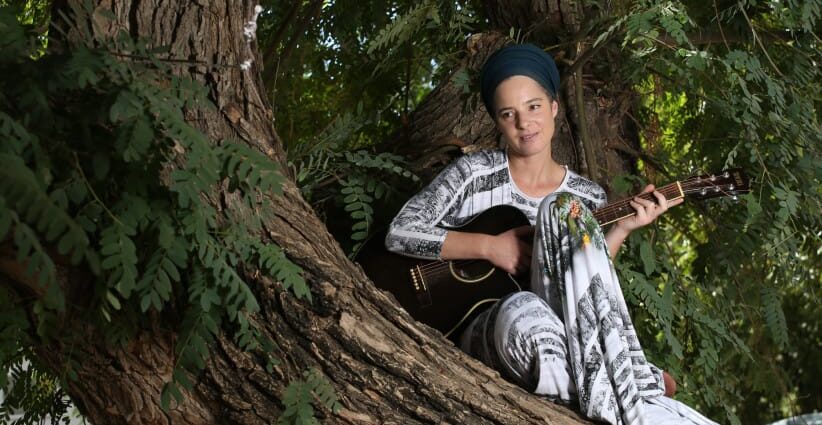
“Well, you’ve given up,” singer Sharon Rotter casually remarked to fellow musician Shiri Hadar during a conversation about their lives.
On the surface, the accusation was true: Rotter and Hadar were part of a generation of prominent female artists who seemed to walk away from the Tel Aviv indie scene at the height of their success in the early to mid 2000s, trading major record deals and mainstream stardom for family life and religious observance.
Rotter’s comment hit a nerve, exposing a deeper truth: While these women had given up the pursuit of commercial celebrity, they weren’t willing to give up on music itself.
But the sting of the remark acted as the sudden catalyst that sent Hadar, the former keyboardist for the indie-rock band Izabo, straight to her phone. “I said, ‘What?’ and immediately called Noa,” Hadar recalls.
The friend on the other end of the line was Noa Gino, a powerhouse vocalist who had spent years looking for a way back into a recording studio.
Gino had once been signed to the major label Hed Arzi and was the featured voice on Danny Sanderson’s Toldot HaMayim project, before her career paused.
Hadar’s phone call was the final piece of the puzzle. “I had wanted to form an all-female group for years,” Gino says. “My husband Ron and I thought of Shiri first. He knew Sharon, and I had met her during classes at a Tel Aviv Jewish heritage center.”
With that call, the three former indie icons were officially reunited, turning a shared sacrifice into a new, faith-based rock band. “We went full steam ahead,” says Hadar.
From Tel Aviv’s indie rock scene to faith, family
Despite their shift toward religious lifestyles, all three women still carry the deep muscle memory of their rock & roll pasts.
They are no longer the secular indie icons who once dominated Tel Aviv’s airwaves, and today, they navigate vastly different personal realities:
Rotter lives on a moshav as a Breslov Hassid; Gino similarly chose a rural religious lifestyle with her family; while Hadar remains in secular central Tel Aviv, raising her children in an Anthroposophic school, while studying the inner dimensions of Torah and Kabbalah.
Yet, the creative link to their roots remains intact – evidenced by Rotter stepping back onto the stage last year at the Enav Center to perform her classic hit “Arutz Elecha” (“Run 2U”) with Berry Sakharof, Hadar writing songs in her home studio, and Gino penning new music from her abode.
The trio initially named their new project Ha’Imahot because their earliest rehearsal sessions were entirely dictated by childcare schedules.
“We used to schedule sessions, only for them to get canceled,” Hadar says.
When they finally committed to releasing music to the public, they swapped the name for the English version, The Mothers, aiming to reach a broader, global Jewish audience.
They have since released a debut single, “100%,” followed by their sophomore track, “Adon HaNiflaot,” which sets the traditional morning prayer blessing Yotzer Or to a chic, modern indie beat.
Inside The Mothers’ creative process
The band now operates out of two home studios in central Tel Aviv, spaces shared by Hadar and her partner, Izabo frontman and producer Ran Shem-Tov. Inside the studio, their roles fell into place based on personality.
“Shiri has excellent taste and an original vision,” Rotter explains. “She always knows how to make things look unique, and she’s the boss in that realm.
“Noa is a gifted writer; she wrote most of the songs about motherhood. She’s the spirit of the group – bringing a deeply spiritual dimension.
“I’m the driving force – fast, efficient, and a pusher; I know how to handle production and keep things light.”
Hadar handles the primary music tracking in the house, working in the pockets of time left by their families.
“We’re waiting for the kids to grow up,” Rotter says with a laugh.
“When they were little, it was a time of survival, and music was at the bottom of the priority list because there was a more important kind of creation happening. Nowadays, the children no longer need me on a moment-to-moment, daily basis, so I can make time to return to things I loved – things that had been put on hold for 20 years.”
Hadar’s path to faith moved through Kundalini yoga before evolving into the study of Kabbalah and the teachings of Rav Kook. As a result, her own home exists in a delicate secular-religious balance.
“We know how to contain this situation within our complex reality,” Hadar says. “Ran hasn’t become religious, but he deeply respects my choice and my daughter’s choice. She is 15 and was with me throughout the entire process of becoming religious. For instance, on Shabbat, I don’t turn on the lights, but he does. Each of us does what we want, though there are things he won’t do. He wouldn’t turn on a burner in the kitchen, for instance.”
The lifestyle shift has fundamentally rewritten their lyric books.
“I once wanted to write only about what I felt was ‘right’ to write,” Gino says. “Back when I worked with Danny Sanderson, I wrote only about relationships and the search for love. Later, I went through a phase of writing only about the Almighty. Today, my lyrics focus on the inner workings of the soul and the world.”
Rotter views their distinct theological choices through a literary lens. “We started in the same place and headed down different paths – much like in Frost’s poem ‘The Road Not Taken.’ There are 70 faces to the Torah; each of us made a choice based on her specific situation… yet ultimately, it all comes down to the same thing.”
Different paths to Jewish spirituality
Operating as an all-female religious rock band presents unique halachic boundaries, particularly regarding kol isha – the Orthodox prohibition against men listening to female singing. To move forward, Gino sought out spiritual counsel before putting their music online.
“The rabbi gave me his approval because, essentially, men can choose whether or not to watch and listen,” Gino explains. “Those who observe the practice of not listening to women simply won’t listen. This approval allows us to work and release songs, because before that, we were really quite stuck.”
While their digital singles are streamed publicly, their upcoming live shows – funded by a grant from the Mifal Hapayis national lottery – will be open to female audiences only.
The rare setup occasionally draws comparisons to HaMechashefot (The Witches), Israel’s most famous all-female rock band, a connection that brings up personal memories for Rotter. “I moved in the same circles as the late Inbal Perlmuter, but sadly, we never actually met. I saw the film about her, and I cried through most of it. It’s a very sad story.”
Balancing religious observance with rock music
The reality of starting over from scratch after walking away from major label backing is a frequent topic of conversation among them.
“Yes, it definitely hurts,” Gino says openly. “Today, I make music and have to go out and find an audience – an audience that could have already been mine.
“My big break happened around the same time as Eviatar Banai’s; we were also signed to Hed Arzi. The label reps would come visit me and then drive down South to visit him. So, yes, it hurts – it hurt for years and used to make my stomach churn – but I’ve come to accept my own journey.”
Rotter measures the outcome differently. “There’s a small sense of a missed opportunity deep down, though I didn’t always feel that way… I make music because it’s part of who I am. I try not to focus so much on the outcome; what drives me is the joy of the journey itself. It’s enough if just one person’s heart opens up, or if we manage to bring someone a moment of happiness when they hear our music.”
Decades spent away from the professional grind have shifted their perspective on what defines a successful musical career. Rather than obsessing over industry metrics or mainstream validation, the bandmates actively practice personal growth and emotional resilience through their music. For them, the metric of success is no longer an industry standard, but a personal one.
“We’ve been working on our character traits for many years, and we realize that nothing is truly critical,” Rotter notes. “The main thing is just having fun together.”
For more, visit youtube.com/@THEMOTHERSIL