A reported advance by Chinese memory-chip maker ChangXin Memory Technologies has unsettled established suppliers, raising questions about future pricing power in a market central to the artificial-intelligence boom. Micron fell about 3.9% in Monday’s U.S. session, putting semiconductor stocks in focus ahead of Tuesday’s Asian trading.
CXMT’s president, Cao Kanyu, outlined plans at an October 10 industry conference in Shanghai to introduce a new server-memory product by the end of 2026. The planned product uses a denser memory-cell design known as 4F², according to reporting on the company’s announcement.
The commercial promise is straightforward: fit more memory into the same area of silicon. If the design can be manufactured reliably and economically at scale, it could give CXMT a stronger position against Samsung Electronics, SK Hynix and Micron.
That remains a conditional outcome. A product-launch target does not establish high-volume production, customer acceptance or an immediate decline in industry prices.
The Competition Threat Behind The Selling
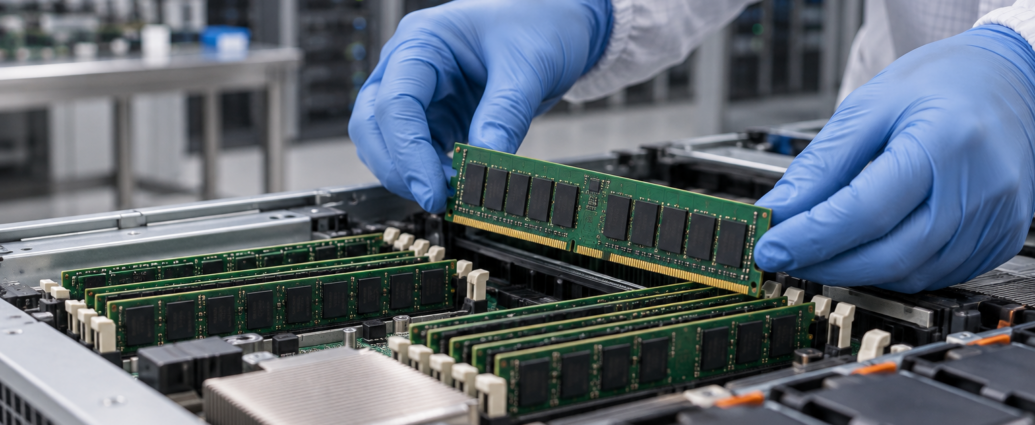
CXMT manufactures dynamic random-access memory, or DRAM, used in devices including computers, phones and servers. DRAM provides working memory for active computing tasks; it is different from the long-term storage that holds files when a device is switched off.
Server memory is particularly important because data centers need large amounts of it to keep processors supplied with information. Expanding AI workloads have increased demand for memory products, including high-capacity server modules, according to research firm TrendForce.
The business is concentrated. TrendForce’s second-quarter figures put Samsung’s share of global DRAM revenue at 39.4%, SK Hynix’s at 24.9% and Micron’s at 23.3%. Together, those three suppliers accounted for about 87.6%.
That concentration helps explain why investors react to a potential challenger. Additional competitive supply could eventually constrain the prices established manufacturers charge, even if demand remains strong.
But manufacturing economics matter as much as design. A denser chip must still deliver acceptable reliability, performance and production yields—the proportion of usable chips a factory produces. Higher theoretical capacity does not automatically mean lower delivered costs.
TrendForce’s October 12 coverage also cautioned that an ambitious launch timetable should not be equated with readiness for large-scale production.
Korea Fell Before Wall Street Closed
South Korean memory stocks had already weakened in Monday’s Asian session, before the U.S. market’s Monday close. Samsung Electronics and SK Hynix declined as investors assessed CXMT’s reported progress.
That sequence matters. Monday’s Korean losses cannot be described as a reaction to a U.S. closing decline that happened hours later.
Tuesday’s Asian trading had not yet provided a confirmed regional outcome for this pre-opening report. The U.S. semiconductor selloff creates a risk to sentiment, but it does not establish that Japanese, Korean or Taiwanese indexes will necessarily fall.
The Nasdaq Composite ended Monday down 120.27 points, or 0.44%, at 27,245.90. The S&P 500 slipped 4.30 points, or 0.06%, to 7,807.24, while the Dow rose 195.60 points, or 0.38%, to 51,850.55.
Buyers And Investors Face Different Questions
For server buyers, successful competition could eventually mean additional sourcing options and better negotiating terms. For incumbent chipmakers, it could mean pressure to defend margins through better products, lower costs or stronger customer relationships.
Consumers should not assume that Monday’s announcement guarantees cheaper phones or laptops. The initial product targets servers, and any benefit to other markets would depend on output, demand and manufacturers’ pricing decisions.
Oil is another cost investors must weigh. Brent settled Monday at $106.65 a barrel and U.S. crude at $93.74, adding energy-price pressure alongside uncertainty over semiconductor competition.
The next scheduled tests arrive quickly. JPMorgan Chase, Goldman Sachs, Citigroup and Wells Fargo report Tuesday. U.S. consumer inflation follows Wednesday, with producer inflation Thursday.
For the memory industry, the more specific milestone is CXMT’s year-end target: whether a reported technology advance becomes a commercially available server product, and at what scale.
JBizNews Desk | Shanghai
© JBizNews.com. All rights reserved. This article is original reporting by JBizNews Desk. Unauthorized reproduction or redistribution is strictly prohibited.