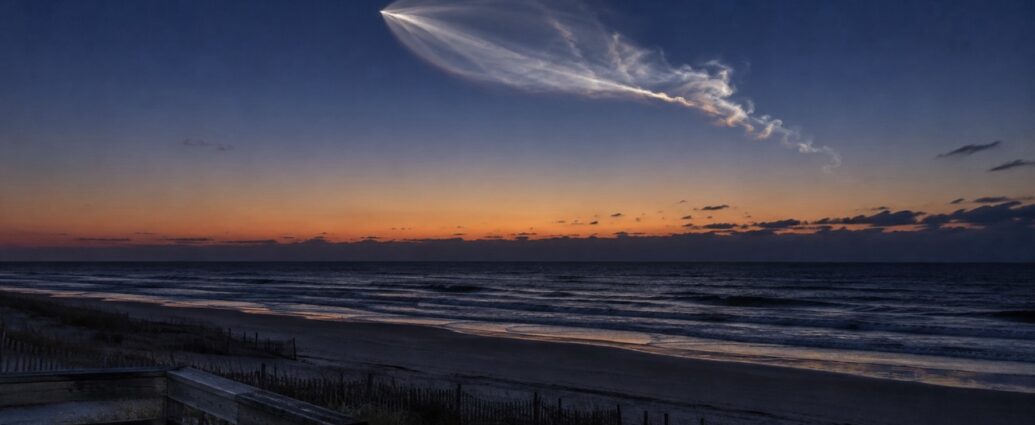
New Jersey residents could catch two sights before Tuesday’s morning commute: the International Space Station crossing overhead around 6:34 a.m. and an illuminated plume from a SpaceX rocket launching from Florida a minute earlier.
The station’s October 13 pass is forecast to offer roughly eight minutes of visibility in parts of New Jersey, reaching about 39 degrees above the horizon. Timing and viewing angles vary by location, and clouds could block the view.
NASA and SpaceX are targeting a 6:33 a.m. Eastern launch from Cape Canaveral Space Force Station. A Falcon 9 rocket will carry a Dragon spacecraft loaded with more than 6,300 pounds of supplies, equipment and research cargo on SpaceX’s 35th commercial resupply mission for NASA.
For viewers along the East Coast, the rocket could produce a “space jellyfish”—a glowing, cloudlike formation created when sunlight catches its exhaust high above ground that remains dark. The rocket is expected to travel northeast along the Atlantic coast, potentially bringing that plume into view from New Jersey after liftoff.
The launch time should not be confused with the local viewing time. During an August SpaceX launch, New Jersey sightings were reported roughly 15 minutes after departure, from the Jersey Shore to Hackensack. Tuesday’s visibility will depend on the flight path, lighting and weather; an identical delay cannot be assumed.
The space station should be easier to distinguish: it appears as a bright point moving steadily across the sky, without an airplane’s flashing lights. Residents hoping to watch should be outside before the predicted pass, with an unobstructed view, and check NASA’s Spot the Station app for their location.
Behind the spectacle is a delivery supporting both the station’s operations and research with potential commercial applications. Dragon’s cargo includes the final set of roll-out solar arrays, hardware for manufacturing artificial retinas in microgravity, and three-dimensional heart tissue models intended to advance drug testing.
Dragon is scheduled to dock autonomously around 11 a.m. Thursday, October 15. NASA’s live launch coverage begins Tuesday at 6:15 a.m. Eastern, giving viewers a way to follow the mission if clouds obscure the sky.
JBizNews Desk | New Jersey
© 2026 JBizNews. All rights reserved.