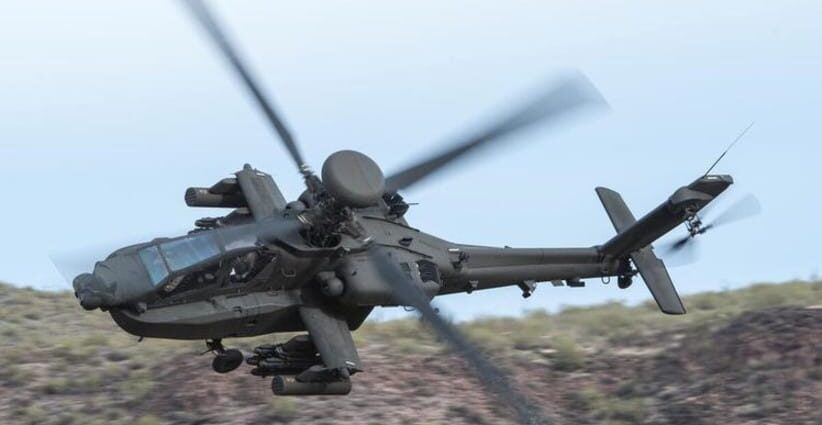
Israel’s Defense Ministry confirmed Wednesday that it purchased 12 Apache attack helicopters from Boeing.
Ministry Director-General Maj.-Gen. (res.) Amir Baram instructed the ministry’s delegation in Washington to sign the agreement with the Pentagon, the ministry confirmed.
“The helicopters, scheduled for delivery at the beginning of the next decade, are of the ‘Echo’ variant, the newest and most advanced model of the helicopter,” the Defense Ministry said.
“The procurement of the Apache helicopters is a critical step in the IDF’s force buildup, one that will strengthen its operational capabilities against a wide range of threats and contribute to the security of the State of Israel in the years to come,” Defense Minister Israel Katz said.
“The Israeli defense establishment invested considerable effort and acted with determination to overcome the challenges and complete this agreement, out of a deep understanding of its importance in ensuring the IDF’s strength and readiness for future challenges,” Katz added.
“I thank our partners in the US administration and the Pentagon for their steadfast commitment to Israel’s security, and for the cooperation and flexibility that made this agreement possible. Thank you to all those involved, led by Baram, for their professional and dedicated work, and for the perseverance that led to the completion of this important procurement,” Katz stated.
“The execution of the Apache agreement was made possible thanks to creative solutions we developed together with our American partners, without compromising operational needs,” Baram said.
“This professional work with the US administration reflects the depth of our strategic relationship and the mutual commitment to Israel’s security. The Defense Ministry will continue to work at full pace to sign additional critical agreements, including the acquisition of additional platforms, munitions, interceptors, and more. This is to ensure immediate readiness for any scenario, alongside the implementation of the decade-long force buildup plan, as part of the Defense Ministry’s strategy in the face of emerging challenges,” he added.
“Boeing has been a trusted partner of Israel in building and advancing the country’s national defense capabilities since its earliest days, and we are proud to continue serving as a leading supplier of fighter aircraft, helicopters, munitions and other equipment in the future,” said Boeing Israel President Maj.-Gen. (res.) Ido Nehushtan.
“The IDF’s selection of the Apache E, following its selection of the world’s most advanced refueling aircraft, the KC-46A, and the decision to procure a second squadron of the world’s most advanced fighter jets, the F-15IA, is compelling proof of its proven operational capabilities on the battlefield and its continued relevance in addressing evolving threats and future operational challenges. Boeing will work in close cooperation with the Government of Israel to provide the Israel Air Force with the world’s most advanced and capable attack helicopters,” Nehushtan added.
Nehushtan served as IAF chief from 2008 until 2012 before leaving the military.
Government diverts Arab sector funding to purchase Apaches, Finance Ministry tells ‘Post’
The government was preparing to allocate NIS 3.5 billion on Wednesday for urgent defense procurement, including a roughly one-billion-shekel deal to purchase Apache helicopters, The Jerusalem Post confirmed earlier on Wednesday.
The Finance Ministry told the Post that close to a billion shekels earmarked for the Apache helicopter purchase would be diverted from funds allocated to a five-year plan to develop Israel’s Arab sector. The remaining NIS 68 million would come from the 2026 state budget.
Government ministers were asked to approve the purchase via an urgent telephone vote, according to Israeli media.
The decision comes two weeks before the elections, a period during which the government must generally exercise restraint and avoid actions that are not particularly urgent.
A legal opinion attached to the government decision reportedly raised two main concerns: creating a situation in which the incoming government is faced with an irreversible situation, as well as risking prioritization of party interests over the public interest.
However, the document added that after examining the necessity and urgency of the decision to advance the procurement, it was found that bringing forward the procurement would be necessary for security reasons.
Shir Perets contributed to this report.