By JBizNews Desk
May 10, 2026
One government report arriving Tuesday morning may do more to shape the direction of the U.S. economy for the remainder of 2026 than any Federal Reserve speech, corporate earnings release, or political debate.
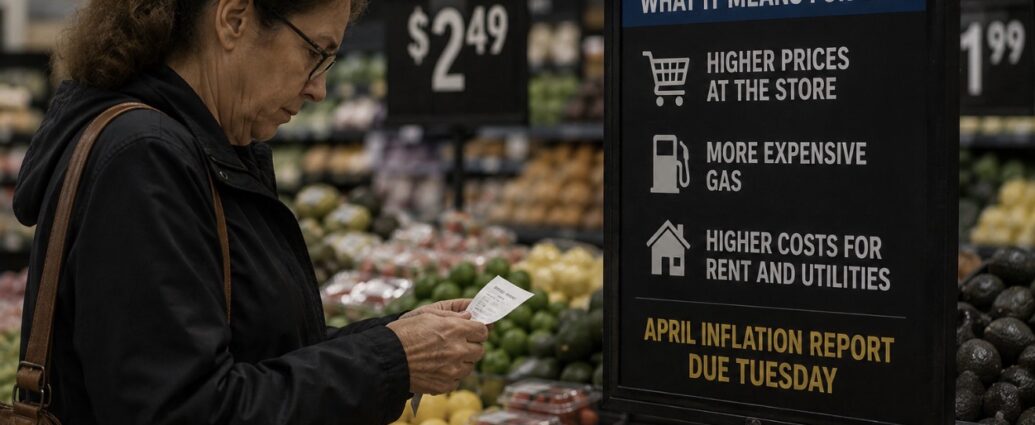
The Bureau of Labor Statistics is scheduled to release the April 2026 Consumer Price Index at 8:30 a.m. ET on Tuesday, May 12 — and economists increasingly expect the data to confirm what American consumers are already feeling every time they fill their gas tanks, pay utility bills, or walk through grocery-store aisles: inflation is accelerating again.
The report arrives at an especially fragile moment for the economy.
Consumer confidence has collapsed to the lowest level ever recorded in the nearly eight-decade history of the University of Michigan Survey of Consumers. Financial markets have almost entirely abandoned expectations for Federal Reserve rate cuts this year. And the ongoing disruption in the Strait of Hormuz continues driving oil and fuel costs sharply higher across the global economy.
Consensus forecasts suggest the inflation picture is about to worsen materially.
Economists surveyed by Kiplinger expect headline CPI to rise approximately 0.6% month over month in April, pushing annual inflation toward roughly 3.7%, up sharply from 3.3% in March and well above the 2.4% pace recorded earlier this year.
Analysts at BofA Securities project an even stronger monthly increase of roughly 0.63%, with annual inflation potentially reaching 3.8%.
Kiplinger economists warned inflation could approach the 4% threshold and remain elevated “until gasoline prices start falling.”
The primary driver is energy.
Since late February, the effective closure of the Strait of Hormuz during the U.S.-Iran conflict has disrupted a significant portion of global oil supply, tightening energy markets and sending fuel costs sharply higher worldwide.
The International Energy Agency estimates that roughly 14 million barrels per day of global supply have been affected by the disruption.
According to prior Bureau of Labor Statistics data, gasoline prices alone surged 21.2% during March, marking the single largest monthly increase in fuel prices since 1967.
April’s report will now reflect another full month of elevated oil and gasoline costs with little evidence yet of a durable diplomatic resolution capable of stabilizing energy markets.
There is also an additional technical factor that could further complicate the inflation picture.
Economists at Bank of America noted the April CPI report will incorporate one-time upward adjustments to housing-related inflation data, particularly rent and owners’ equivalent rent categories, due to data collection disruptions caused by last year’s federal government shutdown.
Those adjustments could place additional upward pressure on core inflation readings beyond what headline forecasts currently imply.
The implications for Federal Reserve policy are increasingly significant.
Interest-rate futures tracked through the CME FedWatch Tool now show markets have effectively priced out any meaningful rate cuts during 2026.
Bank of America has moved even further, shifting its expectation for the first Fed rate cut into the second half of 2027, citing persistent inflation pressure tied to energy prices, tariffs, and structural labor-market changes associated with artificial intelligence.
JPMorgan analysts reached similar conclusions in recent scenario modeling tied to the Iran conflict.
The bank said inflation is likely to remain above 3% through at least early 2027 under virtually every plausible geopolitical outcome, making a return to the Federal Reserve’s long-standing 2% inflation target increasingly unrealistic in the near term.
Consumer expectations are already moving higher.
The Federal Reserve Bank of New York’s Survey of Consumer Expectations showed one-year inflation expectations rising again in April to approximately 3.6%.
That survey was completed before the University of Michigan released Friday’s historically weak consumer-confidence reading, where one-third of respondents specifically identified gasoline prices as their primary economic concern and another 30% cited tariffs.
The broader consequence is that inflation is no longer functioning merely as a market or policy issue.
It is increasingly shaping consumer behavior directly.
Major corporations across retail, manufacturing, restaurants, and travel have already warned investors that customers are beginning to cut discretionary spending while delaying large purchases tied to financing costs and economic uncertainty.
Mortgage rates remain elevated near multi-decade highs. Auto financing costs have climbed sharply. Credit-card delinquency rates continue rising.
A stronger-than-expected inflation report Tuesday would likely reinforce expectations that borrowing costs remain elevated far longer than consumers and businesses had previously hoped.
For financial markets, the release could also determine the direction of stocks, bonds, and the dollar heading into summer.
Treasury yields have risen steadily in recent weeks as investors adjust to the possibility of a “higher-for-longer” interest-rate environment.
A CPI report approaching or exceeding 4% annually could accelerate that repricing further.
For policymakers, the challenge is becoming increasingly difficult.
The Federal Reserve now faces simultaneous pressure from slowing consumer sentiment and still-rising inflation expectations — a combination that leaves little room for easy policy solutions.
Rate cuts risk reigniting inflation. Additional tightening risks further weakening consumer demand and economic growth.
That is why Tuesday’s report matters so profoundly.
It is not simply another monthly inflation number.
It is increasingly becoming a verdict on whether the United States is entering a prolonged period of structurally higher inflation tied to geopolitics, energy disruptions, and supply-chain realignment — or whether price pressures can still be brought back under control without deeper economic damage.
By Tuesday morning, markets, businesses, and households across the country may have a much clearer answer.
— JBizNews Desk
© JBizNews.com. All rights reserved. This article is original reporting by JBizNews Desk. Unauthorized reproduction or redistribution is strictly prohibited.