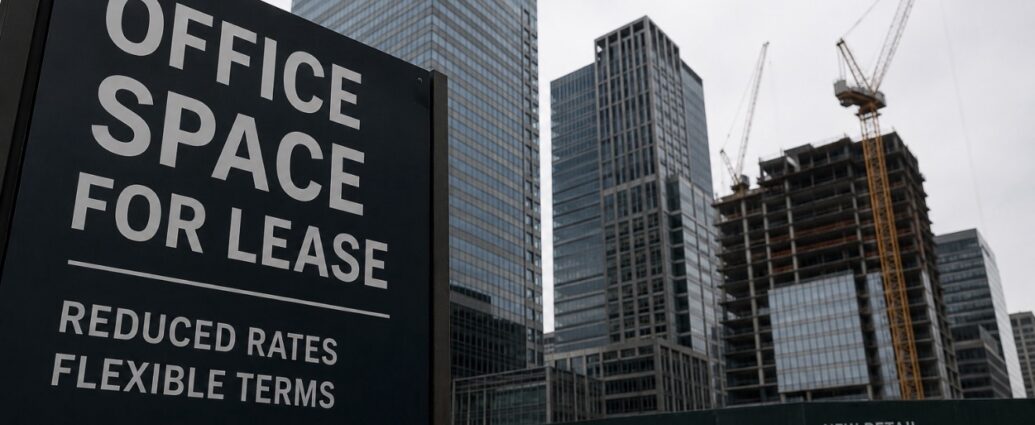
Office buildings, apartments and retail centers nationwide must refinance billions in debt at far costlier terms.
By JBizNews Desk
A long-feared crunch in commercial real estate has arrived.
According to Trepp’s Spring 2026 Quarterly Data Review, $76.6 billion in securitized commercial mortgages face hard deadlines this year, with much of the pressure tied to office and retail buildings — the property types already under the most strain. That is only one slice of a far larger pile: industry estimates put total U.S. commercial real estate loans maturing in 2026 at roughly $936 billion, with more than $1.5 trillion coming due across 2025 through 2027.
The problem is the math of refinancing in a changed world.
Many of these loans were written in the mid-2010s, when owners locked in borrowing costs around 3% to 4%. With the 10-year Treasury yield now near 4.46%, the same buildings are refinancing at 6% to 7% or higher. A property that comfortably covered its old loan can struggle to cover a new one at nearly double the cost.
Two things make it worse. Property values have fallen in several markets, especially offices hit by remote work and high vacancy. That means a new loan covers a smaller share of a building’s value. At the same time, lenders have tightened standards, demanding more income coverage and offering less leverage than they did a decade ago.
The result is what the industry calls a refinance gap. The new loan often will not cover what is still owed, forcing owners to bring fresh cash, find new partners, restructure the loan or hand the keys back to lenders.
For the past two years, lenders avoided a reckoning by extending loans instead of forcing the issue, a practice critics call “extend and pretend.” Of the roughly $957 billion in commercial loans that matured in 2025, The Kaplan Group estimates only 50% to 55% were actually paid off. The rest were pushed forward — straight into this year’s pile.
The strain is already showing up in late payments. The Kaplan Group pegged the delinquency rate on commercial mortgage-backed securities at 7.29%, nearly six times the rate on traditional bank loans. Apartments, once considered one of the safer parts of real estate, are feeling pressure too: multifamily maturities are projected to jump from about $104 billion in 2025 to roughly $162 billion in 2026.
Not every building is in trouble. Trepp stresses that loan quality matters more than the sheer volume coming due. Properties with strong tenants, healthy cash flow and sustainable debt are still refinancing. The danger sits with weaker assets — especially office buildings, which carry a disproportionate share of distressed loans — and properties whose income barely clears their debt payments.
The business stakes spread far beyond landlords. Regional banks hold large amounts of commercial property debt, so rising defaults can pressure the lenders that small businesses and local economies depend on. Private credit funds are stepping in to refinance deals banks will not touch, often at steep terms, shifting risk into less-regulated corners of finance.
And when owners cannot refinance, buildings get sold at a loss, converted, restructured or handed back to lenders — reshaping skylines and tax bases in cities across the country.
The maturity wall, in short, is no longer a forecast. How much of it turns into outright distress, rather than painful but survivable refinancing, will define commercial real estate for the rest of the year.
New York — JBizNews Desk
© JBizNews.com All Rights Reserved. Reproduction or distribution without written permission is prohibited.